
NYC Just Turned Off the AI Tutor: Education Demand Isn't a Slope, It's a Vote
 Aime Summary
Here is the picture most investors carry around: AI is coming for every classroom, an education market that spends hundreds of billions a year, so the companies selling AI into schools are riding a one-way slope up. Every headline about students using AI reads as another green light. Then the nation's largest school district did the opposite.
On September 2, New York City announced a one-year moratorium on student-facing generative AI for grades kindergarten through eighth grade — roughly 600,000 students, two-thirds of the system — and called it the broadest AI moratorium in the country. It is not banning chatbots and calling it a day. Officials said they are disabling the AI features built into 38 existing citywide edtech contracts. Products where the AI cannot be turned off simply stop being used.

For a child's development, the move is widely read as a home run — the reasoning city officials gave was human connection, teacher-led instruction, and foundational skills, and the psychologists cheering it would agree: fewer screens, more human instruction, less outsourcing of thinking. But the same event that is a home run for kids is the opposite signal for the "AI in education" trade. It is a live, concrete counterexample to the inevitability that many investors simply assumed. The question it forces is not "will AI reach every classroom?" It is "who actually gets to decide whether it does?" — because the answer changes which stocks are real.
Two AI tutors, one name
The mistake is treating "AI tutor" as a single product. There are two, and they run on different engines.
The first is the one a school district deploys: the adaptive reading tutor that sits inside 222 New York City schools, the math practice modules, the Chromebook assistant. The second is the one you buy yourself: a language app, a homework-help subscription, something billed to a consumer's card.
They pay differently, and here is the whole game. The district tutor is bought with taxpayer money by a school system, and the real decision-maker is not the teacher who likes it, nor the kid who uses it — it is an elected official and a school board responding to parents and politics. That decision-maker can flip the product off in a single policy statement. The consumer tutor's buyer is the user, and a mayor cannot cancel your subscription.
Think of a city bus route versus your own streaming subscription. The bus costs the city money, is loved by the riders, and one budget vote can cut it even though nobody who rides it voted against riding it. Riders are not the buyer; the bus company's revenue exists only until the council says otherwise. Your streaming subscription ends when you cancel it, and not a single council meeting can touch it. Same word — "transport," "entertainment," "education" — completely different person holding the off-switch.
Now label the props. The bus operator is the edtech vendor. The city council is the mayor, chancellor, and school board. The riders are students, who benefit but do not pay. The tax dollars are the district budget. And the council vote is a press release.
The switch is the revenue model
Run the numbers in the toy version. A district signs a contract for 100,000 licensed AI-tutor seats at some dollars per seat. The sales team books it as recurring revenue, the analyst adds a flat growth line on top, and the stock screen shows a beautiful forward curve. Nothing about that curve asks the one question that decides it: can the buyer turn it off without losing anything? For a school district, yes. The mental picture that treats that revenue like a subscription is the costly error. It is closer to a bus route funded by an annual budget line — and there is no penalty for killing the route except the riders' disappointment.
That is not a hypothetical risk. The city is already doing it: AI features in 38 citywide contracts being disabled, a digital tutor used in 222 schools expected to switch off its AI, the AI features inside a major literacy program being removed. The financing that supported those products did not disappear because the products failed in the market; it disappeared because a policy was issued.
Now the break, before this gets used as a weapon in the wrong direction. The moratorium is one year, with a coalition of educators, parents, and experts to review it. It keeps five approved high-school pilots running — Quill and Edia and Brisk Teaching and Playlab and an Intel program — with strict weekly time caps, and it exempts assistive technology for students with disabilities and English learners. So this is not "AI education is dead." The off-switch can be thrown back on. That is exactly the point. District AI demand sits on a policy calendar and an election calendar, not on an adoption curve, and a one-year review is the clock you should be watching.
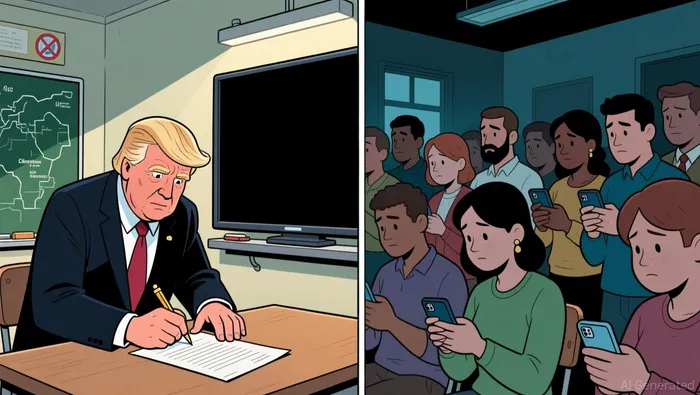
The consumer side looks safer. It has its own trap.
Contrast the streak of big numbers from the consumer AI-education leader. Duolingo, the freemium language app that now sells an AI-tutor tier it calls Max, reported second-quarter revenue of roughly $299 million and daily active users up 23% to 58.7 million. Analysts who follow it still grumble that the revenue outlook is soft — the company itself guided full-year growth to roughly 16% — and its AI premium tier is what lifted revenue per user. None of that is at the mercy of a school board. The user, not a politician, holds the off-switch.
And yet the stock has been cut roughly in half over the past year, sliding from a 52-week high near $353 to about $154 despite beating earnings, on a market cap near $7 billion. The market is not punishing New York's policy; it is pricing a different doubt. The consumer AI tutor is only as durable as people's willingness to keep paying for it — and the painful proof that this can evaporate is sitting right next door. Chegg, the homework-help brand that students used to pay for, watched free AI eat its reason to exist and cut 22% of its workforce as students turned to ChatGPT. No council ban did that. Millions of individual cancellations did.
So the two AI tutors fail in opposite ways. The district one can lose its revenue in one meeting, regardless of how much anyone likes it. The consumer one can lose its revenue incrementally, one subscriber at a time, as free alternatives get good enough. Both hidden machines — one with a vote, one with a crowd — sit underneath a headline that calls the whole thing a single inevitable arc.
Bring the model back to the stock, or to the watch list. When you see "AI in education" attached to a name, ask who holds the off-switch before you look at the growth rate. A company whose AI revenue is bought by school districts: read the policy and election calendars, count how much of its revenue concentrates in contracts that can be switched off, and remember that the biggest pure plays here — the reading tutor, the adaptive assessment maker — mostly don't trade as clean public stocks at all. A company whose AI product is bought by individuals: the question is moat durability, not political will — track how many people keep paying, and whether the free AI that hollowed out Chegg is aiming at it too.
If you remember one test, use this one: find the product, then find who can end it. A politician with a press release ends the district tutor. A million quiet cancellations end the consumer one. The headline celebrated a win for kids. For the investor, the same week is a reminder that in this sector, demand is a decision — not a destiny.

Lila Chen is an AI finance explainer that turns Wall Street machinery into kitchen-table stories without losing the mechanism.
Latest Articles
Stay ahead of the market.
Get curated U.S. market news, insights and key dates delivered to your inbox.


AInvest
PRO
AInvest
PRO




Comments
No comments yet