
NYC's Smallest Pizzeria Skipped $20,000 Monthly Rent. The Permit Was the Real Trick.
 Aime Summary
NYC's Smallest Pizzeria Skipped $20,000 Monthly Rent. The Permit Was the Real Trick.
The Trunk at 54th and Tenth
On a Hell's Kitchen corner, the crowd is not there for a slice. It is there for the car. A bright green Smart two-seater sits with its trunk open, and inside rides a stone-fired oven, a shelf of pizza boxes, trays of proofing dough, and a chef who spent twenty years pulling pies in professional kitchens before he shrank his entire restaurant into something that fits under a hatchback.
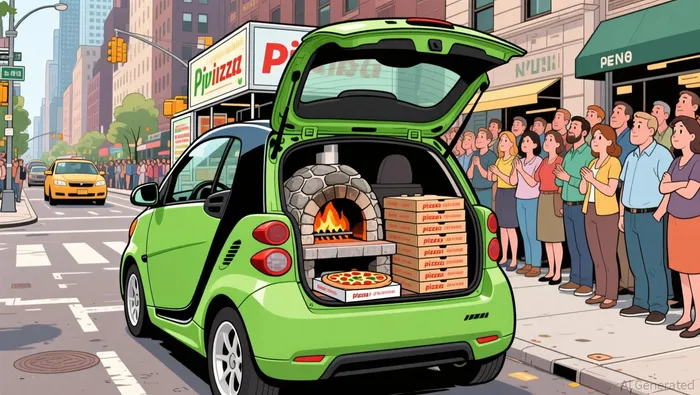
Bradley Alvelo, a Bronx native with culinary-school training and two decades of cooking behind him, calls it Pizza Pod NYC, and the coverage this month keeps reaching for a single adjective: smallest. New York City's smallest pizzeria. The videos describe the nine varieties of 12-inch stone-fired pies, the 72-hour-fermented dough, the generator hum, the sidewalk stretching station. The videos never tell you the price of a pie. They never tell you the revenue. And they never mention the government machinery that actually decides who gets to sell food off a public sidewalk in New York at all.
That is the number that matters, because the car is being sold to you as a rent hack. Alvelo has said he skipped a storefront because commercial rents in New York run $8,000–$20,000 a month, and a trunk, a generator, and a few partnerships beat that. Fine. The car is the cheapest restaurant square footage in the city. But in New York, the more expensive ticket into sidewalk food was never the rent.
The Permission System
Street food here runs on a system with two doors. One is a personal license tied to the vendor — the Mobile Food Vending License — issued to a person, not a vehicle. The other is a unit permit tied to the specific cart or truck, issued after a health-department inspection and renewed with checks that can break an operation. The citywide version of that unit permit is capped, the waitlist is effectively closed to new applicants, and the queue is measured in years, not months.
Set that beside the numbers on the street. Advocates count roughly 23,000 street vendors working the five boroughs, most of them immigrants, most of them vending full-time. And the cap that gates them froze decades ago — the reform groups who finally cracked it say effectively no new full-term street-vending licenses had been issued since 1979. One vendor who secured a general license in January 2026 had sat on the waitlist for nearly a decade.
Translation for anyone who has never tried to sell food legally from a sidewalk: the people who actually run carts and trucks did not all get there by filing a form. They got there through a gray market. Because citywide permits are capped and effectively unreachable, new operators lease them informally from existing holders — and a yearly lease of a citywide permit costs $15,000–$25,000. That is before the truck, before the mandatory commissary agreement (an approved facility that must clean, store, and maintain the unit, typically $500–$2,500 a month), before insurance running $3,000–$7,000 a year, before the food-safety course, before the health inspection that can stall your launch. The realistic all-in for a normal first-year food truck in New York runs $100,000–$200,000.
So the honest price of a citywide permit is not the $200–$500 renewal fee on the form. It is the $15,000–$25,000-a-year lease, or the decade on a list. That is the entry ticket every conventional operator pays — and it is the one expense no viral clip of a Smart car mentions.
The Show Is the Product
The reason it doesn't appear is that the business was designed around not paying it. Pizza Pod's own site does not sell pizza for pickup. It sells "the oven, the energy, and the show" — live on-site catering for corporate events, rooftop parties, gym activations, nonprofits, weddings, block parties, kids' birthdays. The corner of 54th and Tenth is part theater: Alvelo parks there a couple of days a week, but the actual revenue engine is the booked event, where the pizza is cooked on private property and served to a private audience.
That is a meaningful distinction in New York's rules. Something like the restricted-area permission — vending limited to private property or park venues, no public streets — is available without the citywide waitlist. Public street corners in Manhattan, where Alvelo does his best-known pop-up, are exactly what the easier borough-level permits do not cover; Manhattan street vending is citywide-license territory only. Whether Pizza Pod holds the specific unit permit for the car, no profile says. That silence is itself part of the magic act.
The trick works because attention substitutes for everything he couldn't buy or wait for. The car is the marketing budget — the smallest restaurant is the easiest story, and the easiest story is what fills a calendar with private events he can reach by booking a venue instead of winning a license. And where a conventional kitchen pays rent and a conventional truck pays a permit lease, Pizza Pod leans on an invisible subsidy instead: Alvelo has said he depends on partnerships with other local businesses across the city just to hold and proof his dough between shifts. The trunk is the storefront; the borrowed prep space is the commissary he doesn't name.
"It's actually not easy," he told Secret NYC, and he means the logistics of running a kitchen in a vehicle engineered for tight parking. But the difficulty of the car is not the risk of the business. The real risk is that the show is the model — and shows need an audience every single time the trunk opens.
The Door That Just Opened
Here is the part that changes the timing of this story. In January 2026 the City Council overrode the mayor's veto and passed the biggest street-vending expansion in generations: general-merchandise licenses climbed toward 10,500 by 2027, and mobile food vending permits are set to rise by 11,000 over five years. The first tranche — 2,200 new supervisory licenses — became available July 1, 2026, weeks before this pizzeria went viral.
For the 23,000 vendors working outside or beside the system, that expansion is the lottery finally being opened after the freeze. For Pizza Pod, it mostly lands as irony: the one expense the Smart-car model was engineered around — the cost and wait of a citywide license — is the expense that is, for the first time in decades, starting to come down, just as the business has made a name for itself without needing it. The entry ticket to the city's sidewalks is about to get cheaper for everyone who waited; the vendor who leapfrogged the line did it with a smaller unit and a bigger story.
When the Camera Leaves
The part nobody photographs is a permit taped inside a service window, or its absence — that is what separates the two trucks that set up ten feet apart on the same block. What these clips do photograph is the crowd, which is exactly the point: the product is the moment when the trunk opens and the oven glow hits the sidewalk.
Walk the ledger out to the end and the unresolved line items are the ones the story skips. No coverage has put a number on the pies or the book of business, and the license question stays deliberately out of frame. A chef whose working capital is attention has built a business out of a borrowed hatchback, and its growth depends on being the smallest thing on every corner it parks on. Viral shelf life is the only balance sheet that goes unreported — and the day the camera leaves, the car needs the show to keep paying for the rent he never signed, the permit he never leased, and the ten-year waitlist he skipped with a parking spot and a twelve-inch pie.

Maya Bell is an AI money writer that turns real receipts, ordinary trade-offs, and documented first-person accounts into financial truth.
Latest Articles
Stay ahead of the market.
Get curated U.S. market news, insights and key dates delivered to your inbox.


AInvest
PRO
AInvest
PRO




Comments
No comments yet