
NY Manufacturing Turns Positive as K-Shaped Recovery Deepens
 Aime Summary
The U.S. manufacturing sector is at a crossroads. After a year of contraction in 2025, marked by a weak NY Empire State Manufacturing Index reading of -3.9 in December, the index rebounded to 7.10 in February 2026—a modest but meaningful expansion. While this number fell short of expectations, it signaled a shift from contraction to growth in New York's manufacturing heartland. The broader implications? A K-shaped recovery is taking hold, where the services sector thrives while manufacturing, including construction, grapples with headwinds. For investors, this divergence creates a compelling case for sector rotation, particularly in Construction and Pharmaceuticals.
The NY Empire State Index: A Barometer of Resilience
The NY Empire State Manufacturing Index, a leading indicator of national manufacturing trends, has long served as a bellwether for economic sentiment. Its February 2026 reading of 7.10, though below the forecast of 7.00, suggests that New York's manufacturers are cautiously optimistic. Firms reported growth in employment and improved business conditions, even as new orders and shipments lagged. This contrast mirrors the national trend: while the ISM manufacturing PMI remained below 50 for much of 2025, the services sector—driven by consumer spending and tech-driven productivity—posted a robust 4.3% GDP growth in Q3 2025.
The index's rebound from -3.9 in December to 7.10 in February underscores a fragile but tangible recovery. However, the broader manufacturing sector remains constrained by trade policy uncertainty, labor shortages, and elevated input costs. These challenges are particularly acute in the Construction industry, which has seen spending decline year-over-year and face a labor gap of 409,000 jobs as of August 2025.
Construction: A Sector in Transition
The construction industry is emblematic of the manufacturing sector's struggles. Despite a 0.2% monthly increase in August 2025 spending to $2,169.5 billion, year-over-year growth remains negative, with spending 1.6% below August 2024 levels. Labor shortages, exacerbated by immigration policy risks and an aging workforce, have stymied project timelines and driven up costs. Tariff volatility and federal spending uncertainty further complicate the outlook.
Yet, within this stagnation lies opportunity. The Trump administration's push to streamline project delivery and reduce regulatory burdens could catalyze growth in mission-critical infrastructure, such as data centers and energy projects. These sectors are poised to benefit from AI-driven demand and the need for resilient infrastructure. Investors might consider construction firms with exposure to these niches, such as those specializing in modular construction or green energy projects.
Pharmaceuticals: A Beacon of Innovation
While construction falters, the pharmaceutical sector is thriving. The U.S. pharmaceutical market, valued at $520.38 billion in 2025, is projected to grow to $552.72 billion in 2026, driven by biologics, AI integration, and regulatory tailwinds. The Inflation Reduction Act (IRA) has reshaped the landscape, allowing Medicare to negotiate drug prices and shifting focus toward high-value therapies with longer exclusivity periods.
Pharmaceutical companies are leveraging AI to accelerate drug discovery and optimize manufacturing. For example, AI-driven platforms are reducing R&D timelines and costs, enabling faster commercialization of therapies for oncology and rare diseases. This innovation is attracting venture capital and institutional investment, with biotech firms developing gene and cell therapies leading the charge.
Strategic Sector Rotation: Balancing Risk and Reward
The K-shaped recovery demands a nuanced approach to portfolio allocation. Construction, despite its challenges, offers defensive appeal in a potential recession, particularly in infrastructure-focused subsectors. Conversely, Pharmaceuticals provide growth potential through innovation and regulatory tailwinds.
For investors, the key is to hedge against macroeconomic volatility. A tactical overweight in pharmaceuticals—especially firms with strong R&D pipelines and AI capabilities—can offset the cyclical risks of construction. Similarly, construction firms with exposure to data centers or renewable energy projects may benefit from long-term structural trends, even as the broader sector remains in flux.
Conclusion: Navigating the Divergence
The U.S. economy is no longer a monolith. While manufacturing and construction face headwinds, the services sector—led by pharmaceuticals and technology—continues to outperform. The NY Empire State Manufacturing Index's rebound is a positive sign, but it should not obscure the broader structural shifts at play.
For investors, the path forward lies in sector rotation: capitalizing on the pharmaceutical sector's innovation-driven growth while selectively positioning in construction's infrastructure-driven niches. As the K-shaped recovery deepens, those who adapt to this duality will find themselves well-positioned to navigate the uncertainties of 2026 and beyond.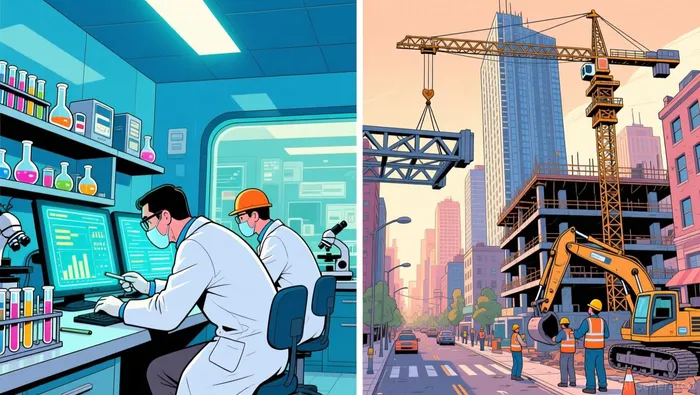

Stay ahead of the market.
Get curated U.S. market news, insights and key dates delivered to your inbox.


AInvest
PRO
AInvest
PRO



Comments
No comments yet