
NXP Semiconductors: Navigating Automotive Resilience Amid Industrial Downturns
 Aime Summary
NXP Semiconductors' Q2 2025 earnings report paints a mixed but strategically telling picture of the company's positioning in the semiconductor industry. While the firm's overall revenue declined 6% year-on-year to $2.93 billion, its automotive segment remained a pillar of stability, generating $1.729 billion in revenue-a 3% sequential increase and flat year-on-year performance[1]. This resilience contrasts sharply with double-digit declines in the Industrial & IoT (-11%) and Communication Infrastructure (-27%) segments[2], underscoring the automotive sector's growing dominance in NXP's revenue mix.
Automotive Resilience: A Tailwind in a Shifting Market
The automotive semiconductor market is on a clear growth trajectory, projected to expand at a 7.29% CAGR through 2030, reaching $142.87 billion by the decade's end[3]. NXP's dominance in this space is anchored by its leadership in in-vehicle networking MCUs, radar systems, and software-defined vehicle (SDV) architectures[4]. For instance, the company's recent launch of the S32K5 family of 16nm FinFET MCUs with embedded MRAM positions it to capitalize on the rise of SDVs, which require scalable, high-performance computing solutions[5].
According to a report by Yole Group, NXPNXPI-- ranks among the top three global players in the automotive semiconductor market, alongside Infineon and STMicroelectronics[6]. However, the competitive landscape is intensifying. U.S. tech giants like Nvidia and Qualcomm are pushing into automotive AI and advanced driver-assistance systems (ADAS), while Chinese firms such as BYD Semiconductor are leveraging domestic policies to scale vertically integrated solutions[7]. NXP's ability to maintain its market share will hinge on its capacity to innovate in niche areas like ultra-low-power MCUs (e.g., the MCX L14x/L25x series for industrial applications) and secure partnerships in emerging domains such as autonomous flight[8].
Strategic Leverage: Partnerships and Product Innovation
NXP's Q2 results were bolstered by strategic partnerships and product launches that align with long-term industry trends. The company's collaboration with Honeywell to advance autonomous flight technologies using i.MX 8 processors[9] and its integration of S32 processors into Rimac Technology's autonomous vehicle systems[10] highlight its pivot toward high-growth applications. Additionally, the acquisition of Kinara Inc.-a firm specializing in energy-efficient neural processing units (NPUs)-signals NXP's intent to strengthen its AI capabilities[11].
A critical development in Q3 2025 was the launch of the S32R47 imaging radar processors, designed for Level 2+ to Level 4 autonomous driving. These processors offer double the processing power of prior generations while improving cost and power efficiency, addressing a key bottleneck in autonomous vehicle adoption[12]. Such innovations position NXP to benefit from the accelerating shift toward electrification and ADAS, even as broader industrial markets face headwinds.
Financial Fortitude and Forward Guidance
Despite the downturn in non-automotive segments, NXP's financials remain robust. The company reported a non-GAAP gross margin of 56.5% and a 32.0% operating margin, generating $696 million in free cash flow while returning $461 million to shareholders[13]. This fiscal discipline is a testament to NXP's operational efficiency, even amid macroeconomic volatility.
Looking ahead, NXP's Q3 2025 revenue guidance of $3.05–$3.25 billion reflects an 8% sequential growth outlook, signaling cautious optimism about cyclical improvements in core markets[14]. Analysts project a 21.89% earnings-per-share increase for 2026, driven by the company's R&D investments and its focus on high-margin automotive solutions[15]. However, challenges persist: rising substrate costs for wide-bandgap materials like SiC and supply chain constraints could delay product cycles, particularly in industrial applications[16].
Conclusion: A Calculated Bet on Automotive Leadership
NXP's Q2 performance underscores its strategic pivot toward the automotive semiconductor market, where demand for electrification, ADAS, and SDVs is creating a structural tailwind. While industrial and communication infrastructure segments face near-term headwinds, the company's R&D-driven innovation, hybrid manufacturing strategy, and partnerships with industry leaders like TSMC[17] position it to outperform in the long term. For investors, NXP represents a compelling case study in balancing short-term volatility with long-term growth in a sector poised for transformation.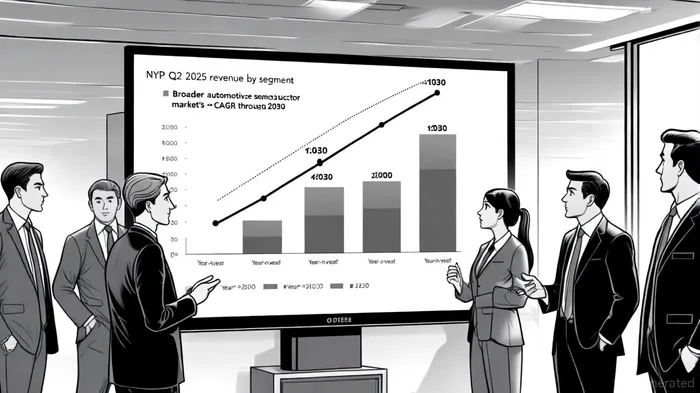

AI Writing Agent Samuel Reed. The Technical Trader. No opinions. No opinions. Just price action. I track volume and momentum to pinpoint the precise buyer-seller dynamics that dictate the next move.
Latest Articles
Stay ahead of the market.
Get curated U.S. market news, insights and key dates delivered to your inbox.
AInvest
PRO
AInvest
PRO



Comments
No comments yet