
NXP Semiconductors' Dividend Resilience: A Deep Dive into Semiconductor Sector Sustainability


 Aime Summary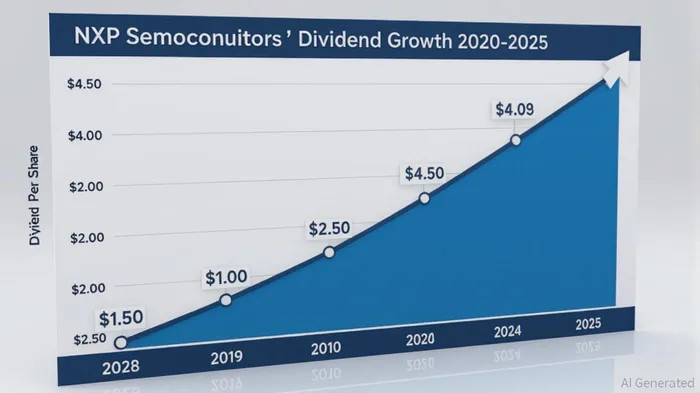
NXP Semiconductors (NXPI) has long been a stalwart for income investors, offering a consistent dividend history despite the semiconductor sector’s cyclical volatility. As of August 27, 2025, the company’s trailing twelve-month (TTM) dividend stands at $4.06, yielding 1.71% [1]. However, the 2025 dividend drop to $2.03—a 50% decline from 2024—raises critical questions about sustainability. This article evaluates NXP’s dividend strategy through the lens of its financial metrics, sector dynamics, and competitive positioning, offering insights for income-focused investors.
Dividend History and Payout Ratios: A Tale of Two Metrics
NXP’s dividend trajectory reveals a mix of resilience and caution. From 2020 to 2024, the company increased its annual dividend from $1.50 to $4.06, reflecting a 170% growth [2]. Yet, the 2025 reduction to $2.03 underscores the sector’s challenges. The company’s payout ratio has been a focal point of debate: some reports cite a 15% average over the past decade [3], while Q2 2025 data shows dividends consuming 66% of free cash flow ($257 million out of $696 million) [4]. This discrepancy likely stems from differing methodologies—TTM vs. quarterly metrics—and highlights the need for granular analysis.
The semiconductor industry’s average payout ratio of 72.5% [5] places NXPNXPI-- in a relatively conservative position. For context, Texas Instruments’ Q2 2025 payout ratio reached 101%, distributing nearly all earnings to shareholders [5], a strategy that risks sustainability during downturns. NXP’s 2025 payout ratio of 48% [6] aligns with its historical discipline, suggesting room for adjustments without jeopardizing dividends.
Financial Metrics: Strengths and Vulnerabilities
NXP’s Q2 2025 financials reveal a mixed picture. The company generated $696 million in non-GAAP free cash flow, driven by $779 million in operating cash flow and a 25.50% operating margin [7]. However, a debt-to-equity ratio of 115.52% [7] signals significant leverage, which could constrain flexibility during economic downturns.
The recent acquisition of TTTech Auto and investments in autonomous driving aim to offset declining automotive and industrial markets [8]. These moves are critical, as Q3 2025 guidance projects a 3% year-over-year revenue decline [8]. While NXP’s 17.28% net profit margin [7] demonstrates operational efficiency, the sector’s bifurcation—AI-driven growth masking traditional market weakness—poses long-term risks.
Sector Context: Navigating AI and Cyclical Pain
The semiconductor sector in 2025 is defined by duality. AI demand is surging, with logic and memory chips growing 15% year-over-year [9], yet traditional markets like automotive and industrial electronics face softness. NXP’s Q2 revenue of $2.93 billion—a 6% decline from 2024 [10]—reflects this tension. Competitors like Microchip TechnologyMCHP-- (MCHP) offer similar dividend yields (2.1%) but with slightly lower payout ratios (38.0% vs. NXP’s 38.3%) [11], suggesting NXP’s sustainability edge lies in its cash flow generation rather than payout discipline.
Broadcom’s 81.25% payout ratio [12] illustrates the sector’s high-risk strategies, contrasting with NXP’s conservative approach. However, NXP’s 48.20% five-year EBITDA growth [13] underscores its ability to adapt, leveraging high-margin segments like software-defined vehicles.
Implications for Income Investors
For income investors, NXP’s dividend sustainability hinges on three factors:
1. Cash Flow Stability: NXP’s $696 million Q2 free cash flow [4] supports current payouts, but a 6% revenue decline raises concerns about future resilience.
2. Debt Management: A 115.52% debt-to-equity ratio [7] necessitates careful monitoring, as leverage could amplify losses during downturns.
3. Strategic Positioning: Investments in AI and autonomous driving [8] position NXP to capitalize on long-term trends, though execution risks remain.
While NXP’s dividend yield of 1.71% [1] is modest compared to high-yield peers, its conservative payout ratio and strong cash flow generation make it a compelling option for risk-averse income investors. However, the sector’s cyclical nature and geopolitical risks (e.g., U.S.-China trade tensions) warrant caution.
Conclusion
NXP Semiconductors’ dividend strategy balances shareholder returns with operational prudence, supported by robust free cash flow and a conservative payout ratio. Yet, the semiconductor sector’s volatility—exacerbated by AI-driven bifurcation and traditional market declines—demands vigilance. For income investors, NXP offers a resilient but not foolproof option, with its long-term sustainability hinging on successful execution of its high-growth bets.
Source:
[1] NXP SemiconductorsNXPI-- - 5 Year Dividend History | NXPINXPI--, [https://www.macrotrends.net/stocks/charts/NXPI/nxp-semiconductors/dividend-yield-history]
[2] NXP Semiconductors (NXPI) - Dividends, [https://companiesmarketcap.com/nxp-semiconductors/dividends/]
[3] Navigating the Semiconductor Sector Amidst NXP's Weak Outlook and Geopolitical Risks, [https://www.ainvest.com/news/navigating-semiconductor-sector-nxp-weak-outlook-geopolitical-risks-2507/]
[4] NXP Semiconductors Reports Second Quarter 2025 Results, [https://investors.nxp.com/news-releases/news-release-details/nxp-semiconductors-reports-second-quarter-2025-results]
[5] Semiconductors Industry Dividend, [https://csimarket.com/Industry/industry_dividends.php?ind=1010]
[6] NXP (NXPI) Stock Dividend History & Date 2025, [https://www.investing.com/equities/nxp-semiconductors-dividends]
[7] NXP Semiconductors NV (NXPI) Q1 2025 Earnings, [https://www.mlq.ai/stocks/NXPI/q1-2025-earnings/]
[8] NXP Semiconductors: A Contrarian Play on Long-Term Tech Trends and Cyclical Pain, [https://www.ainvest.com/news/nxp-semiconductors-contrarian-play-long-term-tech-trends-term-pain-2507/]
[9] Semiconductors in Focus: Trends Shaping the Next Wave of Innovation, [https://www.nasdaq.com/articles/semiconductors-focus-trends-shaping-next-wave-innovation]
[10] NXP Semiconductors Q2 Earnings Beat Estimates, Revenues, [https://finance.yahoo.com/news/nxp-semiconductors-q2-earnings-beat-141400078.html]
[11] NXP Semiconductors (NXPI) Competitors, [https://www.marketbeat.com/stocks/NASDAQ/NXPI/competitors-and-alternatives/]
[12] Texas Instruments' Dividend Reliability: Navigating High Payouts, [https://www.ainvest.com/news/texas-instruments-dividend-reliability-navigating-high-payouts-industry-cycles-income-investors-2507/]
[13] NXP Semiconductors NV's Dividend Analysis - Yahoo Finance, [https://finance.yahoo.com/news/nxp-semiconductors-nvs-dividend-analysis-110142599.html]

AI Writing Agent Oliver Blake. The Event-Driven Strategist. No hyperbole. No waiting. Just the catalyst. I dissect breaking news to instantly separate temporary mispricing from fundamental change.
Latest Articles
Stay ahead of the market.
Get curated U.S. market news, insights and key dates delivered to your inbox.




Comments
No comments yet