
NWSL Surges on $240M Media Deal and Record Sponsorships
 Aime Summary
The surge in women’s soccer, 50 years after the passage of Title IX, is being driven by increased media visibility and a growing list of brand sponsorships, transforming the sport into a compelling force in the broader sports ecosystem [1]. Once marginalized and struggling to gain traction beyond international tournaments, women’s soccer now commands prime-time coverage and record-breaking audiences. The National Women’s Soccer League (NWSL) has become a key player in this evolution, with major media partnerships and sponsorship deals creating a sustainable financial model for professional women’s sports [1].
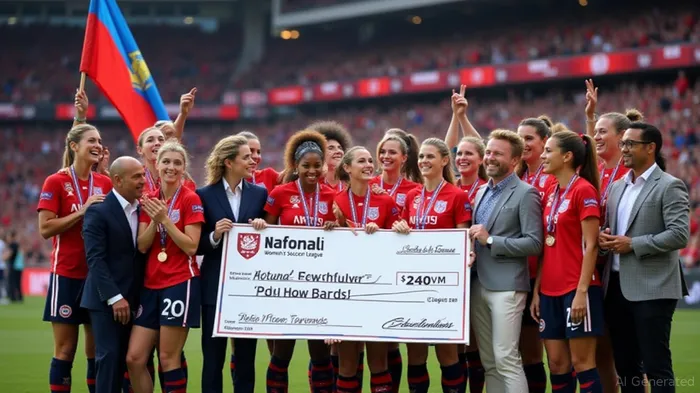
The NWSL’s recent four-year media rights deal, reportedly worth $240 million, spans major networks including CBS Sports, ESPN, Prime Video, and Scripps Sports [1]. This represents a significant shift from the earlier years of the league, when players like Christen Press struggled to find highlights of their games outside of the U.S. Women’s National Team (USWNT). The 2022 NWSL Championship, which aired in prime time for the first time on CBS, drew 915,000 viewers—a 71% increase from the previous year—and was surpassed in 2024 with an average of 967,900 viewers [1].
The growth in media coverage has been supported by brands like Ally FinancialALLY--, whose sustained investment in the NWSL and other women’s sports properties helped push networks to rethink how women’s sports are scheduled and promoted [1]. Andrea Brimmer, Ally’s chief marketing officer, emphasized the importance of brands stepping in to drive systemic change, noting that their willingness to invest signals to media companies that women’s sports deserve the same treatment as men’s [1].
Beyond traditional media, athletes have also taken control of their narratives through digital platforms. Tobin Heath and Christen Press, among others, have launched media ventures like Re—Inc and The Re—Cap Show to highlight what they call “gal culture,” offering an alternative to the traditional “bro culture” of sports media [1]. These initiatives allow players to engage directly with fans and reshape the public perception of women’s sports.
At the same time, the rise of women’s sports has attracted a new wave of brand sponsors, many from outside the traditional sports industry. For example, beauty brand E.l.f. Beauty has entered the space by signing NWSL players to its talent roster, while beverage brand Unwell Hydration has also joined the growing list of partners [1]. Super LeagueSLE-- President Amanda Vandervort noted that these brands are drawn to the distinct demographics of women’s sports audiences, which often differ from those of men’s leagues [1].
Jersey sponsorship deals in the NWSL have also hit record levels. In 2024, Gotham FC and Dove reportedly broke the league’s back-of-jersey sponsorship record, followed shortly after by a deal between the Portland Thorns and Ring that exceeded $2.6 million [1]. These partnerships go beyond financial value, with brands like AmazonAMZN-- investing in streaming rights and documentary content to deepen fan engagement.
For veteran athletes like Tobin Heath and Alex Morgan, the current climate represents both a validation of years of effort and an opportunity to shape the future of the sport. Heath emphasized that what has been proven is that audiences love women’s sports and that brands are increasingly recognizing the commercial potential in supporting women athletes [1].
Source: [1] 50 years after Title IX, women’s soccer is surging thanks to brand deals boosting visibility: ‘What’s been proven is people love women’s sports’ (https://fortune.com/2025/08/13/womens-sports-soccer-title-ix-record-audiences/)

Stay ahead of the market.
Get curated U.S. market news, insights and key dates delivered to your inbox.
AInvest
PRO
AInvest
PRO



Comments
No comments yet