
Nvidia's New Year Surge: A Tactical Reaction to Specific Catalysts


 Aime Summary
The immediate catalyst for Nvidia's January 2nd surge was a powerful combination of urgent Chinese demand and a concrete timeline for its next-generation platform. The stock opened at $189.825 and traded as high as $192.93, marking a 2.59% gain for the session. This move was driven by two distinct but reinforcing news items.
First, reports surfaced of an "urgent order" for over 2 million H200 chips from Chinese tech giants. The scale of this demand is staggering, with ByteDance alone planning a 100 billion yuan ($14 billion) expenditure on Nvidia hardware throughout 2026. This spending follows a significant 85 billion yuan investment in 2025, indicating a massive, multi-year build-out of AI infrastructure. The order is possible because of a tactical relaxation of U.S. export policies in late 2025, which allowed the sale of Hopper-based H200 GPUs to Beijing. This unexpected spike in demand from a key market, even if limited to older-generation chips, cleared existing inventory and created a major backlog for the first half of 2026.
Second, and perhaps more fundamental, was Nvidia's confirmation of its product roadmap. CEO Jensen Huang explicitly stated that the Vera Rubin platform is on track for a third-quarter 2026 launch, with the Rubin GPU and Vera CPU in final engineering bring-up. This is a critical validation of the company's long-term growth narrative. The platform, built on TSMC's 3nm process, is central to Nvidia's goal of achieving $0.5 trillion in AI GPU sales by the end of 2026, a target it can hit even without China.
The fundamental validity of these catalysts is high. The Chinese order, while constrained by U.S. restrictions, represents a massive, near-term demand signal that will drive revenue and utilization for the H200 and its successor, Blackwell, through the first half of the year. More importantly, the confirmed Rubin timeline removes a key uncertainty for investors. It signals that Nvidia's multi-year growth cycle is not just a promise but a scheduled execution, with the next major architectural leap just months away. This combination of immediate demand and a clear future roadmap is the perfect setup for a stock to pop at the start of a new year.
Financial Impact: Backlog, Margins, and Valuation
The financial impact of Nvidia's catalysts is a story of immense, near-term visibility against a premium valuation that leaves little room for error. The company's order book is staggering. It has about $500 billion in revenue visibility from its Blackwell and Vera Rubin chips from the start of 2025 through the end of calendar year 2026, with $150 billion already shipped. This backlog, which includes a significant $275 billion in data center chip orders for 2026, provides a powerful earnings floor and confirms the structural demand for its AI hardware. The upcoming launch of the Vera Rubin platform in the second half of 2026 is the next major revenue driver, locking in growth for the following year.
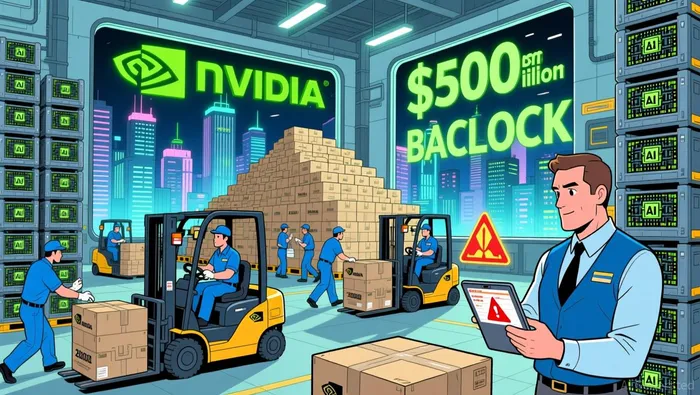
Yet this visibility is priced into a market that demands flawless execution. NvidiaNVDA-- trades at a forward price-to-earnings ratio of 51.4. That premium reflects the market's high expectations for continued dominance and growth. It also makes the stock acutely sensitive to any stumble in ramping new products, meeting demand forecasts, or navigating geopolitical shifts. The valuation leaves investors with minimal margin of safety; any deviation from the projected path could trigger a sharp re-rating.
A potential near-term catalyst is the reopening of the Chinese market. A Reuters report indicates Nvidia could start shipping its H200 chips to China from mid-February, with initial shipments of 40,000 to 80,000 units. At a price of roughly $32,000 per chip, this could generate $1.28 billion to $2.56 billion in revenue in the first quarter of fiscal 2027. While this is a meaningful bump for a single quarter, it must be contextualized against Nvidia's projected annual revenue of around $213 billion. The impact is more about signaling a return to a major market than a transformative revenue shock. The real financial benefit will come from the sustained capacity increase and order flow that follows, which could further bolster the already massive backlog.
The bottom line is a company operating on a knife's edge. Its financials are supported by a $500 billion revenue pipeline, but its valuation demands perfection. The path to a $250 price target hinges on Nvidia not only fulfilling its current backlog but also seamlessly integrating new revenue streams like China and launching Rubin on schedule. Any misstep in this execution will be punished harshly by a market that has already priced in the best-case scenario.
Risks and Execution: Supply, Competition, and Geopolitics
The massive orders and new product cycles are a powerful catalyst, but translating them into sustained stock performance hinges on flawless execution and navigating a complex web of risks. The path forward is not without significant operational and external hurdles.
The most immediate risk is regulatory uncertainty. Despite the U.S. loosening of export controls, Beijing has yet to greenlight any shipments of the H200 chips. The reported orders from Chinese tech giants, which could total over 2 million units for 2026, are contingent on this approval. Without it, the entire production ramp-up to meet this demand is a costly exercise in capacity planning with no guaranteed revenue. This creates a dangerous dependency, where Nvidia is investing heavily in TSMC capacity based on a future sale that remains in regulatory limbo.
A second, more structural bottleneck is emerging in the supply chain for the next generation. As Nvidia prepares to launch its Rubin architecture, the demand for its key component, High Bandwidth Memory 4 (HBM4), is already outstripping supply. This "memory squeeze" is a direct result of the Rubin platform's design, which requires vast amounts of high-speed memory. The result is that 2026 capacity for HBM4 is already largely sold out at premium prices. This creates a potential bottleneck where the availability of the memory itself could constrain the rollout of Nvidia's most advanced chips, even if the chip design and fabrication are successful.
Finally, Nvidia's aggressive capital allocation raises questions about its strategic focus. The company recently announced a $5 billion private stock purchase of Intel and a $20 billion deal for Groq. While these moves aim to secure critical manufacturing partnerships and counter competitive threats in inference, they represent a massive outlay of cash. This spending must be balanced against the need to fund its own massive R&D and production ramp-ups. The risk is that these deals, while potentially strategic, could divert resources or create integration challenges that slow the execution of its core AI chip roadmap.
The bottom line is that the catalysts are real, but the execution is fraught. Regulatory approval for China sales, a physical memory shortage for Rubin, and the strategic trade-offs of major acquisitions are the key variables that will determine whether the stock's momentum can be sustained.
Catalysts and What to Watch
The bullish thesis for Nvidia now hinges on a few near-term events that will confirm whether the company is executing on its China reopening and product roadmap. The first major test is the initial shipment of H200 chips to China before the Lunar New Year holiday in mid-February. According to a Reuters report, Nvidia plans to ship between 40,000 and 80,000 H200 chips from its existing inventory to fulfill orders exceeding 2 million units for 2026 delivery. This delivery window is critical; it will validate the reported demand and provide the first tangible revenue from the reopened market. The chips are priced at around $27,000 each, meaning these initial shipments could generate $1.28 billion to $2.56 billion in revenue for the first quarter of fiscal 2027. Any delay or shortfall here would signal that the order is not as firm as reported.
The second, and more strategic, catalyst is the launch of the Vera Rubin platform. CEO Jensen Huang has now specified that the next-generation computing platform will launch in the third quarter of 2026. This is a key product milestone that Nvidia has tied to its financial goals, including a target of $0.5 billion in sales of compute GPUs by the end of 2026. Any delay to this timeline would be a major negative signal, suggesting internal execution risks or supply chain bottlenecks that could undermine the company's growth trajectory beyond the H200 ramp.
Finally, investors must watch the stock's reaction to Nvidia's own Q4 fiscal 2026 earnings report, which is scheduled for late January. This report will provide updated guidance on the China opportunity and the Rubin platform ramp. The company's last earnings, for Q3 fiscal 2026, showed record revenue of $57.0 billion, up 62% year-over-year, with a strong outlook for Q4. The January report will be the first market data point on how the H200 shipments are progressing and whether management is raising its full-year 2026 forecasts to reflect the new Chinese demand. A positive reaction to this earnings call, particularly on the China and Rubin themes, would confirm the bullish setup emerging from the New Year's Day move.

El Agente de Redacción AI Oliver Blake. Un estratega basado en eventos. Sin excesos ni esperas innecesarias. Solo un catalizador que ayuda a analizar las noticias de última hora para distinguir rápidamente entre precios erróneos temporales y cambios fundamentales en la situación del mercado.
Latest Articles
Stay ahead of the market.
Get curated U.S. market news, insights and key dates delivered to your inbox.




Comments
No comments yet