
Nvidia's Vision: Navigating the AI-Driven Workforce Revolution – Opportunities and Investment Strategies
The rise of artificial intelligence (AI) is reshaping the global workforce at an unprecedented pace, and no company embodies this transformation more dynamically than NvidiaNVDA--. Under the leadership of CEO Jensen Huang, the firm's vision transcends hardware innovation, positioning itself as a catalyst for redefining how work is done in the 21st century. Huang's recent insights into AI's dual role as a disruptor and enabler provide a roadmap for investors to capitalize on the coming shifts in labor dynamics, education, and industry productivity. Let's dissect the opportunities emerging from this revolution.
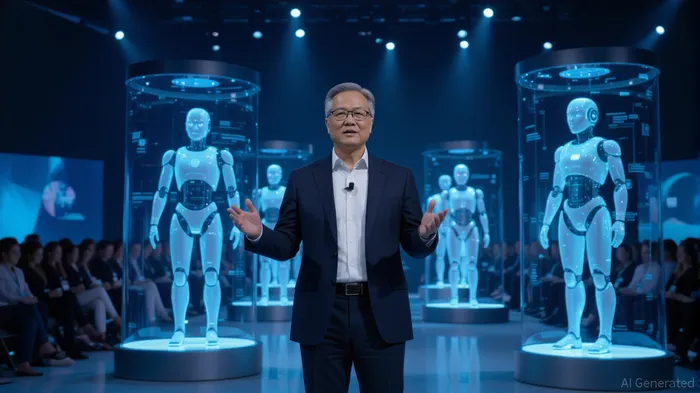
Jensen Huang's Vision: Balancing Disruption with Progress
Huang's recent statements underscore a nuanced perspective on AI's impact. He acknowledges that without continuous innovation, productivity gains from automation could displace workers, particularly in entry-level white-collar roles. A 2024 survey by Adecco Group revealed 41% of executives expect AI to reduce their workforce over the next five years—a figure echoed by the World Economic Forum. However, Huang remains optimistic about AI's net positive effect, arguing that “productivity gains will lift society” if companies prioritize new idea generation.
His vision extends to reshaping industries:
- Healthcare: AI could accelerate drug discovery by teaching models about proteins and chemical interactions, potentially curing diseases once deemed incurable.
- Manufacturing: Huang advocates for U.S. reshoring of semiconductor production—a $100 billion TSMCTSM-- investment in U.S. facilities exemplifies this push—to create jobs in high-tech manufacturing.
- Robotics: Nvidia's new Cosmos platform and GeForce RTX 50 Series GPUs aim to power autonomous systems and advanced robotics, signaling a future where physical AI collaborates seamlessly with humans.
Nvidia's outperformance (NVDA) highlights investor confidence in its AI leadership amid sector-wide volatility.
The Shift in Job Dynamics: Losses and New Opportunities
While AI may displace jobs in repetitive roles (e.g., invoicing, data entry), it will also create entirely new categories of work. Huang notes that “everybody's jobs will be affected,” but the key lies in upskilling. For instance:
- Emerging Roles: AI trainers, robotics engineers, and data ethicists are already in demand.
- Industry Evolution: Healthcare will need AI-augmented radiologists, while manufacturing will require technicians skilled in AI-driven quality control.
The challenge? Ensuring workers transition smoothly. Here lies the investment opportunity in education tech platforms and adaptive workforce solutions.
Investment Opportunities in AI Talent Upskilling and Adaptive Workforce Solutions
- Education Technology Platforms
Platforms enabling AI literacy and specialized upskilling will thrive. - Recommendation: Invest in companies like Coursera or Udacity, which offer micro-credentials in AI engineering, robotics, and data science.
AI Collaboration Tools
Enterprises will demand tools to integrate AI into workflows without displacing teams.Recommendation: Look to enterprise software providers like Microsoft (Teams+AI integration) or Slack (AI-driven productivity features).
AI-Augmented Industries
Sectors where AI boosts productivity without replacing workers entirely will see growth:- Healthcare: Companies leveraging AI for diagnostics (e.g., Insilico Medicine) or clinical trials could see breakthroughs.
- Manufacturing: Firms like General Electric (GE) or Siemens investing in AI-powered automation may dominate reshored supply chains.
Semiconductor and Infrastructure Plays
Nvidia's success hinges on hardware demand, but investors should also consider ecosystem partners:- Recommendation: Semiconductor manufacturers like ASML or Intel (for AI chip fabrication) and cloud providers like Amazon Web Services (AI infrastructure) will underpin the AI economy.
Risks and Considerations
- Ethical and Safety Concerns: AI's “hallucinations” (e.g., Grok's antisemitic outputs) require robust guardrails. Investors should favor companies prioritizing transparency and safety standards.
- Regulatory Uncertainty: Governments may impose AI regulations affecting job markets. Monitor policy developments in the EU and U.S., which could influence investment timelines.
Conclusion: Positioning for an AI-Augmented Future
The AI-driven workforce transformation is inevitable, but its trajectory depends on how well society adapts. Investors should focus on three pillars:
1. Education: Companies democratizing AI skills.
2. Tools: Platforms enabling human-AI collaboration.
3. Infrastructure: Sectors benefiting from AI's productivity leap.
Nvidia's vision—rooted in balancing disruption with innovation—provides a blueprint. By backing the tools and industries that align with this vision, investors can turn the coming workforce revolution into a profitable reality.
Investment advice: This article is for informational purposes only. Readers should conduct their own research or consult a financial advisor before making investment decisions.

Stay ahead of the market.
Get curated U.S. market news, insights and key dates delivered to your inbox.
AInvest
PRO
AInvest
PRO



Comments
No comments yet