
NVIDIA's Trillion-Dollar Bet on AI: Can It Outrun the Fed and Trade Winds?
NVIDIA's (NVDA) stock has surged to a $1.1 trillion valuation, driven by its dominance in AI hardware and software. But as the Federal Reserve's rate policies linger in uncertainty and trade tensions simmer, investors are asking: Can NVIDIANVDA-- sustain this growth? A deep dive into its Q2 earnings, strategic moves, and competitive landscape reveals that its AI ecosystem is positioned to weather macro headwinds—and even thrive in them.
Q2 Earnings: AI as the Engine of Growth
NVIDIA's fiscal Q2 results underscored its AI-driven trajectory. Data Center revenue hit $26.3 billion, a 154% year-over-year spike, accounting for 88% of total revenue. This segment is now a cash-generating machine, fueled by hyperscalers and enterprises racing to build AI infrastructure. The launch of the Blackwell architecture—with its trillion-parameter model capabilities—has created a supply-demand imbalance, with demand “well above supply,” according to CEO Jensen Huang.
The AI Foundry, launched in Q2, further amplifies NVIDIA's moat. By offering access to Meta's Llama 3.1 models and its NIM microservices, NVIDIA is locking in long-term contracts with Fortune 100 companies. This software-as-a-service (SaaS) layer adds recurring revenue streams, shielding it from cyclical hardware demand swings.
Trade Policy Risks: China's Constraints and Sovereign AI's Opportunity
While U.S.-China trade tensions continue to pressure NVIDIA's China revenue—still below pre-export-control levels—the company is diversifying its geographic risk. Sovereign AI initiatives in Japan, Europe, and the Middle East are filling the gap. For example, Japan's ABCI 3.0 supercomputer, built with NVIDIA's H200 GPUs, exemplifies how nations are prioritizing domestic AI infrastructure. NVIDIA now projects sovereign AI revenue to hit “low double-digit billions” in FY2025, offsetting China's headwinds.
The Blackwell GPU's production ramp—beginning in Q4—will also alleviate supply constraints, though mask redesigns and yield improvements are critical. Competitors like AMDAMD-- and IntelINTC-- remain years behind in inference performance, as NVIDIA's MLPerf benchmarks show. This tech lead is a moat against trade disruptions.
Fed Rate Uncertainty: A Mixed Bag, but NVIDIA's Margin Resilience Shines
The Federal Reserve's “wait-and-see” stance—holding rates near 5% but signaling potential cuts by year-end—creates crosscurrents. Lower rates could boost growth stocks like NVIDIA, but inflation risks (e.g., stubborn shelter costs) linger.
Here's why NVIDIA is insulated:
- Margin Discipline: Q2 non-GAAP gross margins held steady at 75%, even with new product mix shifts. Pricing power in high-end chips (e.g., H200) allows NVIDIA to pass costs to customers.
- Structural Demand: AI's adoption curve isn't cyclical. Enterprises like SAPSAP-- and SnowflakeSNOW-- are spending on AI to stay competitive, not speculative hype.
The data shows NVIDIA outperforming broader markets by 74% since April 2024 lows, even as the Fed delayed cuts. This resilience suggests the stock is pricing in long-term AI tailwinds, not short-term rate moves.
Competitor Dynamics: NVIDIA's Full-Stack Lead
AMD and Intel are scrambling to catch up, but gaps remain:
- AMD's MI300A: Struggles with software ecosystem adoption, lagging NVIDIA's CUDA platform.
- Intel's Sapphire Rapids: Falls short on AI inference performance, forcing hyperscalers to rely on NVIDIA.
NVIDIA's full-stack advantage—combining GPUs, networking (Spectrum-X), and software (AI Foundry)—creates switching costs for enterprises. This ecosystem lock-in is a key defensive trait in uncertain markets.
Investment Thesis: A Defensive Tech Play for the AI Era
NVIDIA's valuation isn't just about current earnings—it's a bet on AI's permanence. The Golden Cross (50-day MA above 200-day MA) and a $154.31 all-time high signal investor confidence.
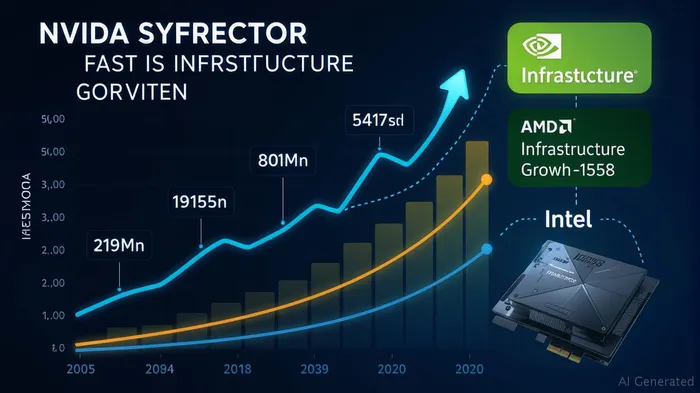
The chart reveals a compounding growth trajectory, with AI adoption accelerating beyond cloud providers to enterprises. This “second wave” of demand—e.g., SAP's AI-driven ERP tools—justifies the valuation.
Risks to Consider:
- Supply Chain Hiccups: Blackwell's yield improvements are critical to meeting demand.
- Geopolitical Volatility: U.S.-China tensions could disrupt chip exports, though sovereign AI mitigates this.
Final Call: Buy the Dip, Hold the Trend
NVIDIA's trillion-dollar valuation isn't overblown—it's a reflection of its AI hegemony. Even if the Fed holds rates higher for longer, NVIDIA's margin resilience, enterprise contracts, and full-stack dominance position it as a defensive tech play.
Investors should:
1. Buy on dips below $150, targeting $175–$200 by year-end.
2. Monitor core PCE inflation (a drop below 2.5% would accelerate Fed cuts, boosting multiples).
3. Avoid overreacting to trade noise; sovereign AI and enterprise demand are durable.
In the AI arms race, NVIDIA isn't just firing ahead—it's rewriting the rules.

Stay ahead of the market.
Get curated U.S. market news, insights and key dates delivered to your inbox.
AInvest
PRO
AInvest
PRO



Comments
No comments yet