
Nvidia Tops Daily Trading Volume at $28.53 Billion as AI Demand Fuels $5 Trillion Market Cap
 Aime Summary
Market Snapshot
Nvidia Corporation (NVDA) concluded trading on August 4, 2026, with a gain of 2.56%, reflecting renewed investor confidence in the semiconductor giant’s growth trajectory. The stock’s performance was accompanied by exceptional liquidity, as NvidiaNVDA-- recorded a trading volume of $28.53 billion, ranking as the most actively traded stock in the market for the day. This surge in activity underscores the heightened attention directed toward the company as it approaches its next earnings report. At the time of the close, Nvidia’s market capitalization stood at a robust $5.00 trillion, with shares trading within a range that saw a one-year low of $164.07 and a high of $236.54. The stock opened the session at $206.64, demonstrating resilience amidst broader market fluctuations. Technical indicators suggest a stabilizing trend, with the 50-day moving average at $205.24 and the 200-day moving average at $196.34, indicating that the stock has recently recovered from periods of sideways trading. The company’s valuation metrics, including a price-to-earnings ratio of 31.64 and a PEG ratio of 0.39, suggest that analysts view the current price as reasonable relative to its substantial growth potential. With a beta of 2.23, Nvidia continues to exhibit higher volatility than the broader market, a characteristic that attracts both institutional investors, who hold 65.27% of the stock, and retail traders seeking exposure to the artificial intelligence sector.
Key Drivers
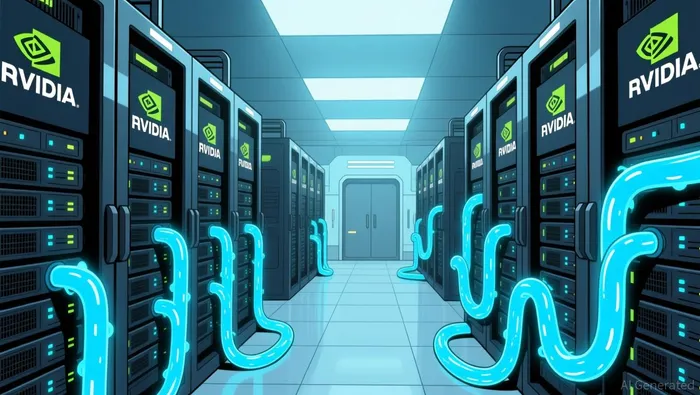
The primary catalyst for Nvidia’s positive performance and increased trading volume is the accelerating spending on artificial intelligence infrastructure by major cloud providers. Investors are increasingly bullish on the demand for Nvidia’s liquid-cooled Blackwell systems, which are central to the current generation of data-center GPUs. This surge in demand has created a supply-demand imbalance, with expectations that demand remains well ahead of supply as the company prepares to release its next earnings report. The market is anticipating that Nvidia will continue its streak of beating analyst estimates, a trend supported by its first-quarter revenue of $81.6 billion and data-center revenue of $75.2 billion. These figures represent exceptional year-over-year growth and have reinforced the narrative that Nvidia remains the dominant force in the AI hardware ecosystem. Analysts highlight that the momentum is expected to continue with the upcoming Vera Rubin platforms, further solidifying the company’s position in the high-performance computing market.
Beyond immediate supply constraints, the broader market environment has provided a supportive backdrop for Nvidia’s stock. A strong rebound in the Nasdaq and the wider semiconductor sector has lifted sentiment across chip stocks, providing a market-wide catalyst for NVDANVDA--. Some analysts argue that Nvidia’s valuation remains attractive relative to its growth prospects and potential future sales. This sentiment is echoed by numerous financial institutions that have recently upgraded their price targets or reaffirmed buy ratings. For instance, Tigress Financial reiterated a strong-buy rating with a target price of $425, while Evercore issued an outperform rating with a target of $413. The consensus among analysts is overwhelmingly positive, with a consensus rating of "Buy" and an average target price of $304.26, suggesting that Wall Street sees significant upside potential from current levels.
However, the news landscape is not without its complexities and potential headwinds. Nvidia has adopted a strategy involving financial guarantees, equity investments, and revenue-sharing arrangements to help customers build AI data centers and secure demand for its Vera Rubin chips. While this approach aims to strengthen its ecosystem and market share, it also introduces new risks. Critics point out that these financial engineering tactics increase exposure to customer defaults, cash outflows, and potentially weaker returns on AI investments. Furthermore, there are growing concerns about circular financing and whether the massive spending by hyperscalers on AI infrastructure can remain economically justified in the long term. These risk-focused narratives suggest that investors may require stronger earnings guidance to sustain a breakout from the stock’s recent sideways trading pattern.
Longer-term competitive risks also loom over Nvidia’s dominance. The emergence of custom AI chips from tech giants and the potential for AI-generated software to weaken the traditional competitive moat of Nvidia’s CUDA platform pose significant challenges. As workloads shift from training toward inference, the relevance of CUDA could diminish, allowing competitors to gain traction. Additionally, insider activity has drawn attention, with recent filings showing that directors have sold significant portions of their holdings. For example, Director Stephen C. Neal sold 15,500 shares, representing an 11.77% decrease in his position. While these sales may be part of pre-arranged trading plans, they reflect a cautious stance among some insiders despite the bullish external outlook.
Despite these concerns, institutional interest remains strong, as evidenced by recent filings from various asset managers. Firms such as Coronation Fund Managers Ltd., Sei Investments Co., and Fairbanks Capital Management Inc. have been seen purchasing shares or increasing their positions, indicating sustained confidence in Nvidia’s long-term prospects. The company’s strong financial health, characterized by a low debt-to-equity ratio of 0.04 and a current ratio of 3.44, further supports its ability to navigate potential market volatility. As Nvidia moves forward, the interplay between robust AI demand, competitive threats, and financial strategy will continue to shape its stock performance, keeping it at the center of investor scrutiny.

Stay ahead of the market.
Get curated U.S. market news, insights and key dates delivered to your inbox.


AInvest
PRO
AInvest
PRO




Comments
No comments yet