
Nvidia Surges 4.8% — But the Catalyst Is Missing
 Aime Summary
Why is the stock moving today?
Nvidia's (NVDA) stock is rallying more than 4.8% as of the latest intraday data, outpacing a broad market rebound. The Dow Jones Industrial Average is up 2.13%, the S&P 500 gained 2.61%, and the Nasdaq Composite surged 3.53%. This outperformance has made NVDANVDA-- a focal point for investors tracking momentum plays and tech sector strength.
While there is no clear, hard catalyst identified—no recent news, earnings reports, or regulatory announcements tied to the move—the stock's surge appears to be part of a broader rally in high-beta tech names. With the Nasdaq's surge, many tech investors are rotating into names with high market-cap exposure, and NVDA—being a flagship AI and GPU player—benefits from such flows. Additionally, recent chatter around AI infrastructure and generative AI tools might be indirectly supporting speculative buying in the sector.
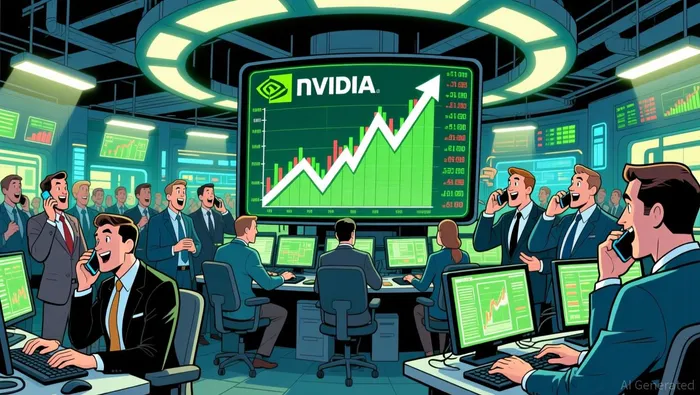
That said, the stock's movement lacks a strong catalyst, and the absence of a clear trigger means that the move could be more susceptible to reversals in the near term.
Why is the stock dropping today?
This is actually not the case: the stock is currently up, not down. As of the data point, Nvidia's shares are up more than 4.8% in the session, closing intraday at $173.11. The confusion may arise from the broader volatility the stock has seen in recent months, including sharp corrections, which might lead some to expect a similar pattern.
However, the current move is not supported by strong volume. While the stock is up more than 4.8%—a significant gain—its volume of 169.8 million shares is below the 20-day average of ~179.6 million and only about 47% of the 60-day high volume of 360.8 million. This weak volume confirmation means that while the price move is meaningful, it's not backed by strong participation from institutional or retail buyers. The active bar ratio is high at 1.0 (every bar shows participation), but the directional bar ratio is low at ~31%, meaning the price movement isn’t showing consistent directional momentum.
This weak volume confirmation could be a red flag for investors expecting a sustained trend. It suggests the move might be more speculative or driven by short-term flows rather than a fundamental shift in sentiment. That doesn’t mean it won’t hold, but it does mean the move is more fragile.
What levels or signals should investors watch next?
From a technical perspective, NvidiaNVDA-- is currently in a downtrend as defined by its 20- and 50-day moving averages (178.57 and 183.05, respectively). The stock is trading below both, which is a bearish signal. Its RSI of 26.04 suggests it is oversold, which could support further buying. However, the ATR of ~$5.10 indicates high volatility, and the stock is still in a range-continuation phase, meaning the move today might just be a pullback within the larger downtrend.
Crucially, the nearest support and resistance levels both sit at $173.00, a level just slightly below the current price. This is a key level to watch. If the stock closes below $173.00, it could trigger a more meaningful pullback, with targets at $168.01 (current price minus 1x ATR). Conversely, a break above $173.00 with strong follow-through volume might suggest a short-term bullish reversal could be in play, with potential targets at $177.19 and $180.75 (price plus 0.8x and 1.5x ATR, respectively).
The main risk is a scenario where the stock fails to maintain the current level and retests the 20-day moving average or even the 60-day low of $164.27. That would suggest the move is not just a short-lived bounce but a larger structural shift. Investors should monitor for volume expansion or contraction around these key levels. Weak volume would support a continuation of the range, while strong volume could confirm a trend change.
In practice, given the weak volume and lack of a clear catalyst, the stock is likely to remain in a consolidation phase over the next few trading sessions. The bottom line is that while the move is meaningful, the technical structure and volume pattern suggest that investors should approach with caution and keep a close eye on the $173.00 level as a critical inflection point.

Stay ahead of the market.
Get curated U.S. market news, insights and key dates delivered to your inbox.


AInvest
PRO
AInvest
PRO



Comments
No comments yet