
Nvidia's Strategic Role in Bridging the U.S.-China Tech Divide: Geopolitical Leverage and Semiconductor Supply Chain Dynamics
 Aime Summary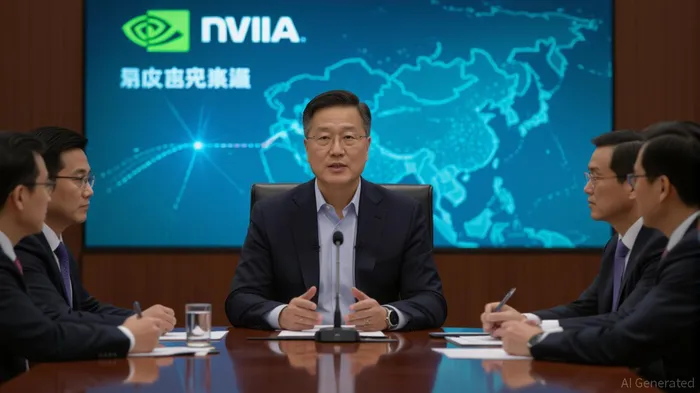
In the escalating U.S.-China technological cold war, Nvidia's CEO Jensen Huang has emerged as an unlikely but pivotal bridgebuilder. His dual engagement with U.S. policymakers under the Trump administration and Chinese tech stakeholders underscores a shift in how semiconductor firms navigate geopolitical tensions. For investors, this dynamic creates both opportunities and risks in a market where regulatory frameworks and supply chain reallocations define competitive advantage.
Geopolitical Leverage and Strategic Adaptation
Huang's recent Beijing visit in July 2025—his second to China this year—highlights his ability to balance U.S. national security concerns with economic realities. By securing a Trump-era reversal of the H20 chip ban, Huang demonstrated his leverage in a fragmented regulatory landscape. This move not only restored $10–$20 billion in projected 2026 revenue but also showcased his capacity to influence policy outcomes. His bicultural background and personal rapport with leaders like Premier Li Qiang and former President Trump have cemented his role as a trusted intermediary.
Nvidia's strategic adaptations extend beyond diplomacy. The company's launch of the B20 chip—a modified Blackwell architecture tailored to U.S. export controls—exemplifies its technical agility. By removing high-bandwidth memory and NVLink capabilities, NvidiaNVDA-- has created a compliant product for the Chinese market while maintaining a competitive edge. This approach mirrors broader industry trends, with AMDAMD-- and IntelINTC-- also developing tiered chip lines to circumvent restrictions.
Semiconductor Supply Chain Reallocation
The U.S.-China tech rivalry has accelerated supply chain decoupling, with Nvidia at the center of this reallocation. The company's shift to U.S.-based manufacturing for Blackwell chips aligns with Trump's “Investing in America” agenda but introduces operational risks. U.S. fabrication capabilities lag behind TSMC's, raising concerns about cost efficiency and yield rates. Meanwhile, China's state-backed industrial policies, including the $47 billion National Integrated Circuit Industry Investment Fund, aim to close the gap in domestic chip production.
For investors, this dual-track development—U.S. policy tailwinds and Chinese self-reliance—creates a complex landscape. Nvidia's 46.94% U.S. revenue share in 2025 contrasts with its 13.11% exposure to China, a market it cannot afford to abandon despite regulatory hurdles. The company's full-stack AI ecosystem, including CUDA and NVLink, further solidifies its moat, even as Chinese firms like Huawei and BaiduBIDU-- invest in alternatives.
Investment Implications for AI Semiconductor Firms
The asymmetry in U.S.-China regulatory environments presents divergent opportunities. U.S. firms benefit from tax incentives and geopolitical leverage, as seen in Nvidia's $100 billion Data Center revenue in 2025. However, reliance on U.S. manufacturing and potential policy reversals pose long-term risks. Conversely, Chinese firms face export control constraints but gain from state subsidies and infrastructure projects like the National Integrated Computing Network.
For AI-driven semiconductor firms, the key lies in adaptability. Startups focusing on RISC-V, chiplets, and photonic ICs are attracting venture capital, but regulatory fragmentation may stifle M&A activity. Investors should prioritize companies with diversified supply chains and ecosystem dominance, as seen in Nvidia's partnerships with MicrosoftMSFT-- and OracleORCL--.
Navigating the Crosscurrents
Huang's dual engagement signals a pragmatic approach to U.S.-China relations, where corporate interests and national security intersect. His ability to secure policy concessions and engineer compliant products reflects a strategic playbook for navigating regulatory crosscurrents. However, the long-term viability of this model depends on geopolitical stability—a wildcard in an era of escalating tensions.
Conclusion: A Bridgebuilder in a Fractured World
Nvidia's role as a U.S.-China tech bridgebuilder is not without risks. Yet, its ability to align with U.S. policy priorities while maintaining access to China's AI market positions it as a unique asset in the semiconductor sector. For investors, the lesson is clear: in a decoupling world, firms that can navigate regulatory duality and supply chain complexity will outperform. As Huang's Beijing visit illustrates, the future of AI semiconductors will be shaped not just by technology, but by the art of geopolitical negotiation.
Investment Takeaway: Position for resilience by targeting firms with ecosystem dominance, regulatory agility, and diversified revenue streams. Monitor policy shifts in both Washington and Beijing, as they will dictate the next phase of semiconductor market dynamics.

Stay ahead of the market.
Get curated U.S. market news, insights and key dates delivered to your inbox.




Comments
No comments yet