
NVIDIA's Strategic Resilience: How Geopolitical Storms Fuel Tech Leadership Amid U.S.-China Tensions
The U.S.-China trade war has become a high-stakes chess match for tech giants, with NVIDIANVDA-- at the center of the fray. As Washington tightens export controls on advanced AI chips, the company's response reveals a paradox: geopolitical headwinds are not stifling its dominance but accelerating its evolution into a global infrastructure powerhouse. For investors, this is a story of adaptation, opportunity, and the enduring value of tech leadership.
Financial Resilience Amid Losses
NVIDIA's Q1 2025 results underscored the costs of geopolitical friction.
The $2.5 billion in lost sales to China and a staggering $4.5 billion inventory write-off for its H20 chip—rendered obsolete by shifting regulations—highlight the immediate pain. Yet NVIDIA's stock has defied gravity, rising 17.76% year-to-date and 20.73% over the past year.
This resilience stems from two factors: its AI-driven diversification into cloud infrastructure and gaming, and its deliberate pivot away from China's unpredictable market. By excluding China from its financial forecasts, NVIDIA has recalibrated expectations, focusing instead on long-term bets in AI supercomputing and partnerships with governments and corporations worldwide.
Supply Chain Reinvention
The company's supply chain strategy exemplifies strategic agility. 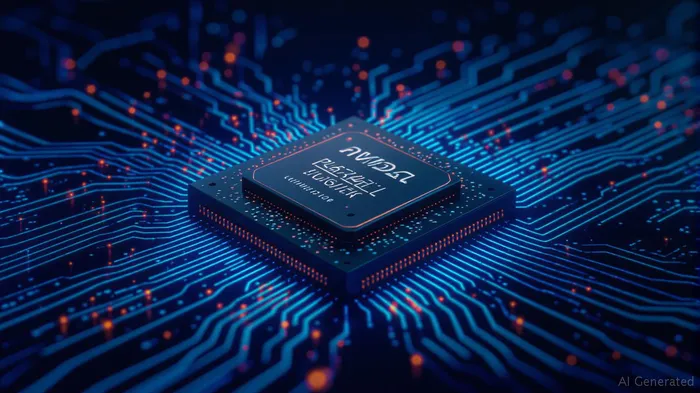
NVIDIA is reengineering its product portfolio to comply with U.S. restrictions while maintaining market access. Its upcoming “scaled-down” Blackwell RTX Pro 6000 chip—stripped of banned features like NVLink—aims to satisfy Chinese demand without violating export rules. Simultaneously, the company is doubling down on U.S. manufacturing, partnering with TSMC's Arizona plant to produce its Blackwell chip domestically. This localization reduces reliance on China's supply chain while capitalizing on U.S. incentives for semiconductor production.
The $500 billion investment pledge over four years signals a broader vision: building an end-to-end AI ecosystem within the U.S. that includes chip fabrication, supercomputer assembly, and AI training infrastructure. This move not only insulates NVIDIA from trade disruptions but positions it to dominate the $563 billion AI infrastructure market analysts project by 2028.
The Geopolitical Chessboard
While U.S. policies aim to curb China's tech ambitions, they've inadvertently fueled its innovation. Chinese firms like Huawei and startups such as DeepSeek are closing the gapGAP-- with NVIDIA, but their progress is reactive rather than transformative. NVIDIA's lead in AI architecture and software ecosystems remains unchallenged.
The near-term risks, however, are stark. The July 9, 2025 tariff deadline looms, with potential 25% tariffs on semiconductors compounding a projected $15 billion revenue hit from prior restrictions. Meanwhile, U.S. senators' warnings to NVIDIA's CEO about engaging with Chinese entities underscore the precarious balance between commercial interests and national security.
Yet these challenges may be transient. Analysts speculate that U.S.-China trade negotiations could ease restrictions if Beijing accelerates rare earths exports, a potential bargaining chip. Even if tensions persist, NVIDIA's shift to Middle Eastern markets—where it's securing AI infrastructure deals with sovereign wealth funds—provides a critical revenue counterweight.
Investment Outlook: Navigating the Storm
NVIDIA's stock reflects a market torn between short-term pessimism and long-term optimism. The company's Q1 losses and regulatory hurdles have created a dip in valuation multiples, but its R&D investments and infrastructure deals suggest a path to recovery.
For investors, the key is recognizing that NVIDIA is not just a chipmaker but a strategic partner to the AI revolution. Its AI cloud platforms, gaming ecosystem, and autonomous vehicle partnerships create recurring revenue streams insulated from geopolitical volatility.
Recommendation:
- Hold for the long term: NVIDIA's valuation is supported by its AI monopoly, and its supply chain shifts reduce dependency on China.
- Watch for catalysts: A U.S.-China trade deal, successful launches of its adapted chips, and Middle Eastern infrastructure wins could trigger a rerating.
- Beware near-term headwinds: The July tariff deadline and inventory write-offs may pressure short-term earnings, but these are temporary hurdles in a multiyear growth story.
In conclusion, NVIDIA's resilience is a masterclass in turning geopolitical adversity into strategic advantage. As the world races to build AI infrastructure, the company's ability to adapt its technology, supply chain, and market focus positions it to emerge stronger—even if the trade war's end remains unclear. For investors, this is a bet on the future of computing, not just the next quarter's earnings.

Stay ahead of the market.
Get curated U.S. market news, insights and key dates delivered to your inbox.


AInvest
PRO
AInvest
PRO



Comments
No comments yet