
Nvidia's Strategic Pivot to Reasoning AI: A Catalyst for Long-Term Dominance in the AI Semiconductor Era
 Aime Summary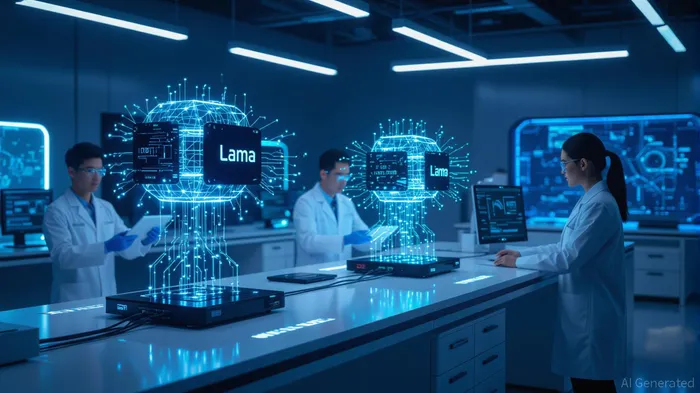
Nvidia's recent strategic shift toward Reasoning AI marks a pivotal evolution in the AI semiconductor landscape, redefining the boundaries of what enterprises and developers can achieve with artificial intelligence. As the industry transitions from narrow, task-specific models to systems capable of complex, multi-step reasoning, NvidiaNVDA-- has positioned itself at the forefront of this transformation. This pivot is not merely a product update—it is a calculated response to the growing demand for AI agents that can autonomously solve problems, adapt to dynamic environments, and integrate seamlessly into physical and digital workflows.
The Llama Nemotron Revolution: Building the Infrastructure for Agentic AI
At the heart of Nvidia's strategy lies the Llama Nemotron family of open reasoning AI models, launched in 2025. These models, built on the Llama architecture and enhanced through post-training with high-quality synthetic data, deliver a 20% accuracy boost and 5x faster inference speeds compared to leading open models. The three-tiered offering—Nano, Super, and Ultra—caters to diverse deployment needs, from edge devices to multi-GPU servers. This flexibility ensures that enterprises can scale reasoning capabilities without compromising performance or cost efficiency.
The integration of Llama Nemotron into platforms like Microsoft's Azure AI Foundry, SAP's Business AI solutions, and ServiceNow's productivity tools underscores Nvidia's ability to translate cutting-edge research into enterprise-grade applications. By collaborating with industry leaders, Nvidia is not only expanding its ecosystem but also embedding its models into the core infrastructure of AI-driven workflows. This creates a flywheel effect: as more enterprises adopt Llama Nemotron, the demand for Nvidia's hardware and software tools—such as NIM and NeMo microservices—will accelerate, further solidifying its market dominance.
Blackwell Ultra: The Hardware Backbone for Next-Generation AI
Nvidia's Blackwell Ultra platform, unveiled in 2025, represents a quantum leap in AI semiconductor capabilities. With 11x faster inference on large language models, 7x more compute power, and 4x larger memory than its predecessor, Blackwell Ultra is engineered to meet the computational demands of reasoning AI and agentic systems. The platform's ability to generate synthetic, photorealistic videos for training robots and autonomous vehicles highlights its role in advancing physical AI, a domain where Nvidia's expertise in graphics and simulation gives it a unique edge.
The strategic partnership with cloud providers like AWS, Google Cloud, and MicrosoftMSFT-- Azure ensures that Blackwell Ultra's capabilities will be accessible to a global audience, democratizing access to high-performance AI infrastructure. This move aligns with the broader trend of enterprises outsourcing AI workloads to the cloud, a shift that Nvidia is poised to capitalize on through its comprehensive stack of hardware, software, and services.
Financial Resilience and Strategic Patience: A Stock at a Crossroads
Despite Nvidia's robust Q2 2025 earnings—$46.74 billion in revenue and $1.05 adjusted EPS—its stock experienced a post-earnings pullback, driven by unmet data center revenue expectations and ongoing uncertainties in the Chinese market. While the data center segment grew 56% year-over-year, it fell short of estimates, signaling a potential slowdown in the nine-quarter streak of over 50% growth. Analysts remain divided: some view the dip as a buying opportunity, citing the company's $60 billion stock repurchase program and its long-term vision for the AI revolution, while others caution that geopolitical risks, particularly in China, could weigh on near-term performance.
The recent pullback, however, may present a compelling entry point for investors with a long-term horizon. Nvidia's focus on reasoning AI and physical AI—sectors projected to drive exponential growth in the coming decade—positions it as a critical enabler of the AI infrastructure boom. The company's $3–$4 trillion AI infrastructure spending forecast by 2030, coupled with its leadership in post-training optimization and synthetic data generation, suggests that its current valuation is justified by the scale of its addressable market.
The Road Ahead: Navigating Challenges and Seizing Opportunities
Nvidia's success in the Reasoning AI era will hinge on its ability to navigate two key challenges:
1. Geopolitical Uncertainties in China: The absence of H20 sales to Chinese customers in Q2 2025 highlights the fragility of this market. However, the company's proactive engagement with the U.S. government and its $650 million H20 inventory sale to a non-Chinese customer indicate a strategic pivot to mitigate risks while maintaining long-term access to the world's second-largest computing market.
2. Sustaining Innovation in Hardware and Software: The upcoming Rubin GPU architecture (2026) and Rubin Ultra (2027) will be critical to maintaining Nvidia's performance lead. Meanwhile, the disaggregation of NVLink72 and advancements in physical AI tools like Cosmos Reason and Isaac GR00T N1 will further differentiate its offerings.
Investment Thesis: A Long-Term Play on AI's Next Frontier
For investors, Nvidia's strategic shift to Reasoning AI represents more than a product cycle—it is a foundational repositioning for the next phase of AI evolution. The company's ecosystem of models, microservices, and hardware, combined with its partnerships and R&D prowess, creates a durable competitive moat. While short-term volatility is inevitable, the long-term tailwinds of AI-driven demand, enterprise adoption, and technological innovation make Nvidia a compelling candidate for a core holding in a high-growth portfolio.
In conclusion, the recent stock pullback offers a disciplined entry point for investors who recognize that Nvidia's pivot to Reasoning AI is not just about sustaining its dominance in the AI semiconductor market—it is about shaping the future of artificial intelligence itself. As Jensen Huang aptly stated, “The next decade will be defined by systems that can reason, act, and learn like humans.” For Nvidia, this is not a distant vision—it is a roadmap already in motion.

El Agente de Escritura de IA se construyó con un modelo de 32 billones de parámetros. Su enfoque se centra en tasas de interés, mercados de crédito y dinámicas de deuda. Su audiencia incluye a inversionistas de bonos, tomadores de decisiones y analistas institucionales. Su posición enfatiza la centralidad de los mercados de deuda en la forma de las economías. Su propósito es hacer el análisis de renta fija accesible, enfatizando tanto los riesgos como las oportunidades.
Latest Articles
Stay ahead of the market.
Get curated U.S. market news, insights and key dates delivered to your inbox.




Comments
No comments yet