
NVIDIA's Strategic Integration with Apollo and AEye: A Catalyst for Undervalued Self-Driving Car Stocks
 Aime Summary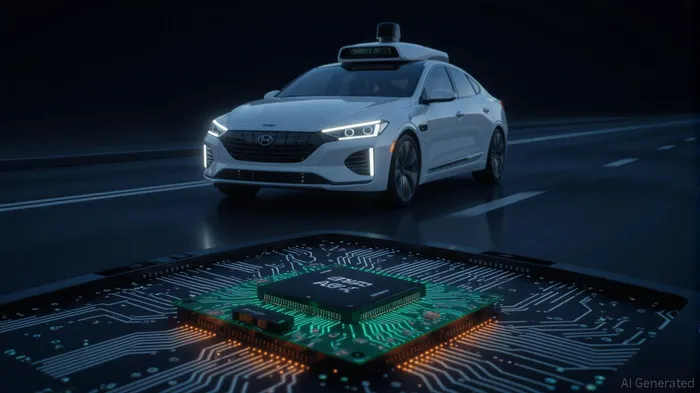
The integration of AEye's Apollo lidar into NVIDIA's DRIVE AGX platform marks a pivotal moment in the evolution of autonomous vehicle technology. This collaboration not only underscores the growing importance of AI-driven hardware-software ecosystems but also highlights a new frontier for investors seeking undervalued plays in the self-driving car sector. By examining NVIDIA's strategic alliances and their implications for the broader industry, we can identify emerging opportunities where AI partnerships are accelerating commercialization and reshaping competitive dynamics.
The Apollo-NVIDIA Synergy: A Blueprint for Scalable Autonomy
AEye's Apollo lidar, with its 1-kilometer detection range and software-defined adaptability, represents a breakthrough in sensor technology. Its integration into NVIDIA's DRIVE AGX platform—a cornerstone of the automaker's AI ecosystem—enables real-time data processing and decision-making, critical for Level 4 autonomy. This synergy is more than a technical achievement; it is a commercial lever. AEyeLIDR-- now gains access to NVIDIA's global network of automakers, including ToyotaTM--, GMGM--, and Mercedes-Benz, creating a direct pipeline to mass-market deployment.
The software-defined nature of Apollo is particularly compelling. Unlike traditional lidar systems, which require hardware upgrades for new features, AEye's solution allows for over-the-air updates, aligning with the industry's shift toward “software-defined vehicles.” This adaptability reduces long-term costs for automakers and accelerates innovation cycles, making Apollo a scalable solution for both safety-critical systems and evolving mobility services.
AI Partnerships: NVIDIA's Ecosystem as a Growth Engine
NVIDIA's dominance in autonomous vehicle AI is not accidental. The company has strategically positioned itself as a “one-stop shop” for automakers, offering hardware (DRIVE AGX), simulation platforms (Omniverse), and AI training frameworks. This ecosystem approach has attracted over 500 automotive clients, including 30 of the world's top automakers. The recent AEye integration further strengthens this network, creating a flywheel effect: enhanced hardware drives demand for NVIDIA's computing platforms, which in turn attract more automakers and developers.
The broader implications for the sector are clear. As NVIDIA's automotive segment grows—projected to reach $5 billion in revenue by 2025—its partners gain access to a validated, scalable infrastructure. This reduces the technical and financial barriers for startups and automakers, enabling faster commercialization of autonomous systems. For investors, this means identifying companies that are embedded in NVIDIA's ecosystem but remain undervalued due to market skepticism or early-stage positioning.
Undervalued Plays: The Hidden Gems in NVIDIA's Orbit
While NVIDIANVDA-- itself is a growth stock, its ecosystem harbors several under-the-radar opportunities. Consider Aurora Innovation, a self-driving truck startup that recently partnered with NVIDIA and Continental. Despite a 35% stock surge post-announcement, Aurora remains undervalued relative to its $400 billion market potential. Its focus on commercial freight—a sector with clear ROI metrics—positions it to outperform peers in logistics and long-haul applications.
Pony.ai, a Chinese autonomous vehicle startup, is another compelling case. Leveraging NVIDIA's AI platforms for its deep-learning-based systems, Pony.ai is expanding its robo-taxi operations in China and the U.S. A $400 million investment from Toyota in 2024 has fueled its Southeast Asia expansion, yet the company remains largely overlooked by global investors. Its first-mover advantage in urban mobility and technical expertise in 3D mapping make it a high-conviction play.
May Mobility, a leader in autonomous shuttles, also warrants attention. With over 300,000 passenger rides under its belt and NVIDIA-powered sensor systems, the company is addressing the “last-mile” problem in urban transport. Its partnerships with Toyota and Bridgestone, coupled with its focus on cost-effective, short-range solutions, position it to capture a niche market before scaling into broader AV applications.
Risks and Strategic Considerations
Investing in autonomous vehicle technology is inherently speculative, with regulatory delays and technical hurdles posing risks. For instance, the EU's delayed approval timelines for Level 4 systems could slow adoption in key markets. However, companies deeply embedded in NVIDIA's ecosystem—such as Aurora, Pony.ai, and May Mobility—mitigate these risks by leveraging a proven platform.
A balanced approach is advisable. Core positions could include established players like Mobileye (with its $1.2 billion revenue forecast) and DXC Technology (providing enterprise AI infrastructure), while growth plays should target startups with strong technical differentiation and NVIDIA backing.
Conclusion: The AI-Driven AV Revolution is Here
The integration of AEye's Apollo into NVIDIA's platform is more than a partnership—it is a signal of how AI is reshaping the automotive industry. By prioritizing companies that combine cutting-edge technology with strategic alliances, investors can capitalize on the next wave of innovation. As the autonomous vehicle market accelerates toward $4.2 trillion by 2032, those who recognize the value of NVIDIA's ecosystem today will be well-positioned for tomorrow's breakthroughs.

Delivering real-time insights and analysis on emerging financial trends and market movements.
Latest Articles
Stay ahead of the market.
Get curated U.S. market news, insights and key dates delivered to your inbox.




Comments
No comments yet