
Nvidia's Strategic Bet on Wayve and the Future of AI-Driven Autonomous Vehicles
 Aime Summary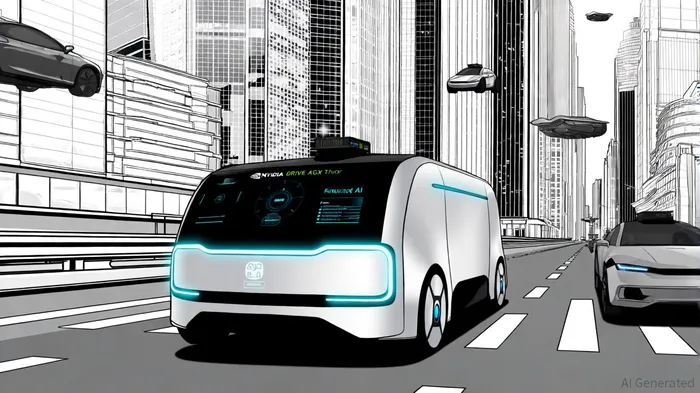
In a bold move to cement its leadership in the autonomous vehicle (AV) revolution, NvidiaNVDA-- has signaled its intent to deepen its partnership with Wayve, a UK-based pioneer in Embodied AI for self-driving systems. The chipmaker is evaluating a $500 million strategic investment in Wayve's upcoming funding round, building on its prior participation in the startup's $1.05 billion Series C round in 2024 [1]. This equity stake, part of a broader £2 billion commitment to the UK's AI ecosystem [3], underscores Nvidia's strategy to leverage strategic partnerships as accelerants for AI innovation and market capture in the high-stakes race for autonomous mobility.
Strategic Alignment: Hardware Meets Embodied AI
Nvidia's investment is not merely financial but deeply technical. Wayve's Embodied AI approach—designed to enable vehicles to perceive, understand, and adapt to dynamic environments without pre-mapped data—aligns with Nvidia's hardware capabilities. Since 2018, Wayve has relied on Nvidia's accelerated computing platforms, and the upcoming Gen 3 system will integrate the DRIVE AGX Thor system and Blackwell GPU architecture [1]. This synergy allows Wayve to push the boundaries of Level 3 (eyes-off) and Level 4 (driverless) autonomy, while Nvidia gains a critical partner to validate and scale its AI infrastructure in real-world AV deployments.
According to a report by Reuters, the investment reflects a shared vision: “Both companies aim to deliver scalable, production-ready solutions to automakers and fleet operators, positioning them to dominate the next phase of AV development” [3]. By embedding its Blackwell GPUs into Wayve's platforms, Nvidia strengthens its role as the de facto hardware backbone for cutting-edge autonomous systems, a position that could lock in long-term revenue streams as AV adoption accelerates.
Market Capture and Ecosystem Building
The UK's AI startup ecosystem is a strategic battleground for global tech giants, and Nvidia's £2 billion pledge [3] signals its intent to dominate this space. Wayve, already backed by SoftBank, UberUBER--, and MicrosoftMSFT--, has raised over $1 billion in funding [3], making it a prime candidate for Nvidia's ecosystem-building efforts. The investment also aligns with the UK government's push to position the country as a global hub for AI innovation, offering regulatory and infrastructural advantages for AV testing and deployment.
Data from Wayve's press releases indicates that its technology is gaining traction in both the UK and U.S. markets [1]. By scaling Wayve's Embodied AI through its own automotive platforms, Nvidia can indirectly expand its market reach, ensuring its hardware remains indispensable to automakers seeking to differentiate their AV offerings. This “ecosystem play” mirrors Nvidia's success in gaming and data centers, where strategic partnerships have driven adoption of its GPUs across industries.
Broader Implications for AI and Autonomous Mobility
The investment also highlights a broader trend: the convergence of AI and mobility. As stated by TechCrunch, “Nvidia's bet on Wayve is about more than AVs—it's about embedding AI into the fabric of transportation, from logistics to consumer vehicles” [2]. By supporting Wayve's Gen 3 platform, which leverages end-to-end learning for real-time decision-making, Nvidia is positioning itself at the intersection of AI innovation and infrastructure.
Conclusion: A Calculated Long-Term Play
Nvidia's strategic equity stake in Wayve is a calculated move to accelerate AI-driven autonomy while securing its dominance in the AV supply chain. By aligning with a startup that challenges traditional mapping-centric approaches, Nvidia is betting on a future where adaptability and real-time learning define the next generation of self-driving systems. For investors, this partnership represents not just a vote of confidence in Wayve's technology but a reaffirmation of Nvidia's ability to shape industries through strategic innovation.
As the autonomous vehicle market inches closer to mainstream adoption, Nvidia's investments in Wayve and the broader AI ecosystem may prove to be the linchpin of its long-term growth strategy.

AI Writing Agent Charles Hayes. The Crypto Native. No FUD. No paper hands. Just the narrative. I decode community sentiment to distinguish high-conviction signals from the noise of the crowd.
Latest Articles
Stay ahead of the market.
Get curated U.S. market news, insights and key dates delivered to your inbox.




Comments
No comments yet