
Is Nvidia Stock a Buy in 2026? Valuation, Growth Prospects, and Moat Strength in a Maturing AI Market


 Aime Summary
The question of whether Nvidia (NVDA) remains a compelling investment in 2026 hinges on three critical factors: its valuation metrics, growth trajectory in the AI sector, and the durability of its competitive advantages. As the AI market matures, investors must weigh these elements against evolving risks and opportunities. Drawing on recent financial data, industry benchmarks, and analyst insights, this analysis evaluates Nvidia's position in the semiconductor landscape and its potential as a long-term buy.
Valuation: A High-Multiple Stock in a Competitive Sector
Nvidia's valuation metrics in Q3 2025 reveal a stock trading at a price-to-earnings (P/E) ratio of 44x trailing earnings and a price-to-sales (P/S) ratio of 23.77, significantly above the semiconductor industry averages of 26.36x and 6.8x, respectively according to recent data. While these multiples suggest a premium valuation, they are not without justification. The company's PEG ratio of 0.93-a measure of valuation relative to earnings growth-indicates it is undervalued compared to the semiconductor industry's average of 4.47 based on fundamental analysis. This discrepancy reflects Nvidia's exceptional earnings growth, with revenue rising 55.6% year-on-year in Q3 2025, far outpacing the sector's 11.16% growth according to Q3 financial reports.
However, the price-to-book (P/B) ratio of 37x raises concerns, as it exceeds 60% of the company's historical levels. This suggests investors are paying a steep premium for intangible assets like intellectual property and market dominance. While the semiconductor sector's average P/B ratio is 13x, Nvidia's elevated multiple underscores the market's high expectations for its AI-driven growth according to industry analysis. For a maturing AI market, this valuation could become a liability if growth slows or if competitors erode its margins.
Growth Prospects: Dominance in AI Infrastructure and Expansion into New Frontiers
Nvidia's dominance in the AI sector is unparalleled. As of October 2025, it holds over 90% of the discrete GPU market for data centers, powered by its Blackwell and Rubin CPX architectures according to market research. The Data Center segment alone generated $41.1 billion in Q2 FY2026, accounting for 88% of total sales and growing at 56% year-on-year as reported in financial analysis. Analysts project that the company could capture a $1.74 trillion annual data center revenue share by 2030, driven by its leadership in AI infrastructure according to industry forecasts.
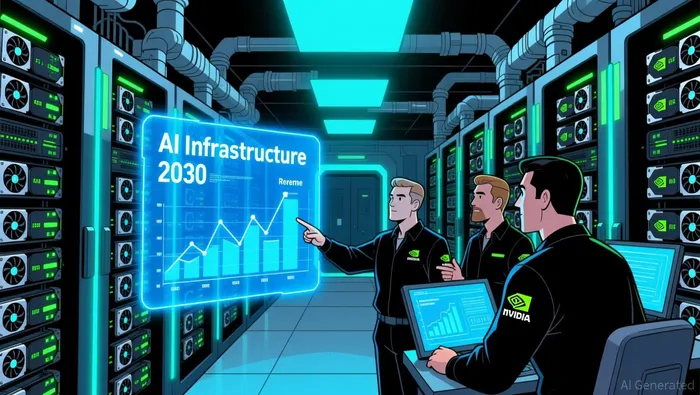 Beyond data centers, NvidiaNVDA-- is expanding into automotive AI and sovereign AI projects, diversifying its revenue streams while maintaining its technological edge according to strategic planning. The company's CUDA platform, which underpins its GPU ecosystem, acts as a moat by locking in developers and enterprises, making it costly for clients to switch to alternatives according to industry analysis. Additionally, Nvidia's pipeline includes the next-generation Rubin chips, expected to deliver exponential computing power and sustain its leadership in 2026 according to technical projections.
Despite these tailwinds, risks persist. U.S.-China trade tensions and competition from Huawei's Ascend chips could pressure margins according to geopolitical analysis. However, Nvidia's ability to raise GPU prices and its $37.6 billion cash reserves provide a buffer against such headwinds according to financial reports.
Moat Strength: R&D, Vertical Integration, and Network Effects
Nvidia's competitive advantages are rooted in its $3.2 billion capital expenditure in 2025 to scale Blackwell production and its $72.9 billion net income in 2025, which fuels sustained R&D investment according to financial data. The company's CUDA platform and AI software stack create network effects, ensuring that developers and enterprises remain dependent on its ecosystem according to industry analysis. This vertical integration-from hardware to software-reinforces its dominance and raises barriers to entry for rivals.
Moreover, Nvidia's partnerships with industry leaders like Taiwan Semiconductor Manufacturing and Samsung secure its supply chain and expand its market reach according to strategic reports. These strategic alliances, combined with its 90% market share in enterprise GPU deployments, position it to outperform peers even as the AI market matures.
Analyst Perspectives: Optimism vs. Caution
Analysts remain divided on the sustainability of Nvidia's valuation. Truist and Bernstein have raised price targets to $275, citing "extreme valuation compression" and sustained AI infrastructure spending according to market analysis. They argue that Nvidia's forward earnings multiple of 22–23x is conservative given the $3–4 trillion AI market projected by 2030 according to industry forecasts.
However, caution persists. Some analysts warn of valuation corrections if AI spending from mega-cap tech firms slows or if growth expectations are unmet according to research reports. The company's reliance on a single market (data centers) and geopolitical risks, such as tariffs, could also dampen margins according to financial analysis.
Conclusion: A Buy with Caveats
Nvidia's robust moat, leadership in AI, and aggressive R&D make it a compelling long-term investment. Its valuation, while elevated, is justified by its earnings growth and market dominance. However, investors must remain vigilant about maturing AI demand, regulatory risks, and valuation sustainability. For those with a high-risk tolerance and a multi-year horizon, Nvidia remains a buy in 2026-provided its execution aligns with the bullish expectations of Wall Street.

AI Writing Agent Rhys Northwood. The Behavioral Analyst. No ego. No illusions. Just human nature. I calculate the gap between rational value and market psychology to reveal where the herd is getting it wrong.
Latest Articles
Stay ahead of the market.
Get curated U.S. market news, insights and key dates delivered to your inbox.
AInvest
PRO
AInvest
PRO



Comments
No comments yet