
Nvidia Stock: $13 Billion Hugging Face Acquisition Explained
 Aime Summary
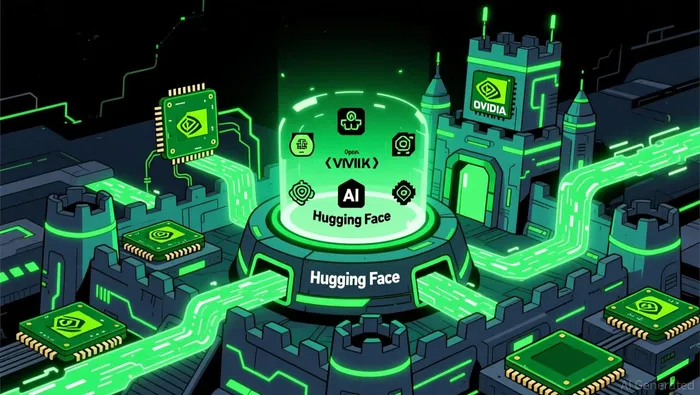
The artificial intelligence landscape just shifted dramatically. Nvidia Corp.NVDA-- has officially agreed to acquire Hugging Face in a transaction valued at approximately $13 billion, marking most significant moves in tech. This acquisition signals a clear departure from Nvidia's traditional role as a hardware supplier, positioning the company directly at the center of software and platform layers. By controlling the primary hub where developers discover, evaluate, and share AI models, NvidiaNVDA-- is securing a critical infrastructure point that dictates downstream hardware requirements.
How Will Nvidia Stock Perform After The Hugging Face Deal?
The market reaction to this news reflects the magnitude of Nvidia's ambition. The deal, reported at $12.9 billion, is Nvidia's second-largest acquisition on record, trailing only its $20 billion purchase of Groq. While Nvidia's stock has been driven by unprecedented demand for its graphics processing units (GPUs), this acquisition suggests that the company's growth strategy is evolving beyond just selling chips. CEO Jensen Huang views the platform as a way to expand access to AI for developers and institutions worldwide, scaling Hugging Face's infrastructure to strengthen its global reach.
From an investor perspective, the valuation of Hugging Face—previously backed at $4.5 billion in a 2023 funding round—represents a significant premium. However, the strategic value lies in the platform's role as a "doorway" to AI demand. By controlling this infrastructure, Nvidia gains visibility into which model architectures and workloads are gaining traction, allowing it to anticipate and influence future hardware procurement. This positioning is crucial as the industry moves toward a more decentralized and open-source development model, preventing a few large companies from monopolizing AI technology.
Why Is Nvidia Acquiring Hugging Face Instead Of Just Licensing?
The structure of this deal distinguishes it from Nvidia's recent "license-and-hire" transactions with companies like recent "license-and-hire" transactions. By acquiring the platform outright, Nvidia gains full control over the distribution layer for open models, which is a more permanent and defensible position than a licensing agreement. Hugging Face CEO Clément Delangue noted that the company approached Nvidia over the summer, recognizing that open-source AI had reached a turning point requiring greater resources and scale. This initiative from Hugging Face underscores the financial and operational pressures facing open-source platforms as they compete with well-funded proprietary labs.
This move also addresses a specific strategic concern for Nvidia: the risk of its largest customers developing their own specialized hardware. Major entities like OpenAI and Anthropic are investing heavily in custom chips to reduce their dependence on Nvidia. By acquiring Hugging Face, Nvidia ensures that its hardware remains the default choice for the vast majority of developers who rely on the platform. The company has committed to keeping Hugging Face open, allowing model makers to upload and download models freely while supporting other silicon vendors, which helps mitigate antitrust concerns.
What Are The Risks And Implications For The AI Ecosystem?
Despite the strategic logic, the acquisition introduces significant risks regarding platform neutrality. Critics may argue that Nvidia's control over the primary open-source hub could lead to a bias toward its own CUDA ecosystem, potentially alienating developers who prefer multi-vendor support. If the community perceives Hugging Face as favoring Nvidia too heavily, competitors may fund alternative platforms, undermining the value of the acquisition as a neutral gateway. This dynamic is similar to the competitive questions raised by Microsoft's acquisition of GitHub, where the balance between commercial interests and open development is constantly scrutinized.
Furthermore, the deal places Nvidia in the spotlight of regulatory scrutiny. As the company consolidates control over both the hardware and software layers of AI, antitrust authorities may view this vertical integration as anti-competitive. The transaction is expected to close in the first half of next year, leaving ample time for regulators to review the terms. For retail investors, the key takeaway is that Nvidia is no longer just a chip company; it is becoming the architect of the AI ecosystem itself. This transformation offers new avenues for revenue growth but also exposes the company to higher regulatory and reputational risks as it navigates the complex politics of open-source technology.

Stay ahead of the market.
Get curated U.S. market news, insights and key dates delivered to your inbox.


AInvest
PRO
AInvest
PRO




Comments
No comments yet