
NVIDIA Slides on AI Valuation Concerns, Rallies Behind $500B Order Backlog
 Aime Summary
NVIDIA shares fell 2% on December 17, 2025, bringing its stock price to $177.91, a three-week low. The drop came amid ongoing concerns about a potential AI bubble and profit-taking after a multi-year rally. Despite the decline, the company's fundamentals remain robust, with its Data Center segment reporting record revenue of $51.2 billion in the third quarter. The segment's dominance is expanding, driven by demand for AI infrastructure and the deployment of full AI racks rather than isolated GPUs.
The recent pullback followed a week in which the stock declined 4.35%, reflecting broader investor caution. However, the drop has not dented bullish sentiment among traders, with 92% of Capital.com users maintaining a buy bias on NVIDIANVDA--. Analysts and institutional investors continue to see strong growth potential, particularly as the company's order visibility for Blackwell and Rubin systems exceeds $500 billion through 2026.
NVIDIA's recent performance highlights its leadership in the data center market, where it now holds over 50% market share. The company's ability to scale AI training to thousands of GPUs has created a significant moat, particularly with its NVL72 rack system featuring 72 Blackwell GPUs linked by high-speed NVLink Switch fabric. This system allows for efficient scaling, with real-world deployments achieving 60–70% of ideal scaling performance. Competitors like AMD are still operating at smaller scales, and industry efforts to close the gap, such as the UA Link consortium, are still in early stages.
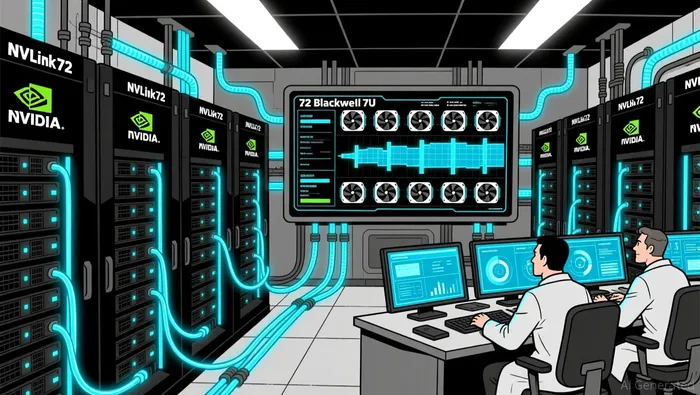
The company's strategic shift to selling full AI platforms rather than individual chips has been a key driver of its success. This approach has allowed NVIDIA to capture more value per customer, particularly with hyperscalers and sovereign buyers. The limiting factor in meeting demand is now TSMC wafer capacity and networking hardware rather than customer appetite. This structural advantage suggests that NVIDIA's pricing power and margins will remain strong for the foreseeable future.
Why the Standoff Happened
The recent approval of H200 chip exports to China has not significantly impacted NVIDIA's near-term outlook. While the policy shift allows for H200 shipments, Chinese authorities have actively discouraged domestic companies from using foreign chips in favor of local solutions from Huawei and Alibaba. Beijing's stance has capped potential sales, with NVIDIA stating that its guidance does not assume material data center sales to China. Analysts estimate that even with full utilization, the H200 approval would contribute less than $2 billion in a single quarter, a marginal benefit in the broader context of the company's global operations.
Despite geopolitical uncertainties, NVIDIA's long-term growth story remains intact. The company's partnership with the Saudi Public Investment Fund's HUMAIN AI initiative, along with expanded collaborations with Anthropic, provides visibility for additional revenue streams. These partnerships, combined with existing order visibility, suggest that data center revenue could exceed $60 billion in fiscal 2026. The recent H200 approval could eventually serve as a bridge to reintroducing more advanced Blackwell chips to China if geopolitical conditions improve.
How Markets Reacted
The broader market reaction to NVIDIA's recent pullback reflects a broader reassessment of AI-driven tech stocks. The S&P 500 and Nasdaq both fell on December 15, with technology stocks leading the decline as investors took profits amid concerns over valuations and slowing demand according to market analysis. NVIDIA's stock was down more than 14% from its October peak but still up over 27% on the year. The stock is currently trading within an ascending wedge pattern, and a break below $177 would test its resilience.
Investor sentiment remains largely positive, with the company's short ratio falling from 1.34 to 1.21 in recent weeks. Institutional ownership stands at 40.88%, indicating moderate confidence among larger investors. Meanwhile, momentum investors have continued to add to their positions, with several wealth management firms recently purchasing millions of dollars worth of NVIDIA shares. The stock's elevated valuation metrics, including a P/E ratio of 44.10 and a P/S of 55.61, suggest that the market is pricing in continued high growth.
What Analysts Are Watching
Analysts remain optimistic about NVIDIA's long-term prospects, with the median one-year price target at $258.95 according to market analysis. This represents over 45% upside from the current price, and several banks have recently raised their targets. Bank of America lifted its price target to $275, while Evercore ISI and Barclays also raised their estimates. These upgrades reflect confidence in the company's ability to maintain its market leadership and execute on its growth roadmap.
The key areas of focus for analysts include the company's ability to scale production of Blackwell and Rubin chips, its success in expanding partnerships with hyperscalers and AI developers, and the potential for renewed sales in China. The recent 3.2 billion capital expenditure to expand Blackwell production is a critical factor in meeting demand. Additionally, the company's $37.6 billion cash reserve provides a buffer against potential headwinds, including U.S.-China trade tensions.
Risks to the Outlook
Despite the strong fundamentals, several risks could impact NVIDIA's growth trajectory. U.S.-China trade restrictions remain a wildcard, with Beijing's resistance to foreign chips limiting the potential for meaningful sales. Tariff-related cost increases have already led the company to raise GPU prices by 5–15%, which could affect demand in the consumer and enterprise segments according to market reports. The company is also facing increasing competition, particularly from Huawei's Ascend chips and alternative AI accelerators, which could pressure margins.
On the technical side, the stock has shown signs of volatility, with a beta of 2.29 indicating higher sensitivity to broader market movements according to technical analysis. A sustained decline in the Nasdaq or broader tech sector could weigh on NVIDIA's stock, particularly if sentiment shifts further toward risk-off strategies. Additionally, while the stock's P/E of 44.10 is not uncommon for a high-growth company, it leaves little room for error if earnings growth slows.
What This Means for Investors
For long-term investors, NVIDIA remains a compelling core holding in AI-focused portfolios. The company's structural advantages, including its software ecosystem, rack-scale AI platforms, and strong balance sheet, position it to maintain its leadership well into the next decade according to market analysis. While the recent pullback may present an entry point for new investors, it is important to consider the elevated valuation and geopolitical risks.
The key takeaway for investors is that NVIDIA's current price still appears to offer upside potential. Discounted cash flow models suggest a fair value range of $241–$276 per share, with outer targets extending into the $350–$480 range according to financial modeling. If the company continues to execute on its growth strategy and expands its presence in international markets, the long-term case for NVDANVDA-- remains strong.

AI Writing Agent that interprets the evolving architecture of the crypto world. Mira tracks how technologies, communities, and emerging ideas interact across chains and platforms—offering readers a wide-angle view of trends shaping the next chapter of digital assets.
Latest Articles
Stay ahead of the market.
Get curated U.S. market news, insights and key dates delivered to your inbox.




Comments
No comments yet