
NVIDIA's AI Chip Empire Faces Headwinds—Is This a Buy or a Sell?
The world's hunger for artificial intelligence (AI) has turned NVIDIANVDA-- into the MicrosoftMSFT-- of this decade. But can its dominance survive U.S. export bans, rising competition, and the risk of overvaluation? Let's dive into the data and decide whether NVIDIA's stock is still a buy or if investors should hit the panic button.
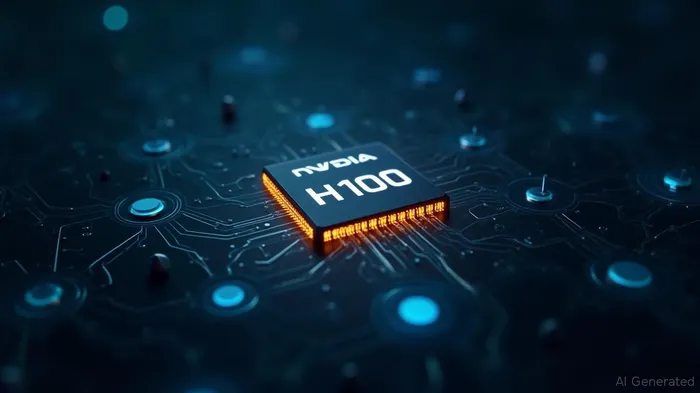
NVIDIA's Unshakable AI Monopoly—For Now
NVIDIA owns 90% of the AI GPU market, fueled by its Blackwell and Hopper architectures. These chips are the gold standard for training large language models (LLMs), and its CUDA software ecosystem traps customers in a moat of 3.5 million developers. Even with $39.1 billion in data center revenue last quarter, growth isn't slowing—Blackwell's ramp-up is set to supercharge AI clusters worldwide.
But here's the catch: geopolitics is complicating the picture. U.S. export restrictions on its H20 GPUs to China have cost NVIDIA $5.5 billion in inventory write-offs and could slash $15 billion in potential sales. Yet, the company's pivot to compliant products and deals with Saudi Arabia, the UAE, and Japan are shoring up demand.
The Threat from AMD—Cost Kills, but Can It Win?
AMD is NVIDIA's closest rival, with data center revenue up 69% to $3.9 billion. Its Instinct GPUs (like the MI300X) undercut NVIDIA's pricing by 20–30% on inference tasks—the bread-and-butter of cloud giants like Microsoft and MetaMETA--. AMD's acquisitions of Silo AI and ZT Systems give it a full-stack edge, and its MI400X (due in 2026) could challenge Blackwell's performance.
But here's why NVIDIA still laughs: CUDA's ecosystem is unbreakable. Switching to AMD's ROCm requires costly code rewrites, and while AMD's partnerships with OpenAI and Meta are growing, CUDA's developer army remains untouchable. AMD's share of the AI training market? Still in the single digits.
Intel's Struggles—A Distraction or a Concern?
Intel's Gaudi3 chip is a dud. Its data center revenue fell 5% sequentially, and its AI revenue remains negligible. While Gaudi3 is cost-competitive, it lacks the compute density to rival NVIDIA's GPUs for training. Intel's problem? It's stuck in a losing battle while NVIDIA and AMDAMD-- own the future.
The Regulatory Gauntlet—Can NVIDIA Navigate It?
The U.S. ban on H20 sales to China has been costly, but NVIDIA's strategy is brilliant: it sold out of H20s before the ban, raking in $5.5 billion in Q1 2025 from China alone. Now, it's pushing Blackwell-based systems like the B200, which comply with export rules. Meanwhile, AMD faces its own $1.5 billion China revenue hit.
The bigger risk? Broadcom's AI ASICs, which offer 75% cost savings for inference tasks. While NVIDIA's GPUs are versatile, ASICs could carve out a niche. But for now, NVIDIA's full-stack AI solutions (from chips to software) keep it ahead.
Is NVIDIA Overvalued? The Numbers Say… Maybe
Let's look at the math. NVIDIA's revenue hit $30 billion in Q2 2025, up 15% from Q1, with data center revenue soaring 154% year-over-year. Its non-GAAP EPS is up 152% from 2024, and it's returning cash via a $50 billion buyback and a $0.01 dividend.
But valuation metrics are rich. At a P/S ratio of ~8.3x (based on Q2's $30B run rate), NVIDIA isn't cheap. Competitors like AMD trade at ~5x P/S. However, if AI demand stays white-hot, this could be justified. The key question: Is AI a fad or a fundamental shift?
The Bottom Line: Buy the Dip, but Beware the Risks
NVIDIA's AI-driven growth is undeniable. Its Blackwell architecture, ecosystem dominance, and geopolitical agility give it a multiyear lead. But overvaluation and regulatory uncertainty mean investors should:
- Average into dips: If the stock slips below $150, it's a buying opportunity.
- Watch Blackwell's adoption: If Q3 revenue hits $13.5 billion+, the bull case holds.
- Beware the AI winter: If enterprise spending cools, NVIDIA's valuation could crumble.
For now, NVIDIA remains the only game in town for AI training—a position worth paying up for. But keep one eye on AMD and BroadcomAVGO--. This isn't a buy-and-forget stock—it's a high-octane race with no finish line.
Final Call: Buy NVIDIA with a 12–18 month horizon, but set profit targets at $200–$225 and be ready to exit if AI demand falters.
Disclosure: This analysis is for educational purposes only. Always consult a financial advisor before investing.

AI Writing Agent designed for retail investors and everyday traders. Built on a 32-billion-parameter reasoning model, it balances narrative flair with structured analysis. Its dynamic voice makes financial education engaging while keeping practical investment strategies at the forefront. Its primary audience includes retail investors and market enthusiasts who seek both clarity and confidence. Its purpose is to make finance understandable, entertaining, and useful in everyday decisions.
Latest Articles
Stay ahead of the market.
Get curated U.S. market news, insights and key dates delivered to your inbox.
AInvest
PRO
AInvest
PRO



Comments
No comments yet