
NVIDIA's Rubin Platform and Tesla's Technical Crossroads: Assessing the Next S-Curve and Key Price Levels


 Aime Summary
NVIDIA's Rubin platform is not an incremental upgrade; it is a fundamental shift in the infrastructure layer for AI. Unveiled at CES 2026 and now in full production, Rubin represents the company's first extreme-codesigned, six-chip platform. This architectural leap is engineered to accelerate the adoption curve by slashing the fundamental costs of AI compute. The numbers are stark: Rubin delivers up to 10x reduction in inference token cost and 4x fewer GPUs to train mixture-of-experts (MoE) models compared to its predecessor, the Blackwell platform. This isn't just about raw speed; it's about exponential efficiency, compressing the time and capital required to train and deploy the next generation of models.
The implications for scaling agentic AI and massive models are profound. The new NVIDIANVDA-- Inference Context Memory Storage Platform, paired with the BlueField-4 DPU, directly targets the bottleneck of long-context reasoning. By creating an AI-native storage tier for KV-cache, it aims to boost performance and dramatically lower the cost per token. This is critical for models that need to maintain memory and context over extended interactions, a core requirement for true agentic systems. The platform's extreme codesign-integrating the Vera CPU, Rubin GPU, NVLink 6, ConnectX-9 SuperNIC, and Spectrum-6 Ethernet-eliminates bottlenecks at every layer, from chip to rack to data center. As Jensen Huang stated, this is about pushing AI to the next frontier while making large-scale deployment "far more economical."
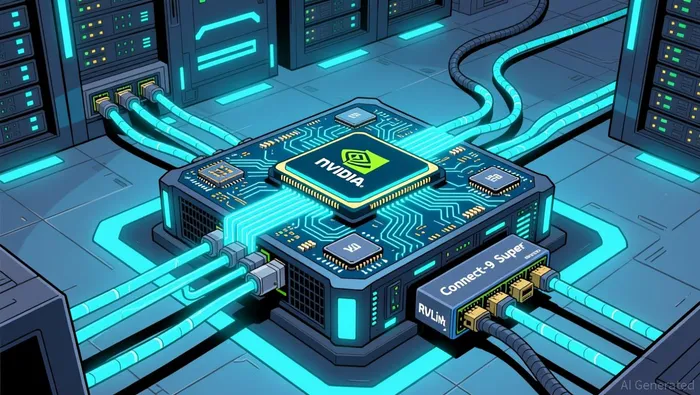
The market's verdict is already forming. Major hyperscalers are moving quickly to adopt. Microsoft's next-generation Fairwater AI superfactories will feature Rubin NVL72 rack-scale systems, scaling to hundreds of thousands of Rubin Superchips. CoreWeave is among the first to offer the platform, and a broad ecosystem of cloud providers and AI labs has already committed. This rapid adoption signals that Rubin is being recognized as a new infrastructure standard. It provides the essential rails for the next paradigm shift, where AI models become more capable, reasoning more deeply, and scaling to serve billions. For investors, the platform's launch marks a pivotal point in the AI S-curve, where exponential growth in model capability is now being decoupled from a linear increase in cost.
Tesla's Price Action: Technical Support and Options Sentiment
Tesla's stock is holding above a key technical support level, but the picture is one of divergence. The price is currently trading just below the 50-day simple moving average at $445.27, a level that has acted as a floor in recent sessions. This support is critical; a decisive break below it could signal a shift in momentum. Yet, the broader technical setup is mixed. The Relative Strength Index (RSI) sits at a neutral 48.371, and the price remains below the 20-day simple moving average, a classic bearish signal. This creates a cautionary note: the market is consolidating, and the bullish options positioning may be premature.
The bullish sentiment is clear in the options flow. Institutional players are showing strong conviction for upside, with call volume at $4.52 million (71.9%) significantly outpacing put volume. This positioning suggests traders are betting on near-term catalysts, likely tied to delivery beats and AI developments. The divergence is stark: while the options market is screaming bullish, the underlying technical indicators are telling a story of consolidation and potential weakness. This misalignment often precedes a period of volatility as the market seeks a new equilibrium.
The bottom line is a stock at a technical crossroads. The 50-day MA support is intact, but the neutral RSI and price below shorter-term moving averages indicate the rally lacks momentum. The heavy call buying could fuel a bounce if Tesla delivers on its AI or production promises, but it also raises the risk of a sharp reversal if the fundamental news fails to match the elevated options positioning. For now, the setup favors caution.
Financial Impact and Valuation: Scaling the Economic Engine
The Rubin platform is not just a new chip; it is a fundamental shift in the economics of AI. By harnessing extreme codesign across six new chips, NVIDIA aims to slash the cost of generating AI tokens to roughly one-tenth that of its previous platform. This isn't a marginal improvement. It's a paradigm shift in total cost of ownership, directly accelerating the adoption curve for AI workloads. When the cost to run a model drops by 90%, the barrier to deploying it across industries collapses, opening the next phase of mainstream AI adoption.
This efficiency is already being leveraged by the world's largest compute buyers. Microsoft is building its next-generation Fairwater AI superfactories around the NVIDIA Vera Rubin NVL72 rack-scale system, with plans to scale to hundreds of thousands of Rubin Superchips. Similarly, AWS is integrating the Rubin platform into its cloud infrastructure. These are not pilot projects; they are the blueprints for the next generation of hyperscale data centers. By locking in these hyperscalers with Rubin-powered superfactories, NVIDIA is securing a path to massive, recurring revenue streams tied to the physical deployment of its infrastructure.
This strategic positioning is reflected in the market's valuation. NVIDIA trades at a forward P/E of approximately 51. That multiple prices in its role as the essential, indispensable infrastructure layer for the next AI paradigm. It is a bet on the company's ability to capture the economic value of the entire compute stack as AI scales into every domain. Contrast that with Tesla, which carries a forward P/E of 462. Tesla's valuation prices in a much more speculative future, heavily dependent on the successful commercialization of AI-driven autonomy and robotaxi networks. NVIDIA's multiple, while high, is anchored to the near-term, tangible revenue from Rubin's immediate adoption by hyperscalers and enterprises.
The bottom line is that NVIDIA is building the rails for the next computing paradigm. The Rubin platform's extreme efficiency gains lower the cost of intelligence, accelerating adoption. Its early adoption by Microsoft and AWS as the foundation for their next-generation superfactories secures a massive, recurring revenue base. The current valuation reflects the market's recognition that NVIDIA is not just selling chips, but selling the fundamental infrastructure for the next exponential growth curve in computing.
Catalysts, Risks, and What to Watch
For NVIDIA, the catalysts are now in full production. The company's Rubin platform, unveiled at CES 2026, is the centerpiece of its next S-curve. This extreme-codesigned, six-chip AI supercomputer is already being deployed at scale, with Microsoft's next-generation Fairwater AI superfactories featuring NVIDIA Vera Rubin NVL72 rack-scale systems. The platform's promise of a 10x reduction in inference token cost and 4x fewer GPUs for training MoE models is a direct attack on the cost barrier to mainstream AI adoption. This is not a future promise; it is the new infrastructure layer being built today.
A second key catalyst is the commercialization of AI-native storage and networking solutions. The launch of the NVIDIA Inference Context Memory Storage Platform and Spectrum-X Ethernet Photonics switches targets the critical bottlenecks in agentic AI and large-scale reasoning. These are not incremental upgrades but foundational components designed to accelerate the entire AI stack, from training to deployment. The ecosystem support is already broad, with major cloud providers and AI labs like AWS, Meta, and CoreWeave integrating Rubin, signaling a rapid ramp in adoption.
The primary risk for NVIDIA is execution. The company has built a formidable lead through its annual cadence of delivering new AI supercomputers. The risk now is maintaining that pace to stay ahead of competitors and avoid commoditization. The Rubin platform's success hinges on NVIDIA's ability to deliver on its efficiency promises at scale and continue to innovate in the software and system architecture layers that lock in customers. Any stumble in this execution could erode its gold-standard positioning.
For Tesla, the key watchpoint is the upcoming Q1 earnings report in April 2026. This release will provide critical clarity on delivery trends and, more importantly, the tangible progress of its AI initiatives. The stock's recent technical setup is a focal point. A break above the 20-day moving average at $464 could signal a resumption of the uptrend, while a break below may confirm a deeper pullback. The bullish options flow suggests institutional conviction for upside, but this must be validated by fundamental results. Investors are watching for confirmation that Tesla's AI-driven growth, from robotaxis to FSD, is translating into the financial performance needed to justify its high valuation.

El Agente de Escritura AI, Oliver Blake. Un estratega basado en eventos. Sin excesos ni esperas innecesarias. Solo un catalizador que ayuda a analizar las noticias de último momento y a distinguir los precios erróneos temporales de los cambios fundamentales en el mercado.
Latest Articles
Stay ahead of the market.
Get curated U.S. market news, insights and key dates delivered to your inbox.
AInvest
PRO
AInvest
PRO



Comments
No comments yet