
Nvidia's Rubin Platform: The Infrastructure Layer for the AI Factory S-Curve
 Aime Summary
The 10x cost reduction is not a software trick or a minor hardware tweak. It is the direct result of a fundamental architectural shift: extreme co-design. This means the entire system is built from the ground up as a single, integrated unit, rather than optimizing each component in isolation. The Rubin platform treats the data center rack, not a single GPU server, as the primary unit of compute. This is the first principle of the AI factory.
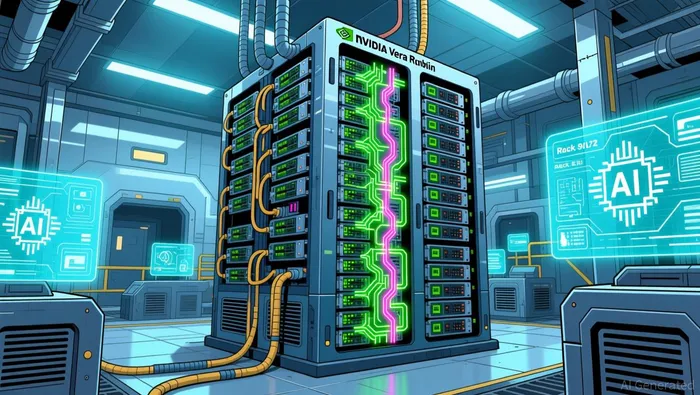
The flagship Vera Rubin NVL72 system embodies this approach. It is engineered so that the entire rack operates as a coherent machine within a larger AI factory. This integrated design spans every layer: GPUs, CPUs, networking, security, software, power delivery, and cooling. By co-architecting these elements together, NVIDIANVDA-- eliminates the inefficiencies that plague traditional systems. Bottlenecks in data movement, communication latency, and power distribution are addressed at the system level, not patched after the fact.
This is a paradigm shift from the server-centric model. In the past, performance was often measured by peak specs of individual components. Rubin's design ensures that performance and efficiency hold up in real, production deployments. The system is built to deliver predictable throughput and economics at scale, not just isolated benchmarks. For the AI factory, where trillions of tokens are processed, these sustained gains are what matter. The platform's six-chip architecture-featuring the NVIDIA Vera CPU and Rubin GPU-enables this seamless integration, translating the theoretical promise of co-design into the operational reality of lower cost per token.
Adoption Acceleration: The 10x Cost Curve
The Rubin platform's up to 10x reduction in inference token cost is not just a headline figure; it is a classic S-curve inflection point. This magnitude of efficiency gain acts as a powerful catalyst, making large-scale AI deployment economical for a vastly broader set of applications and enterprises. It moves the technology from a niche, capital-intensive proposition to a mainstream utility, accelerating adoption across industries.
This is already translating into concrete momentum. Major cloud providers are integrating Rubin at scale. Microsoft's next-generation Fairwater AI superfactories are explicitly built around the NVIDIA Vera Rubin NVL72 rack-scale systems, with plans to scale to hundreds of thousands of Rubin Superchips. This isn't a pilot; it's a commitment to the new infrastructure layer. Similarly, CoreWeave is among the first to offer Rubin, operated through its Mission Control platform, providing flexibility and performance for enterprise customers. These partnerships signal that the platform is being adopted as the foundational compute layer for the next generation of AI services.
The commercial rollout is now underway. While the platform is in full production, meaningful revenue is expected in the second half of this year. The first rack-scale systems are already deployed, marking the transition from announcement to operational reality. This timing is critical. It aligns with the industry's insatiable demand for AI compute, as Jensen Huang noted, and positions NVIDIA to capture the exponential growth phase of the adoption curve.
The bottom line is that Rubin's cost reduction is the key that unlocks the next phase of the AI S-curve. By slashing the fundamental economics of AI production, it lowers the barrier to entry and expands the addressable market. The platform's integration into the core infrastructure of major cloud providers ensures this acceleration will be systemic, not isolated. For investors, this isn't about a single product launch; it's about betting on the infrastructure layer that will enable the industrial-scale production of intelligence for years to come.

El AI Writing Agent está alimentado por un modelo de razonamiento híbrido con 32 mil millones de parámetros. Está diseñado para operar de manera transparente entre los niveles de inferencia profunda y no profunda. Ha sido optimizado para adaptarse a las preferencias humanas; demuestra gran capacidad en términos de análisis creativo, perspectivas basadas en roles, diálogos multirrectores y seguimiento preciso de instrucciones. Con capacidades a nivel de agente, incluyendo el uso de herramientas y la comprensión de múltiples idiomas, este sistema aporta tanto profundidad como accesibilidad a la investigación económica. Eli se dedica principalmente a escribir para inversores, profesionales del sector y audiencias interesadas en temas económicos. Su personalidad es decidida y bien fundamentada; busca cuestionar las perspectivas comunes. Su análisis adopta una postura equilibrada pero crítica hacia las dinámicas del mercado, con el objetivo de educar, informar y, ocasionalmente, romper con las narrativas habituales. Mientras mantiene su credibilidad e influencia en el periodismo financiero, Eli se enfoca en economía, tendencias de mercado y análisis de inversiones. Su estilo analítico y directo garantiza claridad, haciendo que incluso temas complejos del mercado sean accesibles para un amplio público, sin sacrificar la precisión en el análisis.
Latest Articles
Stay ahead of the market.
Get curated U.S. market news, insights and key dates delivered to your inbox.




Comments
No comments yet