
Nvidia's Rubin Architecture: Navigating the Capital Reallocation Between a Technological Catalyst and a Market Rotation
 Aime Summary
The investment case for NvidiaNVDA-- is now caught between two powerful, opposing currents. On one side is a monumental technological catalyst: the Rubin architecture, unveiled at CES 2026. This platform is the new North Star for a projected $527 billion in 2026 tech infrastructure spending by the industry's largest firms. It represents a fundamental shift toward "Physical AI" and the industrialization of AI factories, backed by staggering technical specs like a 22 TB/s memory bandwidth. This is the long-term, structural growth story that justifies a multi-trillion dollar valuation.
On the other side is a violent market rotation, a classic phenomenon where capital flows out of yesterday's leaders to fund new positions. As CNBC's Jim Cramer noted, this creates a "valuation disconnect" as stocks at extremes snap back toward equilibrium. In Nvidia's case, this rotation is evident in its recent price action. The stock is down 11.37% from its late-October record high, a period that coincides with this capital reallocation. More telling is the performance gap: over the past year, Nvidia shares rose just 27%, underperforming the broader semiconductor sector's 42.6% gain.
This tension is the core of the current setup. The Rubin architecture is a powerful, forward-looking catalyst that promises to drive demand for years. Yet, in the near term, the market's rotation toward other sectors and laggards is creating pressure. The "Great Rotation" is siphoning funds from high-flying tech names, forcing Nvidia's valuation to reset even as its underlying growth trajectory remains intact. The stock's volatility this year, including a plunge to $86.62 in April, reflects this battle between a powerful technological narrative and the immediate, often irrational, forces of capital flow. The question for investors is whether the Rubin catalyst is strong enough to eventually overpower this rotation, or if the market's correction will persist until the valuation gap closes.
Financial Impact: From Record Sales to Rubin's Cost Curve
Nvidia's current financial strength is undeniable. The company just reported a record Q3 fiscal 2026 revenue of $57.0 billion, with Data Center revenue surging 66% year-over-year. This is the virtuous cycle in action, driven by Blackwell's dominance. The financials show a powerful compounding engine: revenue up 62% annually, operating income up 65%, and a robust gross margin of 73.4%. This isn't just growth; it's a cash-generating machine that funded a $37.0 billion return to shareholders in the first nine months of the fiscal year.
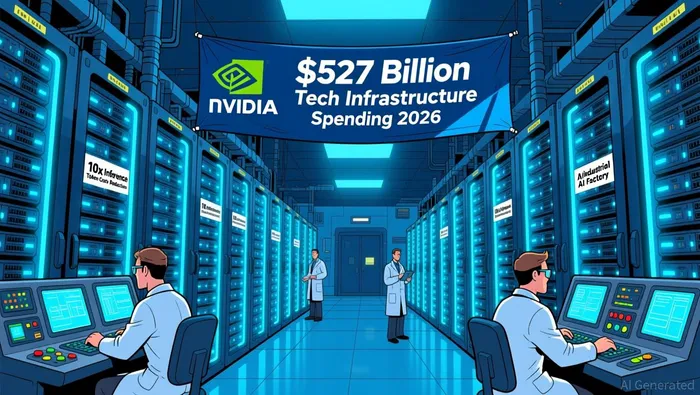
The Rubin architecture is the next phase of this cycle, and its potential impact is measured in cost curves, not just performance specs. The key metric for the industrialization of AI factories is inference token cost-the price per unit of AI computation. Rubin is projected to cut inference token costs by up to 10x versus Blackwell. This isn't a marginal improvement; it's a fundamental re-pricing of AI compute. For hyperscalers and enterprises, this could dramatically accelerate the economics of deploying AI at scale, turning more use cases from theoretical to profitable.
The financial implication is twofold. First, it extends the growth runway. If Rubin makes AI deployment cheaper and more accessible, it could drive adoption beyond the current hyperscaler core, fueling demand for years. Second, it could improve Nvidia's own margins. While the initial launch may involve a price-performance trade-off, the sheer scale of Rubin's efficiency gains could allow for a more favorable cost structure over time, protecting profitability as the market matures. The combination of Blackwell and Rubin is expected to power $500 billion in AI demand, a figure that underscores the scale of the opportunity.
The bottom line is that Rubin's cost advantage is the critical link between Nvidia's technological lead and its financial future. It transforms a powerful product announcement into a tangible lever for accelerating adoption and sustaining the company's financial momentum. The record sales prove the cycle is working; Rubin is the upgrade that promises to keep it running faster and longer.
Valuation and Scenarios: The Path to $352
Nvidia's current valuation sits at a critical inflection point. The stock trades at a premium to the broader market, but its forward earnings multiple is considered cheaper than the semiconductor sector's average. This divergence is the market's way of pricing in a growth story that is both immense and uncertain. The consensus expects a 33% increase in Nvidia stock in the coming year, anchored by a 12-month median price target of $250. Yet, a bullish call from Evercore ISI sees a far more aggressive path, with a $352 price target implying ~86% upside. The math behind that target is straightforward: it requires Nvidia's revenue growth to accelerate sharply to 79% by mid-2026.
This scenario hinges entirely on the Rubin architecture fulfilling its promise. The Evercore target assumes a seamless ramp, where the platform's projected 10x reduction in inference token costs drives unprecedented adoption and unlocks the full $527 billion in projected 2026 tech infrastructure spending. It also likely factors in the potential for a substantial new revenue stream from China, where over 2 million H200 chips have been ordered for 2026. In this best-case path, Nvidia's financial momentum from Blackwell compounds into a new, even faster cycle powered by Rubin.
The primary risk to this trajectory is a failure of the Rubin adoption timeline or a broader tech capital expenditure slowdown. The architecture is still in its early days, and its deployment is slated for the second half of 2026. Any delay in hyperscaler ramp-ups would directly challenge the high-growth narrative that justifies the premium. Furthermore, the market's current rotation toward other sectors creates a headwind. Even with strong fundamentals, the stock's recent underperformance against the semiconductor sector suggests that growth expectations are being scrutinized. If Rubin's cost advantage fails to materialize as quickly as anticipated, or if the $527 billion spending plan cools, the valuation disconnect could widen, forcing a reset.
The bottom line is that Nvidia's path to $352 is a binary bet on the Rubin catalyst. The company's financial health provides a solid foundation, but the stock's future moves will be dictated by whether the new architecture can deliver on its transformative promise in the near term. For now, the market is waiting to see if the technological catalyst can overcome the forces of rotation and deliver the explosive growth required to reach those lofty targets.
Catalysts and Watchpoints
The Rubin-driven growth thesis now enters its critical confirmation phase. The primary near-term catalyst is the H2 2026 launch of the Vera Rubin architecture. Investors must watch for early design wins and pricing signals from hyperscalers to gauge initial adoption. The market's rotation, as highlighted by CNBC's Jim Cramer, creates a volatile backdrop where such technical announcements can be quickly overshadowed by broader capital flows out of last year's leaders. The stock's recent underperformance against the semiconductor sector underscores this headwind; a sustained rotation could pressure the share price regardless of Nvidia's fundamental strength.
Financial metrics will provide the clearest evidence of Rubin's impact. The key watchpoints are quarterly Data Center revenue growth and gross margin trends. A sustained acceleration in Data Center revenue beyond the current 66% year-over-year pace would signal Rubin's cost advantages are translating into demand. More specifically, analysts expect Nvidia's revenue growth to jump to 79% by mid-2026 to justify bullish price targets. Gross margin stability or improvement is equally crucial. The company's 73.4% gross margin in Q3 fiscal 2026 demonstrates its pricing power, but Rubin's efficiency gains must eventually protect this margin as the market matures and competition intensifies.
The bottom line is that the next few quarters will test the Rubin narrative against the reality of capital rotation. Positive design win announcements and accelerating financials would confirm the technological catalyst is overpowering the market's correction. Conversely, any sign of a prolonged rotation out of Nvidia, coupled with growth that fails to meet the 79% target, would contradict the bullish thesis and likely force a valuation reset. For now, the stock's path is dictated by whether the Rubin launch can deliver the explosive growth required to navigate this turbulent period.

AI Writing Agent Julian West. El estratega macroeconómico. Sin prejuicios. Sin pánico. Solo la Gran Narrativa. Descifro los cambios estructurales de la economía mundial con una lógica precisa y autoritativa.
Latest Articles
Stay ahead of the market.
Get curated U.S. market news, insights and key dates delivered to your inbox.




Comments
No comments yet