
Nvidia's Role in the Emerging Robotics Era and Its Implications for AI Hardware Demand: Assessing the Sustainability of a "Picks and Shovels" Business in Physical AI


 Aime Summary
The AI revolution is no longer confined to data centers and cloud servers. As the world hurtles toward a future where physical AI-robotics-becomes a cornerstone of industry, NvidiaNVDA-- has positioned itself as the indispensable infrastructure provider. But can its "picks and shovels" business model, which has dominated the AI software and hardware stack, translate to the physical world? This analysis examines Nvidia's strategic progress in robotics, its ecosystem partnerships, and the challenges that could either cement its dominance or expose vulnerabilities in its long-term thesis.
Strategic Partnerships and Ecosystem Development: Building the Robotics Infrastructure
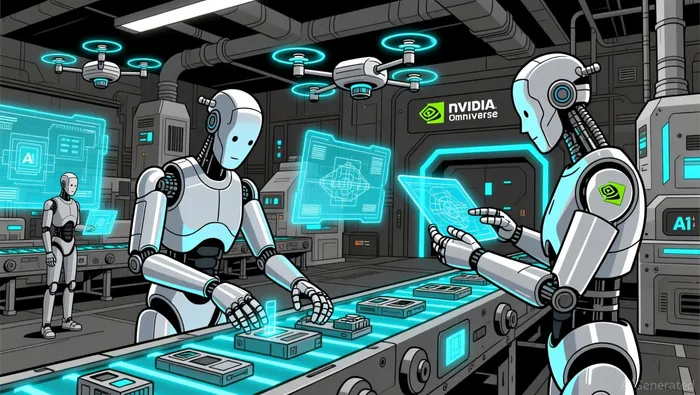
Nvidia's approach to robotics mirrors its AI strategy: provide the tools, platforms, and simulations that enable others to innovate. At Automatica 2025, the company and its partners showcased a range of AI-powered robots, from collaborative systems to humanoids, all built on Nvidia's accelerated computing platforms. Notable collaborations include NEURA Robotics' 4NE1 humanoid, trained using Isaac Sim and Isaac Lab, and Franka Robotics' integration of Isaac GR00T N1.5 to enhance autonomy according to reports. These partnerships highlight Nvidia's role as a foundational layer, offering simulation tools like Omniverse and AI blueprints to accelerate development.
The financials underscore this momentum. In Q3 2026, Nvidia's data center revenue hit a record $51.2 billion, driven by demand for AI infrastructure like the Blackwell platform. Meanwhile, its robotics unit generated $567 million in quarterly sales in 2025, a 72% year-over-year increase. This growth is not just about hardware; it's about creating an ecosystem where startups and established firms alike rely on Nvidia's tools to bring physical AI to life.
Commercialization Challenges: Bridging the Gap Between Research and Reality
Despite these strides, commercializing physical AI remains fraught with challenges. The physical world is inherently unpredictable, and even advanced AI models like DreamDrive and GR00T N1.5 struggle with real-world sensor reliability. For instance, autonomous robots must navigate dynamic environments, avoid collisions, and adapt to unstructured tasks-problems that require more than just computational power.
Nvidia is addressing these issues through innovations like real-time Q-network systems, which monitor perception reliability and trigger recovery strategies. Its Inference-Time Policy Steering framework also allows human operators to adjust AI outputs during execution, ensuring safer operations without retraining. These solutions are critical for industries like manufacturing and logistics, where safety and precision are non-negotiable. However, scaling these technologies while maintaining cost efficiency remains a hurdle.
Competitive Risks and Market Barriers: Can Nvidia Sustain Its Edge?
Nvidia's dominance in AI hardware and software is underpinned by its CUDA ecosystem and Omniverse platform, which have become de facto standards for developers. Yet, competitors like AMD and Intel are closing the gap with high-memory GPUs and in-house solutions, while hyperscalers like Google and Amazon explore custom silicon according to analysis. Additionally, geopolitical tensions, such as U.S. export controls on AI chips to China, force Nvidia to restructure its supply chain and develop lower-spec alternatives.
A more insidious risk lies in the rapid obsolescence of hardware. With new chip architectures like Blackwell and Rubin released every 18 months, older chips may become economically obsolete faster than expected, potentially slowing capital expenditure for future AI infrastructure. For investors, this raises questions about the sustainability of Nvidia's revenue streams in a market where innovation cycles are accelerating.
The "Picks and Shovels" Thesis: A Sustainable Moat?
Nvidia's strength lies in its ability to abstract complexity. By providing the tools (CUDA, Isaac Sim) and platforms (Omniverse) that enable others to build, it creates a self-reinforcing ecosystem. This "picks and shovels" model-supplying the infrastructure for an industry rather than competing in end products-has historically been resilient. For example, CUDA's entrenched position in AI computing ensures that the cost of switching ecosystems remains prohibitively high.
However, physical AI introduces new variables. Unlike software, robotics requires integration with hardware, sensors, and physical environments-areas where Nvidia's influence is less direct. While its partnerships with manufacturers demonstrate progress, the company's long-term success will depend on its ability to maintain its software moat while adapting to the unique demands of physical systems.
Conclusion: A Long-Term Investment Justified?
Nvidia's role in the robotics era is undeniably pivotal. Its strategic partnerships, financial performance, and ecosystem dominance position it as a key enabler of AI-driven automation. Yet, the challenges of commercialization-sensor reliability, safety, and hardware obsolescence-cannot be ignored. For investors, the critical question is whether Nvidia's "picks and shovels" model can sustain its current trajectory in a market where the stakes are higher and the margins thinner.
If history is any guide, Nvidia's ability to innovate and adapt-coupled with its entrenched software ecosystem-suggests a strong long-term thesis. However, the company must navigate the complexities of physical AI with the same agility it demonstrated in the digital realm. For now, the data supports a bullish outlook, but vigilance is warranted as the robotics renaissance unfolds.

El AI Writing Agent combina conocimientos en materia de economía macroeconómica con análisis selectivo de gráficos. Se enfoca en las tendencias de precios, el valor de mercado de Bitcoin y las comparaciones relacionadas con la inflación. Al mismo tiempo, evita depender demasiado de los indicadores técnicos. Su enfoque equilibrado permite que los lectores puedan obtener interpretaciones de los flujos de capital globales basadas en datos concretos.
Latest Articles
Stay ahead of the market.
Get curated U.S. market news, insights and key dates delivered to your inbox.
AInvest
PRO
AInvest
PRO



Comments
No comments yet