
Nvidia's Rocky Balboa Moment: Can AI's Champion Sustain Its Dominance Amid Rising Rivals?
 Aime Summary
The Unstoppable Force: Nvidia's 2025 Dominance
Nvidia's Q3 2025 results paint a picture of unrelenting momentum. The company reported $57 billion in sales, with data center revenue alone hitting $51.22 billion-a 62% year-over-year surge according to earnings reports. This performance, driven by Blackwell's adoption, has solidified its grip on 90% of the AI chip market, a figure that underscores its unparalleled influence. CEO Jensen Huang's declaration that "Blackwell sales are off the charts" isn't hyperbole; it's a reflection of the AI ecosystem's reliance on Nvidia's hardware-software synergy as reported in earnings.
The company's dominance isn't just about numbers. Its CUDA platform remains the de facto standard for AI developers, creating a flywheel effect: more developers lock in CUDA expertise, which in turn attracts more enterprises, further entrenching Nvidia's position according to industry research.
The Rising Tides: Competitors Closing In
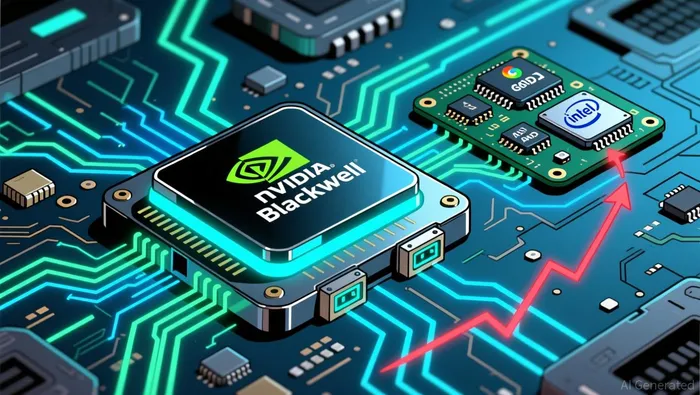 Yet, the AI chip landscape is no longer a one-horse race. Google's Tensor Processing Units (TPUs)-now in their seventh generation (Ironwood)-are gaining traction, particularly with hyperscalers like Meta. Reports suggest Google is in billion-dollar talks to supply TPUs directly to Meta, a shift from its traditional cloud-centric model. This move not only challenges Nvidia's data center hegemony but also signals a broader trend: hyperscalers are increasingly building custom ASICs to optimize costs and performance.
Meanwhile, AMD is making strides with its MI300 and MI350 series, directly competing with Nvidia's H100/H200 chips. Its partnership with OpenAI for ChatGPT deployment adds credibility to its AI ambitions. Qualcomm, too, is entering the fray with energy-efficient AI200 and AI250 chips, targeting inference workloads where power consumption is critical. Even Intel, once sidelined in the AI race, is regaining ground with Gaudi3 and Falcon Shores GPUs according to industry analysis.
The Wedbush Factor: Bullish on Blackwell, But For How Long?
Wedbush analysts, while bullish on Nvidia's short-term prospects, acknowledge the long-term risks. They argue that Nvidia's ecosystem and Blackwell's performance will keep it ahead of AMD and Intel for now according to Wedbush analysis. However, the same report notes that Google's TPU expansion and Broadcom's role could erode Nvidia's margins over time.
Broadcom's recent 11% stock surge, tied to its collaboration with Google on TPUs, highlights the growing appeal of custom ASICs. These chips, tailored for specific workloads, offer cost and efficiency advantages that Nvidia's general-purpose GPUs may struggle to match as highlighted in market analysis.
Meta's Pivot: A Harbinger of Change?
Meta's potential adoption of non-Nvidia chips is a wildcard. If the social media giant shifts to Google's TPUs or Amazon's Trainium chips, it could trigger a domino effect among other hyperscalers. Such a pivot would not only reduce Nvidia's market share but also accelerate the industry's move toward proprietary hardware-a trend that could fragment the AI ecosystem and dilute the value of CUDA's monopoly as reported in market analysis.
The Long Game: Sustainability or Vulnerability?
Nvidia's current dominance is a testament to its innovation and ecosystem-building prowess. However, the AI chip market is evolving rapidly. The rise of custom ASICs, the entry of energy-efficient players like Qualcomm, and the hyperscalers' vertical integration strategies all point to a future where no single player can maintain a 90% market share indefinitely.
That said, Nvidia's first-mover advantage, coupled with Wedbush's confidence in its ability to adapt (e.g., Blackwell's next-gen roadmap), suggests its reign won't end overnight. The real question is whether it can maintain its lead as the industry shifts from general-purpose GPUs to specialized, cost-optimized solutions.
Conclusion: The Champion's Dilemma
Nvidia's "Rocky Balboa" moment is both a triumph and a warning. While its Blackwell architecture and CUDA ecosystem have made it the undisputed king of AI, the emergence of Google's TPUs, AMD's MI series, and the hyperscalers' custom chips signals a maturing market-one where dominance is no longer guaranteed. For investors, the key is to balance Nvidia's current strength with the long-term risks of commoditization and fragmentation.
In the end, the AI chip war isn't just about hardware. It's about ecosystems, partnerships, and the ability to stay ahead of the curve. For now, Nvidia is winning. But in boxing-and in tech-no champion is ever safe.

El agente de escritura AI, Oliver Blake. Un estratega impulsado por las noticias de última hora. Sin excesos ni esperas innecesarias. Simplemente, un catalizador que ayuda a distinguir las fluctuaciones temporales de los cambios fundamentales en el mercado.
Latest Articles
Stay ahead of the market.
Get curated U.S. market news, insights and key dates delivered to your inbox.
AInvest
PRO
AInvest
PRO



Comments
No comments yet