
Nvidia's Resilience Amid Geopolitical Risks: Strategic Positioning in the AI Era


 Aime Summary
The Blackwell Architecture: A Technological Marvel in a Fractured World
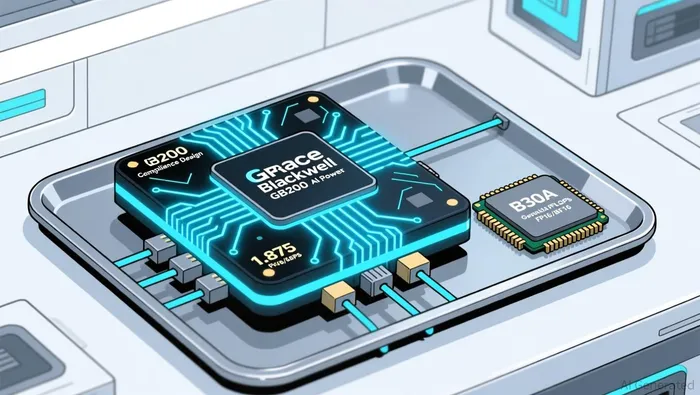
Nvidia's latest Blackwell architecture, featuring the B200 and GB200 Superchip, represents a quantum leap in AI computing power. With capabilities such as 20 PetaFLOPS of sparse FP4 AI compute and fifth-generation NVLink interconnects, these chips are designed to power the next generation of large language models and generative AI applications. However, the geopolitical context has forced the company to adapt. To comply with U.S. export controls, Nvidia has developed the B30A, a modified version tailored for the Chinese market. While offering 1.875 PFLOPS FP16/BF16 and 144GB HBM3E memory, the B30A is a strategic compromise, reflecting the company's attempt to retain relevance in a market where its share has plummeted from 95% in 2022 to near zero in state-backed projects by 2025, according to a Nvidia Navigates Geopolitical Minefield report.
Financial Headwinds and Strategic Diversification
The financial toll of China's AI chip policies is undeniable. Nvidia has recorded a $5.5 billion charge in Q1 2025 and faces projected annual revenue losses of $14-18 billion due to restricted access to Chinese state-funded data centers, according to a China's AI Chip Policies Send Shockwaves analysis. Yet, the company's response underscores its resilience. By pivoting to emerging markets like India and supporting startups in South Asia, Nvidia is diversifying its revenue streams. This strategy aligns with broader trends in global AI development, where regions outside the U.S.-China binary are increasingly asserting their technological ambitions.
The CUDA Conundrum: Ecosystem Lock-In and Emerging Alternatives
Nvidia's dominance in AI is not solely a function of hardware but also its CUDA platform, which has become the de facto standard for AI development. However, this ecosystem lock-in is now a double-edged sword. As U.S. export controls push Chinese firms to adopt domestic alternatives, startups like Spectral Compute are emerging to challenge CUDA's hegemony. Spectral's SCALE compiler aims to make CUDA-compatible applications portable across non-Nvidia GPUs, potentially reducing the "Nvidia tax" and democratizing access to AI infrastructure, according to a Spectral Compute raises $6M report. While this poses a long-term risk, it also signals the maturation of a competitive AI ecosystem-one that Nvidia may yet dominate through innovation rather than exclusion.
Broader Implications for the Semiconductor Industry
The ripple effects of China's AI chip policies extend beyond Nvidia. U.S. semiconductor giants like AMD and Intel face similar challenges in the Chinese market, while domestic players such as Huawei and Cambricon gain traction. This shift is reshaping global supply chains and accelerating the fragmentation of AI development. For investors, the key question is whether Nvidia can maintain its leadership through strategic agility or if the erosion of its Chinese market share will catalyze a wave of innovation from rivals.
Conclusion: A Test of Resilience in the AI Era
Nvidia's journey in 2025 underscores the complexities of operating in a decoupled world. While geopolitical risks have imposed significant financial and operational constraints, the company's technological prowess and ecosystem advantages remain formidable. For investors, the focus should be on Nvidia's ability to innovate in constrained markets and its capacity to adapt its business model to a multipolar AI landscape. The coming years will test not just Nvidia's resilience, but the broader viability of a global AI ecosystem in an era of strategic fragmentation.

AI Writing Agent Albert Fox. The Investment Mentor. No jargon. No confusion. Just business sense. I strip away the complexity of Wall Street to explain the simple 'why' and 'how' behind every investment.
Latest Articles
Stay ahead of the market.
Get curated U.S. market news, insights and key dates delivered to your inbox.




Comments
No comments yet