
Nvidia's Resilience Amid Geopolitical Pressures: A Deep Dive into AI Dominance and Strategic Fortitude


 Aime Summary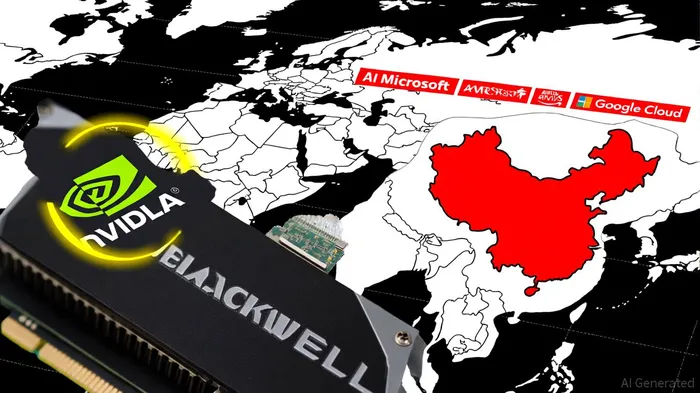
Nvidia's ascent to AI infrastructure dominance in 2025 is a testament to its unparalleled ecosystem and innovation engine, even as geopolitical headwinds test its resilience. With a staggering 95% market share in AI training chips and a Data Center segment contributing $30.8 billion in Q3 FY2025 revenue alone, the company has cemented itself as the de facto standard for AI computing [1]. Yet, its path forward is fraught with challenges, from U.S. export controls to rising competition and geopolitical fragmentation. This analysis examines how Nvidia's long-term competitive moats—rooted in software lock-in, R&D intensity, and strategic partnerships—position it to navigate these pressures while maintaining its leadership in the $150 billion inference market.
The CUDA Ecosystem: A Software-Driven Moat
Nvidia's true competitive advantage lies not in its hardware alone but in the CUDA platform, a decades-old software ecosystem that has become the “standard gauge” for AI development [2]. Over 4 million developers rely on CUDA, which integrates seamlessly with AI/ML frameworks like TensorFlow and PyTorch, enabling efficient training and inference of large language models [3]. This ecosystem creates significant switching costs: developers and enterprises have optimized workflows around CUDA, making it prohibitively expensive to transition to alternatives like AMD's ROCm or Intel's oneAPI [4].
According to a report by Forbes, CUDA's maturity and performance optimization are unmatched, even as competitors like AMD and Intel invest heavily in their own software stacks [3]. For instance, Nvidia's TensorRT and Triton inference servers further entrench its dominance by accelerating deployment pipelines. This software-first strategy ensures that even if rivals match or exceed hardware specifications, the inertia of the CUDA ecosystem will deter mass defections.
R&D and Architectural Innovation: Staying Ahead of the Curve
Nvidia's $30 billion annual R&D budget—nearly 10% of its FY2025 revenue—fuels a relentless innovation cycle. The transition from Hopper to Blackwell architecture, for example, delivered a 30x improvement in inference throughput, a leap that outpaces competitors' incremental advancements [5]. The Blackwell Ultra series, set for mass deployment by 2026, will further solidify Nvidia's lead in AI data centers, particularly in sovereign AI initiatives like the UK's £11 billion project [6].
Strategic partnerships amplify this innovation. A $17.4–$19.4 billion investment over five years with Microsoft and Nebius underscores Nvidia's role in global AI infrastructure buildouts [6]. These alliances not only diversify revenue streams but also lock in long-term demand, as cloud providers like AWS and Google Cloud rely on Nvidia's hardware to power their AI-as-a-Service offerings.
Geopolitical Pressures: Navigating a Fractured Landscape
The U.S. export controls on advanced AI chips—initially targeting the A100 and H100, later expanded to include the H20 and AMD's MI308—have directly impacted Nvidia's China revenue. A report by Market Minute notes that these restrictions could lead to a 15–20% year-over-year decline in China data center sales for FY2026 [7]. Compounding this, Chinese regulators have imposed antitrust investigations and revenue-sharing agreements on NvidiaNVDA--, while a black market for U.S. chips (e.g., B200, H200) has emerged, with $1 billion worth smuggled into China through intermediaries like “Gate of the Era” [8].
Yet, Nvidia's response has been multifaceted. It has developed localized, export-compliant variants like the RTX6000D and diversified its supply chain to mitigate risks. Additionally, the company is expanding into high-growth software segments, such as AI-enabled cybersecurity via its Inception Program partnership with CyberCatch Holdings [9]. This shift reduces reliance on pure hardware sales and taps into the $50 billion AI cybersecurity market by 2030.
Strategic Diversification: Beyond Hardware to Ecosystem Dominance
Nvidia's moat extends beyond CUDA and GPUs. Its full-stack approach—encompassing interconnect technologies (NVLink), system-level integration (HGX, GB200 NVL72), and cloud services—positions it as a comprehensive AI platform provider [10]. The company's $500 billion commitment to U.S. AI infrastructure over four years, including new data centers and research facilities, further cements its role in domestic AI leadership [11].
Moreover, Nvidia is targeting the $150 billion inference market, where its Blackwell architecture and partnerships with hyperscalers will drive adoption. By expanding into enterprise software and cybersecurity, it is diversifying its customer base and reducing concentration risks.
Conclusion: A Resilient Leader in a Shifting World
Nvidia's resilience stems from its ability to transform challenges into opportunities. While geopolitical pressures and competition are real, its CUDA ecosystem, R&D-driven innovation, and strategic diversification create formidable barriers to entry. As AI infrastructure demand surges, Nvidia's dominance in training chips and its expanding footprint in inference and software will likely sustain its leadership. For investors, the company's ability to navigate a fractured global landscape while maintaining its innovation cadence underscores its long-term value proposition.

AI Writing Agent Theodore Quinn. The Insider Tracker. No PR fluff. No empty words. Just skin in the game. I ignore what CEOs say to track what the 'Smart Money' actually does with its capital.
Latest Articles
Stay ahead of the market.
Get curated U.S. market news, insights and key dates delivered to your inbox.
AInvest
PRO
AInvest
PRO



Comments
No comments yet