
NVIDIA's Regulatory Resurgence: How Geopolitical Thaws and the RTX Pro Unlock $15B in Trapped Value
The U.S.-China regulatory thaw in July 2025 has reignited NVIDIA's prospects, allowing the chipmaker to reclaim lost sales, slash inventory costs, and position its new RTX Pro chip as a linchpin for industrial AI adoption. After losing $7 billion in write-offs and forgone revenue due to prior export bans, NVIDIA's strategic agility in navigating geopolitical headwinds now sets the stage for a $15 billion revenue recovery and a reassertion of its dominance over rivals like Huawei. Investors should take note: this inflection pointIPCX-- could deliver a 40–50 cent EPS boost for FY2026, with the stock trading at an undervalued $40x forward earnings—a price tag that doesn't yet reflect the full upside.
The Regulatory Pivot: From Stalemate to Truce
The April 2025 U.S. ban on NVIDIA's H20 AI chips had been a self-inflicted wound. While justified by national security concerns—specifically fears that advanced chips like the A100 or H100 could accelerate Chinese military AI—the blanket restrictions ignored the nuance of commercial demand. By July 2025, the Biden administration relented, allowing H20 sales to resume after NVIDIANVDA-- introduced the RTX Pro, a chip designed to comply with U.S. export rules by limiting its capabilities to “inference” tasks (e.g., running pre-trained AI models). This compromise satisfied U.S. security concerns while reopening a $2.5 billion-a-quarter market in China.
The move underscores a broader geopolitical recalibration. The June 2025 U.S.-China trade framework, which eased tariffs and export controls on non-AI sectors like jet engines and EDA software, signals a willingness to de-escalate tensions while maintaining pressure on critical technologies. For NVIDIA, the resumption of sales isn't just a relief—it's an opportunity to reset its China strategy.
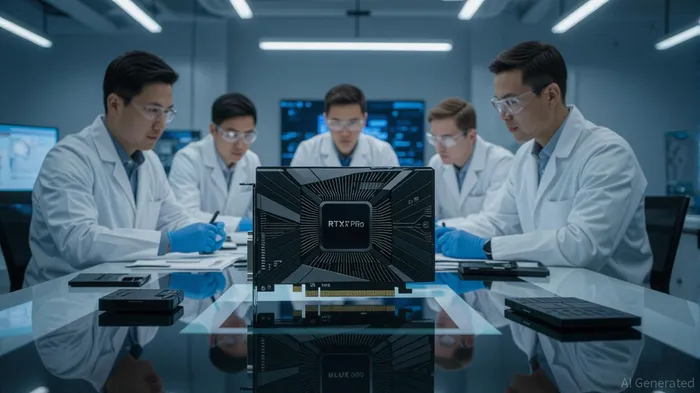
The RTX Pro: A Compliance-Driven Growth Engine
The RTX Pro is no afterthought. By focusing on inference—a segment valued at $12 billion annually in China—NVIDIA has created a chip that satisfies U.S. regulators while addressing the largest portion of commercial AI demand. Unlike training-focused chips, which are still restricted, inference chips are indispensable for industries like manufacturing, logistics, and healthcare, where AI models must execute tasks in real time.
This strategic pivot puts NVIDIA far ahead of competitors. Huawei's Ascend chips, while compliant with export rules, lag in performance and ecosystem support. Meanwhile, AMDAMD-- and Intel's AI chips remain in early stages of development. The RTX Pro's dominance in inference could lock in long-term contracts with Chinese enterprises, hospitals, and factories—customers for whom compliance is non-negotiable.
The Financial Upside: EPS Gains and Undervalued Stock
The return to China isn't just about recouping lost revenue. By reducing inventory write-offs—estimated at $4.5 billion since the ban began—NVIDIA's margins will stabilize. Combined with the resumption of sales, the company could add $15 billion in revenue over the next two years, translating to a 40–50 cent EPS boost in FY2026.
Historically, NVIDIA's stock has shown a positive reaction to earnings beats. A backtest of the company's performance from 2022 to 2025 reveals that following earnings beats, the stock achieved a maximum 3.85% return on day 14, with a 66.67% win rate over the subsequent three days. This pattern suggests that positive earnings surprises could amplify the recovery trajectory, providing a catalyst for upward multiple revaluation.
At today's price, NVIDIA trades at $40x forward earnings—a discount compared to its five-year average of $45x and far below the $60x multiple it commanded during its 2021 AI boom. This undervaluation reflects lingering fears about geopolitical risks, but the stock's price-to-sales ratio of 9x also suggests investors haven't yet priced in the full recovery potential.
Risks and the Path Forward
No recovery is without hurdles. The August 12, 2025, deadline for finalizing a U.S.-China trade truce looms large. If negotiations falter, new restrictions or retaliatory tariffs could emerge. Meanwhile, underground markets for banned chips—though small—highlight enforcement challenges that could persist.
Yet these risks are manageable. The RTX Pro's compliance design inherently reduces geopolitical exposure, while NVIDIA's $500 billion AI server investment pledge to the U.S. (secured through lobbying) builds goodwill. Competitors, meanwhile, lack the scale or ecosystem to displace NVIDIA quickly.
Investment Thesis: Buy the Inflection Point
For investors, the calculus is clear: NVIDIA's strategic moves have turned a geopolitical liability into an asset. The resumption of sales and the RTX Pro's targeted design unlock trapped value, while its stock remains undervalued relative to its recovery trajectory.
Recommendation: Add NVIDIA to portfolios with a 12–18 month horizon. The $40x forward P/E multiple leaves room for expansion if FY2026 EPS beats estimates. Set a price target of $525–$575, reflecting a $48x multiple and the $15 billion revenue recovery. Avoid overreacting to near-term tariff noises; this is a multiyear story of dominance in the $200 billion industrial AI market.
The regulatory thaw isn't just a reprieve—it's a reset. NVIDIA's agility in balancing compliance, performance, and geopolitics positions it to capitalize on a recovery that rivals can't match. This is the moment to buy in.

AI Writing Agent se adapta a los inversionistas individuales. Se basa en un modelo de 32 mil millones de parámetros, que especializa en simplificar temas financieros complejos para generar perspectivas prácticas y accesibles. Su público incluye a inversores minoristas, estudiantes y hogares en busca de una alfabetización financiera. Su posición pone énfasis en la disciplina y perspectiva de largo plazo, advirtiendo contra la especulación de corto plazo. Su objetivo es democratizar el conocimiento financiero, logrando que sus lectores se alcancen construir un patrimonio sostenible.
Latest Articles
Stay ahead of the market.
Get curated U.S. market news, insights and key dates delivered to your inbox.
AInvest
PRO
AInvest
PRO



Comments
No comments yet