Nvidia's record growth is real — the margin floor is the price of this cycle

Wednesday, Sep 2, 2026 7:28 am ET2min read
NVDA--
Aime RobotAime Summary

- NVIDIA's Q2 2027 revenue hit $96.22B, driven by 117% YoY data-center growth (92.5% of total).

- Hyperscale clients ($48.71B) and AI/enterprise ($40.31B) fueled the surge via Blackwell Ultra/Vera Rubin.

- Gross margin fell to 75% (non-GAAP), projected to drop to 71-72% in Q4 due to rising memory costs.

- $279B procurement surge (vs. $119B prior) locks in multi-year memory costs, straining near-term margins.

- Guidance confirms 70%+ FY2028 growth but warns margin recovery to 72-73% won't materialize until late 2028.

Few companies have ever grown off a base this large as fast as NvidiaNVDA-- just did. In the quarter ended July 26, 2026, total revenue hit $96.22 billion, up 106% from a year earlier. The machine doing that work is essentially one segment: data-center revenue of $89.02 billion, up 117% year over year and 18% sequentially. Divide the segment by the total and you get what makes this quarter so concentrated — data center is about 92.5% of everything Nvidia sells.
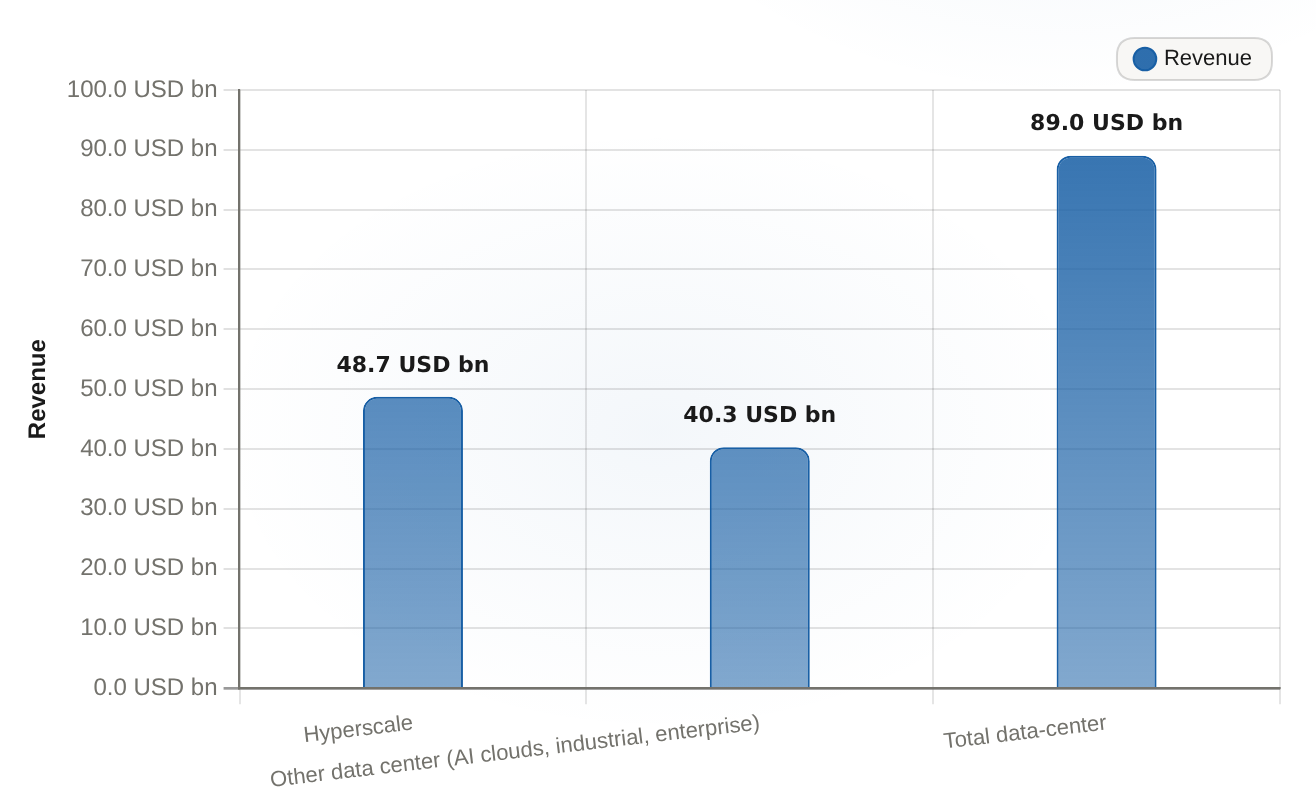
NVIDIA data-center revenue breakdown, Q2 FY2027 USD billions, GAAP segment basis
NVIDIA data-center revenue breakdown, Q2 FY2027USD billions, GAAP segment basis

Data-center revenue of $89.02bn is the growth engine, split between hyperscale ($48.71bn) and other data center ($40.31bn) on the same GAAP segment basis.

SegmentRevenue (USD bn)
Hyperscale48.71
Other data center (AI clouds, industrial, enterprise)40.31
Total data-center89.02
That concentration is worth sitting with before the headline numbers turn into a story. Within data center, hyperscale customers — the biggest cloud operators — accounted for $48.71 billion, with the rest, roughly $40.31 billion, coming from AI clouds, industrial, and enterprise buyers. Strip out the 117% growth and the year-earlier data-center figure was running near $41 billion a quarter. Most of that surge sits on the Blackwell Ultra ramp and the early full-production rollout of the Vera Rubin platform, deployed across Google Cloud, Microsoft Azure, Oracle Cloud Infrastructure, CoreWeave, and Nebius.
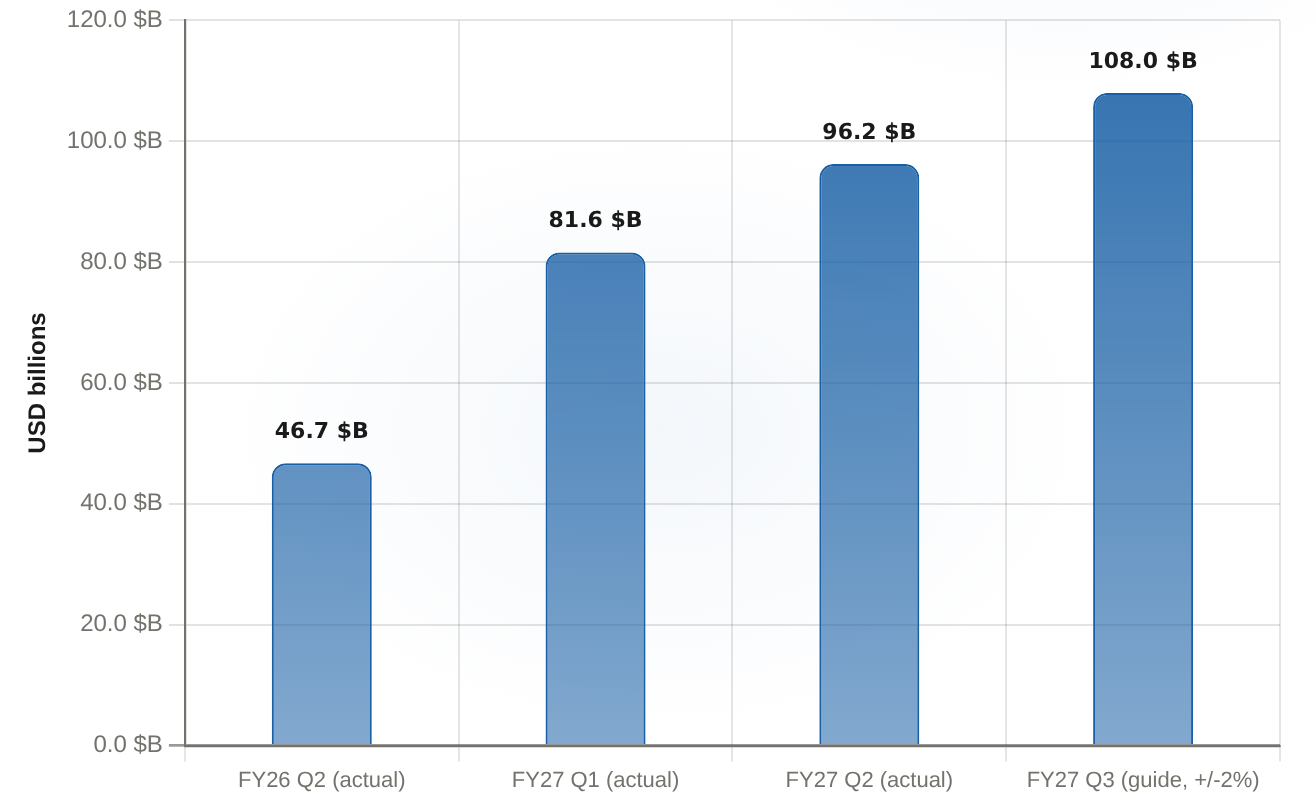
NVIDIA quarterly total revenue, FY26 Q2 to FY27 Q3 guide USD billions
NVIDIA quarterly total revenue, FY26 Q2 to FY27 Q3 guideUSD billions

NVIDIA total revenue nearly doubled from FY26 Q2 to the FY27 Q3 guide, an accelerating quarterly ramp.

PeriodTotal revenue ($B)
FY26 Q2 (actual)46.74
FY27 Q1 (actual)81.6
FY27 Q2 (actual)96.22
FY27 Q3 (guide, +/-2%)108
The total keeps stepping up — $46.74 billion in FY26 Q2, $81.6 billion in the first quarter of this fiscal year, $96.22 billion in Q2 — and Nvidia guided total revenue for Q3 to roughly $108 billion, plus or minus 2%. On the demand side, that guide is a claim about an AI buildout financed by roughly $725 billion of combined 2026 capex from Amazon, Microsoft, Alphabet, and Meta, among others. Jensen Huang distilled the era on the call: "AI has reached its inflection point" and "compute is revenue." Here is where the quarter stops being a pure growth story. The same product cycle that is feeding that revenue is also squeezing how much of it Nvidia keeps. Gross margin — the share of each sales dollar Nvidia keeps after paying for the chips and memory in its systems — was 75.0% in Q2 on a non-GAAP basis. Management expects it to fall to about 74% in Q3, then bottom at a 71%–72% floor in Q4 FY2027 on memory cost flow-through, before recovering to 72%–73% through FY2028 as pricing adjusts. That is guidance, not a reported result — but it is management telling investors the near-term constraint is margin, not demand. AI server prices have risen more than 15% in some cases to offset the memory cost, and still margin falls.
The mechanism is worth understanding because it defines the whole trade. Rack-scale Blackwell Ultra and Vera Rubin systems drive the revenue up, but the HBM and memory Nvidia buys to build them flows straight into cost of sales. Nvidia's procurement commitments jumped to $279 billion from $119 billion in the prior quarter, and management says most of it is memory — secured for multi-year Vera Rubin demand. So Nvidia is paying up front, and on current pricing it absorbs that cost faster than the 15%-and-up server price increases claw it back. The result: a leading indicator that the growth is real, but that it is priced through a visibly falling margin until pricing power catches up. The read for someone deciding what to do now is the trade-off, not either number alone. Top-line growth of this magnitude is not translating one-for-one into margin — and by extension not one-for-one into EPS — this cycle. The Q3 guide assumes zero data-center compute revenue from China, with Hopper shipments under 1% of Q2 data-center revenue, so export-control exposure is already stripped out of the base case. That is the variable worth watching as the quarters roll in: whether the guided 71%–72% floor in Q4 actually holds, and whether gross margin resumes its climb toward 72%–73% in FY2028 — a back-half-weighted recovery, not a near-term event. Growth at this pace is not in doubt — Nvidia guides to roughly 70% revenue growth in FY2028. What the guide asks you to accept is that a record quarter comes with a visible, guided cost attached. Demand is not the issue. Whether the margin floor breaks is.

Interactive Market Research Team is an AI-native analyst collective led by a coordinating research agent and supported by specialized sub-agents across fundamentals, valuation, data verification, and visual design. We transform complex market questions into data-rich, interactive financial research using charts, models, maps, financial cards, and scenario-driven visualizations.

Latest Articles

Stay ahead of the market.

Get curated U.S. market news, insights and key dates delivered to your inbox.

Comments


No comments

No comments yet