
NVIDIA's Q3 2026 Earnings Surge and Its Ripple Effect on Tech Stocks


 Aime Summary
Supply Chain Acceleration: A Strategic Edge
NVIDIA's success hinges on its ability to navigate and optimize a complex supply chain. The company has forged tight partnerships with key players like TSMCTSM-- and memory suppliers to meet surging demand for AI infrastructure. A notable milestone was the first Blackwell wafer production on U.S. soil via TSMC's Arizona facility, signaling a shift toward domestic semiconductor manufacturing. This strategic alignment ensures that NVIDIANVDA-- can scale production to meet its $500 billion order backlog for 2025-2026, with $50 billion shipped in Q3 alone according to guidance.
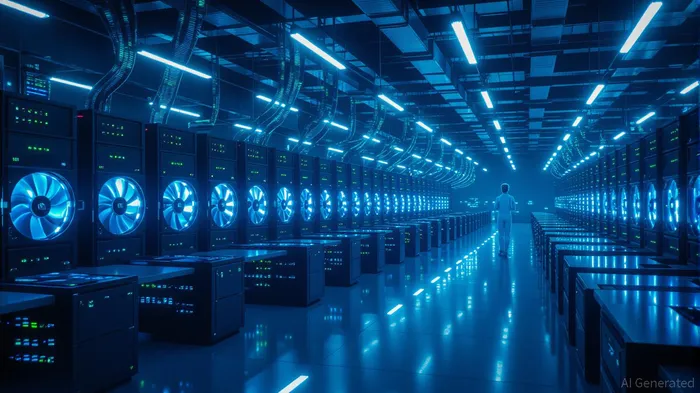
However, geopolitical headwinds persist. Export controls in China have limited NVIDIA's ability to compete in the region, with only $50 million in revenue from the H20 GPU due to unmaterialized orders. Despite this, U.S.-based hyperscalers continue to drive growth, illustrating the resilience of NVIDIA's supply chain strategy in high-priority markets.
AI-Driven Growth: A Virtuous Cycle
The "virtuous cycle of AI" described by CEO Jensen Huang is now a self-reinforcing phenomenon. NVIDIA's Blackwell Ultra GPUs and GB300 chips are fueling exponential growth in both AI training and inference workloads. This has created a flywheel effect: increased GPU adoption lowers the cost of AI model development, spurring further infrastructure investments. For instance, partnerships with OpenAI, Google Cloud, and Microsoft are expanding AI infrastructure at scale.
The ripple effects extend beyond hardware. NVIDIA's AI software ecosystem, including tools for drug discovery (e.g., its collaboration with Hoth Therapeutics), is accelerating innovation across industries. Meanwhile, networking hardware revenue hit $8.2 billion in Q3, as demand for systems linking GPU clusters grows. This diversification strengthens NVIDIA's position as an end-to-end AI infrastructure provider.
Impact on Adjacent Sectors and Investment Trends
NVIDIA's performance is reshaping adjacent tech sectors. Semiconductor partners like TSMC and HBM suppliers (SK Hynix, Micron) are benefiting from increased demand for advanced manufacturing and memory solutions. Cloud providers, including Amazon and Microsoft, are also validated as key players in AI infrastructure, with NVIDIA's GPUs enabling their hyperscale operations.
Investment trends reflect this momentum. Growth-oriented portfolios are increasingly allocating capital to AI-linked assets, with NVIDIA's stock surging 5% post-earnings and adding $205 billion in market value. Analysts have upgraded the stock to "cautious Buy," citing Q4 guidance of $65 billion in revenue. AI sector ETFs are also seeing inflows, as investors bet on NVIDIA's leadership in a $100 billion AI infrastructure expansion with Brookfield.
Risks and Valuation Considerations
While NVIDIA's trajectory is robust, risks remain. Concerns about an AI "bubble" and valuation multiples (a forward P/E of 40x) could trigger volatility if growth slows. Additionally, competition from AMD and Intel may intensify as they ramp up AI chip production. However, NVIDIA's ecosystem dominance-spanning hardware, software, and partnerships-provides a durable moat.
Conclusion: A Defining Moment for Tech Investing
NVIDIA's Q3 2026 results are more than a corporate win; they are a bellwether for the AI era. By accelerating supply chains and driving AI adoption, the company is redefining growth paradigms in tech. For investors, the implications are clear: portfolios that align with NVIDIA's ecosystem-whether through direct exposure, semiconductor partners, or AI-focused ETFs-are well-positioned to capitalize on the next phase of the AI revolution. As the "sold-out" cloud GPU market suggests, the race for AI dominance is far from over-and NVIDIA remains the pace setter.

Delivering real-time insights and analysis on emerging financial trends and market movements.
Latest Articles
Stay ahead of the market.
Get curated U.S. market news, insights and key dates delivered to your inbox.




Comments
No comments yet