
NVIDIA's Q3 2026 Earnings Call: Contradictions Emerge in AI Infrastructure, Blackwell, Rubin, and China Market
 Aime Summary
Date of Call: November 19, 2025
Financials Results
- Revenue: $57 billion, up 62% year over year; record sequential revenue growth of $10 billion, or 22%
- Gross Margin: GAAP gross margin 73.4% and non-GAAP gross margin 73.6%, improved sequentially; Q4 outlook GAAP 74.8% and non-GAAP 75.0% (±50 bps); working to hold mid-70s gross margin into FY2027
Guidance:
- Total revenue for Q4 expected to be $65 billion, ±2% (midpoint implies ~14% sequential growth)
- Q4 GAAP gross margin expected 74.8% and non-GAAP 75.0% (±50 bps); targeting mid-70s gross margins into FY2027
- GAAP operating expenses expected to be approximately $6.7 billion and non-GAAP operating expenses approximately $5.0 billion
- GAAP/non-GAAP other income expected to be ~ $500 million (excludes gains/losses from marketable/public equity securities)
- GAAP/non-GAAP tax rates expected to be ~17% (±1%)
- Outlook assumes no data center compute revenue from China
Business Commentary:
- Revenue and Growth:
- NVIDIA reported
revenueof$57 billionfor Q3, up62%year over year, with record sequential revenue growth of$10 billion, or22%. This growth was driven by strong demand for accelerated computing, powerful AI models, and agentic applications.
Data Center Performance:
- The company's
data center revenuereached a record$51 billion, increasing66%year over year. - Growth was attributed to the GB300 ramp and networking contributions from NVLink scale-up and robust double-digit growth across Spectrum X Ethernet and Quantum X InfiniBand.

- AI Infrastructure and Compute Demand:
- NVIDIA achieved visibility to a
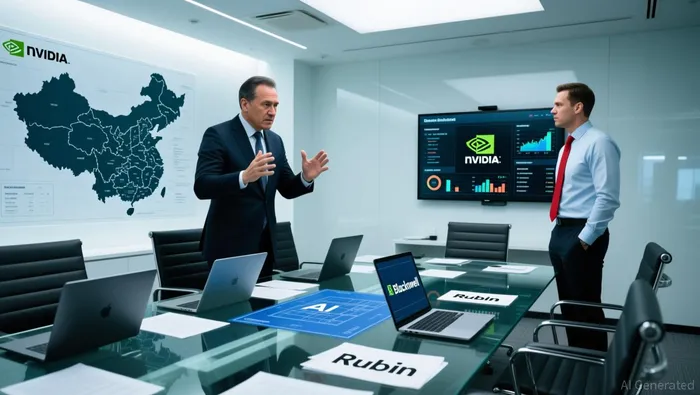
$500 billionBlackwell and Rubin revenue from the start of 2025 through the end of 2026. This is due to high demand for AI infrastructure, as data centers are sold out, and the GPU installed base is fully utilized.
GPU Architecture Advancements:
- The GB300 product contributed roughly two-thirds of the total Blackwell revenue, driving growth in cloud service providers and hyperscalers.
- The Rubin platform is on track to ramp in the second half of 2026, promising X-factor performance improvements relative to Blackwell.
Sentiment Analysis:
Overall Tone: Positive
- Management repeatedly described demand as exceeding expectations: "demand for AI infrastructure continues to exceed our expectations," "the clouds are sold out," and provided quantified strength: revenue $57B, up 62% YoY; record Q3 data center revenue $51B, up 66% YoY; visibility to $500B of Blackwell+Rubin revenue through end of 2026; Q4 guide of $65B.
Q&A:
- Question from Joseph Moore (Morgan Stanley): Are the $500B Blackwell+Rubin parameters still on track given prior $150B shipped and how much upside exists?
Response: Management: Yes — on track for the $500B target; shipped $50B this quarter and expects the number to grow with additional orders (e.g., KSA, Anthropic) providing upside.
- Question from C.J. Muse (Cantor Fitzgerald): Is there a realistic path for supply to catch up with demand over the next 12–18 months or will the shortage extend?
Response: Management: Supply-chain planning with TSMC, packaging, memory partners and ODMs is strong and positions NVIDIA to scale, but meeting surging, multi‑layered demand is complex; they expect to ramp through planning and partner execution.
- Question from Vivek Aria (Bank of America Securities): What NVIDIA content per gigawatt assumptions underpin the $500B, and how much of the $3–4T TAM will need vendor financing?
Response: Management: NVIDIA content per gigawatt rises each generation (Hopper ~20–25, Blackwell ~~30, Rubin higher); most hyperscaler CapEx will be cash-flow funded, while additional agentic AI buildouts will involve diverse financing across countries and industries.
- Question from Ben Ritzes (Melius): How will the expected free cash flow be allocated between buybacks and ecosystem investments and what are the criteria for investments like Anthropic/OpenAI?
Response: Management: Cash will fund growth, maintain a strong balance sheet, continue buybacks, and make strategic ecosystem investments to expand CUDA adoption and secure offtake; investments aim for deep technical partnerships and equity stakes that drive ecosystem expansion.
- Question from Jim Schneider (Goldman Sachs): Where do you see inference as a share of shipments next year and what is Rubin CPX designed for?
Response: Management: CPX is targeted at long‑context workloads (large context ingestion) with strong perf/W and perf/$; inference demand is accelerating but exact share is uncertain — NVIDIA expects inference to be a large market and asserts multi‑year leadership via GB300/Blackwell.
- Question from Timothy Arcury (UBS): What is the single biggest bottleneck (power, financing, memory, foundry) that could constrain growth?
Response: Management: Multiple constraints exist (power, financing, memory, foundry), but they are tractable; NVIDIA emphasizes advanced planning, broad partnerships, and superior perf/watt to mitigate these bottlenecks.
- Question from Stacey Raskin (Bernstein Research): What are the biggest input cost increases, and how should we think about margin and OpEx next year?
Response: Management: Input prices are rising but they plan to hold mid‑70s gross margins via cost improvements, cycle time and mix; OpEx will grow to support engineering and new architecture investments.
- Question from Aaron Rakers (Wells Fargo): Has the view on AI ASICs/XPUs versus GPU architectures changed — will ASICs see real deployments?
Response: Management: The complexity and diversity of AI workloads favor a full‑stack, versatile GPU platform; NVIDIA's CUDA ecosystem, multi‑chip/rack solutions, cloud presence and offtake diversity make GPUs the superior, broadly deployable choice versus single-purpose ASICs.
Contradiction Point 1
AI Infrastructure Demand and Supply Chain Readiness
It highlights the differing expectations regarding the readiness of the supply chain to meet AI infrastructure demand, which is crucial for company growth and market positioning.
Does AI infrastructure have a realistic path for supply to catch up with demand in the next 12–18 months? - C.J. Muse (Cantor Fitzgerald)
2026Q3: We now realize that the demand is probably double what we initially thought and that we probably need to keep investing more and more to meet that. But as I mentioned, we have been preparing for this for some time, and we have been investing a lot more than the initial demand. - Jensen Huang(CEO)
What needs to happen for $2B–$5B in China business shipments? How sustainable is this growth into Q4? - Vivek Arya (Bank of America Securities)
2026Q2: We have a well-planned supply chain with all major technology companies, including TSMC, our memory vendors, and system ODMs. We are prepared for significant growth, driven by the transitions from general-purpose to accelerated computing, generative AI, and agentic AI applications. - Jen-Hsun Huang(CEO)
Contradiction Point 2
Hopper Shipments and Blackwell's Impact
It involves differing statements about Hopper's contribution to data center growth, which could impact revenue expectations.
What is the primary bottleneck constraining NVIDIA's growth: power, financing, memory, or foundry capacity? - Timothy Arcuri (UBS)
2026Q3: Blackwell will continue to be the lion's share of data center growth in Q3. Hopper is still being sold but is expected to be less significant than Blackwell. - Colette Kress(CFO)
How should we allocate the $7 billion Q3 data center growth among Blackwell, Hopper, and networking components? - Stacy Rasgon (Sanford C. Bernstein & Co.)
2026Q2: Hopper is still being sold but is expected to be less significant than Blackwell. - Colette M. Kress(CFO)
Contradiction Point 3
Rubin's Performance Improvement
It highlights differing expectations regarding the performance improvement of the Rubin platform, which could impact product positioning and market expectations.
Can you discuss the Rubin CPX product's impact on the overall TAM considering its target customer applications? - Jim Schneider (Goldman Sachs)
2026Q3: Rubin promises an X-factor improvement in performance relative to Blackwell. - Jensen Huang(CEO)
How does the transition to the Rubin product add incremental capabilities, and is its performance improvement bigger, smaller, or similar to Blackwell? - James Schneider (Goldman Sachs)
2026Q2: Rubin will deliver an order of magnitude improvement in perf per watt for reasoning systems, enhancing revenue generation and AI capability. - Jen-Hsun Huang(CEO)
Contradiction Point 4
China Market Impact and Export Controls
It involves differing statements regarding the impact of export controls on the China market, which could affect revenue projections and investor expectations.
Can you confirm the $500 billion revenue target for Blackwell and Rubin in 2025 and 2026? Is there potential for upside beyond those figures? - Joseph Moore (Morgan Stanley)
2026Q3: The opportunity for more on top of $500 billion exists. - Toshiya Hari(CIO)
Previously mentioned $15 billion China impact vs. $8 billion for H20, which exceeds expectations by $3 billion. How should we model future impacts? - Vivek Arya (Bank of America Securities)
2026Q1: Our Q2 is significantly down due to these controls. - Colette Kress(CFO)
Contradiction Point 5
AI Infrastructure Supply and Demand
It highlights differing perspectives on the ability of the supply chain to meet AI infrastructure demand, which is crucial for production and revenue planning.
Can AI infrastructure supply catch up with demand over the next 12 to 18 months? - C.J. Muse (Cantor Fitzgerald)
2026Q3: We have a well-planned supply chain with all major technology companies, including TSMC, our memory vendors, and system ODMs. We are prepared for significant growth. - Jensen Huang(CEO)
Are there other major GPU cluster investments such as Saudi Arabia and the UAE, and how are these orders affecting Blackwell's lead times and year visibility? - C.J. Muse (Cantor Fitzgerald)
2026Q1: We're losing or giving up $2.5 billion of sales in Q1. We're going to give up $4 to $4.5 billion in Q2. - Colette Kress(CFO)

Discover what executives don't want to reveal in conference calls
Latest Articles
Stay ahead of the market.
Get curated U.S. market news, insights and key dates delivered to your inbox.
AInvest
PRO
AInvest
PRO



Comments
No comments yet