
NVIDIA's Q3 2025 Earnings Report and the Future of AI Hardware Demand


 Aime Summary
The artificial intelligence revolution is no longer a speculative narrative-it is a seismic force reshaping global technology markets. NVIDIA's Q3 2025 earnings report, released amid a frenzy of strategic alliances and infrastructure bets, offers a masterclass in how a company can position itself at the epicenter of this transformation. For long-term investors, the report underscores NVIDIA's dominance in AI hardware and its ability to monetize the accelerating shift toward AI-driven computing. Yet, it also raises critical questions about sustainability, competition, and the risks of overreliance on a narrow set of hyperscale clients.
According to a report by , , , . This performance reflects the company's stranglehold on AI infrastructure, as hyperscalers and enterprises race to deploy generative AI capabilities. , NVIDIA's CFO, emphasized that demand for AI hardware "continues to exceed expectations," with customers "transforming their infrastructure to support generative AI"
according to the earnings call transcript. Such statements are not mere corporate optimism; they are backed by concrete commitments.
A multibillion-dollar partnership with Anthropic and Microsoft, for instance, involves NVIDIANVDA-- injecting up to $10 billion into the AI ecosystem while securing $30 billion in Azure compute resources-a transaction that signals both capital allocation discipline and strategic foresight.
The company's long-term vision is equally compelling.
NVIDIA's Blackwell and Rubin platforms, designed for next-generation AI workloads, . This figure alone redefines the scale of opportunity in AI hardware. 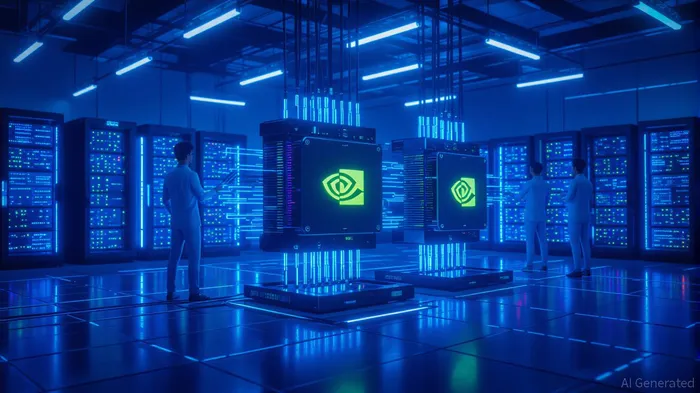 .
.
, NVIDIA's CEO, has repeatedly stressed that the world is "in the early stages of a transition toward AI-driven computing," a claim validated by TSMC CEO C.C. Wei, who described AI demand as "very strong." For investors, this alignment between NVIDIA's product roadmap and industry trends is a rare and powerful catalyst.
However, the path forward is not without risks. .
As noted in the earnings preview, NVIDIA's growth is heavily dependent on a "limited set of hyperscaler customers." While this focus has driven exceptional margins and scalability, it also exposes the company to shifts in client priorities or regulatory scrutiny. Long-term investors must weigh this against NVIDIA's ability to diversify into adjacent markets, such as autonomous vehicles or edge computing, though the current emphasis remains firmly on AI.
Another critical factor is the competitive landscape. NVIDIA's leadership in AI chips is unchallenged for now, but rivals like AMD and Intel are investing aggressively.
, while seemingly paradoxical, reflects a broader industry trend: collaboration to secure supply chains and shared infrastructure. This dynamic could either solidify NVIDIA's dominance or erode its margins as competitors catch up. For now, the latter appears unlikely, given the Blackwell and Rubin platforms' technical superiority and the time required for alternatives to scale.
Looking ahead,
suggests confidence in maintaining its trajectory. Yet, investors should remain vigilant about macroeconomic headwinds, such as interest rate volatility or slowing cloud spending, which could dampen demand. , if confirmed, would further entrench its role in shaping AI's future but also raise questions about return on capital.
In conclusion, NVIDIA's Q3 2025 report is a testament to its strategic acumen in capitalizing on the AI boom. For long-term investors, the company's ability to monetize infrastructure demand, secure high-margin partnerships, and innovate at scale presents a compelling case. However, the concentration of revenue streams and the inevitability of competitive responses mean that vigilance is essential. As the AI era unfolds, NVIDIA is not just a beneficiary-it is a builder of the new paradigm. The question for investors is not whether AI will reshape technology, but whether NVIDIA can sustain its leadership in a world where the stakes have never been higher.

Stay ahead of the market.
Get curated U.S. market news, insights and key dates delivered to your inbox.




Comments
No comments yet