
NVIDIA's Q3 2025 Earnings Performance and Market Reaction: AI Hardware Leadership and Growth Sustainability in a Cooling Tech Cycle


 Aime Summary
NVIDIA's Q3 2025 earnings report, released on November 19, 2025, has ignited intense debate about the sustainability of its AI-driven growth amid signs of a broader tech industry "cooling cycle." The company
, far exceeding Wall Street's expectations, . This performance underscores NVIDIA's dominance in the AI semiconductor market, where
. However, as the broader tech sector faces volatility and questions about overvaluation, investors must weigh NVIDIA's leadership against emerging risks.
AI Hardware Leadership: Blackwell and Hopper Fuel the Fire
NVIDIA's Q3 success hinged on its Blackwell and Hopper platforms, which delivered record-breaking performance gains. The Blackwell GPU, in particular,
on large language model benchmarks compared to its predecessors. CEO emphasized that Blackwell sales were "off the charts," with
major deployments by like SoftBank and xAI. These platforms are not just about raw compute power; they also
address , . This dual focus on performance and sustainability
positions NVIDIA to capitalize .
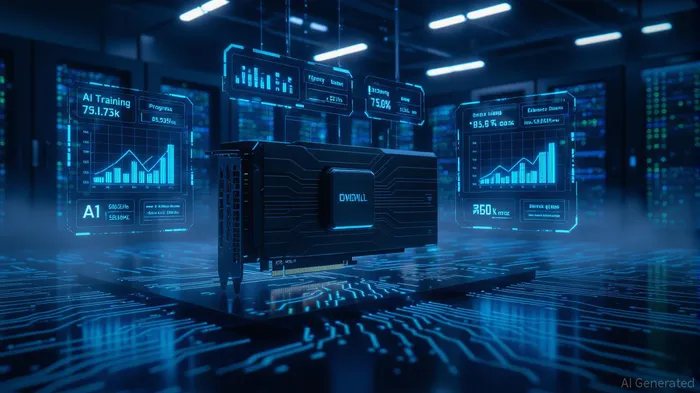
Analysts have responded with upgraded forecasts.
Bank of America reiterated a "buy" rating, citing "surging demand for artificial intelligence processing power," while BNP Paribas Exane and Stifel raised price targets.
The company's forward guidance , sparking speculation about a potential peak in AI spending. Yet, even a conservative forecast reflects the scale of NVIDIA's dominance:
its data center division alone is expected to capture half of all AI infrastructure spend.
Growth Sustainability: A Cooling Cycle or a Supercharged Supercycle?
The broader tech industry is at a crossroads. While NVIDIA's AI hardware business thrives,
, signaling investor caution. , raising questions about whether its success is a one-off or part of a longer-term trend.
The AI semiconductor sector itself is undergoing a transformation.
AI chips, , . The , critical for AI accelerators,
. However,
this growth is constrained by supply bottlenecks, including fragile supply chains for gallium and germanium used in GaN devices. NVIDIA's ability to navigate these challenges-through strategic partnerships and vertical integration-will be key to sustaining its momentum.
Competitors like AMD and Intel face an uphill battle. While they are making incremental gains in the AI chip market,
NVIDIA's ecosystem of software, tools, and partnerships (e.g., with Microsoft and Anthropic) creates a formidable moat.
in U.S. CHIPS Act facilities highlights the capital intensity of the sector, but production lead times remain a hurdle. For now,
NVIDIA's Blackwell and Rubin platforms .
Risks and Realities: Overvaluation or Overconfidence?
Despite the bullish narrative, risks loom.
NVIDIA's reliance on a concentrated group of hyperscaler customers-such as Microsoft, Amazon, and Google-exposes it to demand volatility. Additionally,
the company's balance sheet is under pressure from major AI deals, including a reported $100 billion investment in OpenAI. These commitments could strain liquidity as the industry faces a potential correction.
The broader tech sector's growth in Q3 FY26. However,
the Magnificent 7's dominance . tech revenue) raises concerns about systemic overvaluation. For NVIDIANVDA--, the challenge will be to diversify its revenue streams beyond AI while maintaining its leadership in a market that could face regulatory scrutiny or supply shocks.
Conclusion: A Leader in a High-Stakes Game
NVIDIA's Q3 2025 results reaffirm its position as the undisputed leader in AI hardware. Its platforms, coupled with a focus on energy efficiency, have positioned it to capitalize on the AI infrastructure boom. Yet, the broader tech industry's cooling cycle-marked by Nasdaq volatility and supply chain fragility-introduces uncertainty. For investors, the key question is whether NVIDIA can sustain its growth trajectory while addressing these risks. The answer may lie in its ability to innovate beyond AI, expand into adjacent markets (e.g., , robotics), and navigate the geopolitical and economic headwinds shaping the semiconductor landscape.

Stay ahead of the market.
Get curated U.S. market news, insights and key dates delivered to your inbox.
AInvest
PRO
AInvest
PRO



Comments
No comments yet