
Nvidia Q2 Earnings: Data Center Misses on China Absence


On August 27 after the U.S. market closed, NvidiaNVDA-- reported results for fiscal Q2 2026 (April 28 – July 27, 2025). All eyes were on its data center business, which fell short of expectations because no H20 chips were sold to China during the quarter.

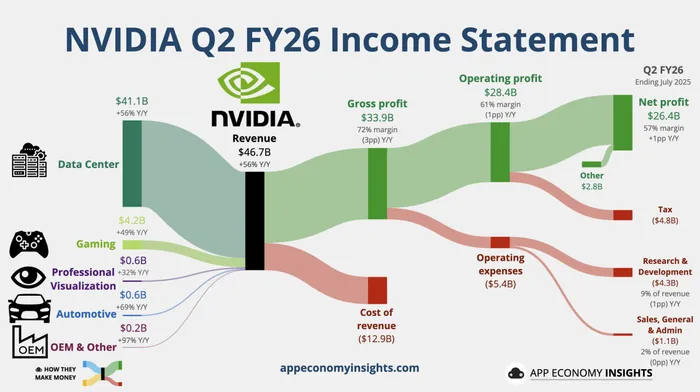
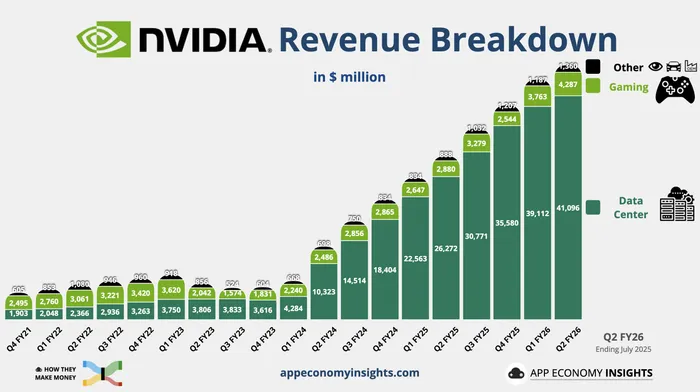
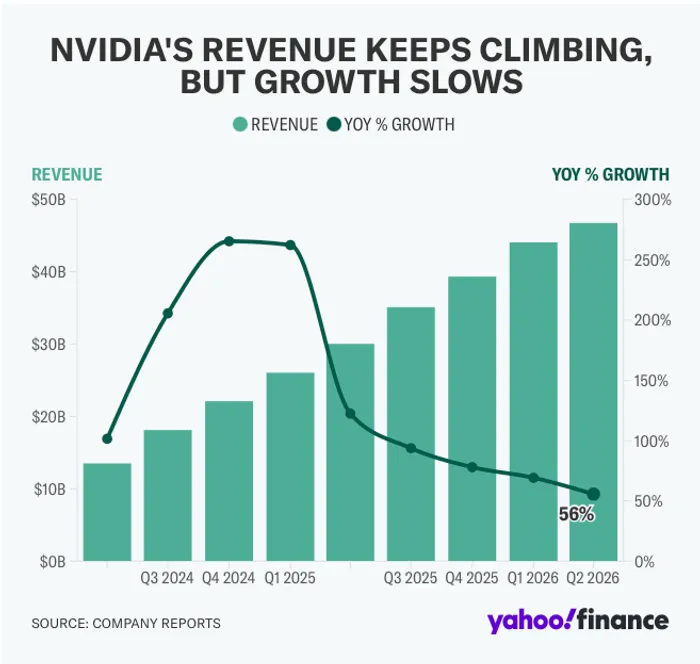
Nvidia’s Q2 revenue came in at $46.74 billion, up 56% year over year, beating analysts’ expectations of $46.23 billion. However, data center revenue—the most closely watched metric—was $41.1 billion, up 56% but slightly below the $41.3 billion consensus.
Gaming and professional visualization revenue exceeded forecasts, while automotive and robotics came in below expectations.
On a non-GAAP basis, adjusted EPS was $1.05, up 54% from a year ago and ahead of analysts’ forecast of $1.01.
For guidance, Nvidia projected Q3 revenue between $52.92 billion and $55.08 billion, with a midpoint of $54 billion, slightly above the $53.46 billion consensus. Gross margin guidance was 73–74%, in line with the 73.4% market estimate.
On capital returns, Nvidia’s board approved a $60 billion increase to its stock repurchase program, with no expiration date.
Revenue growth remains strong, though the year-over-year growth rate has been gradually slowing—a natural development.
Following the report, Nvidia shares fell more than 3% after hours.
Nvidia Missed China in Q2 — But Could Return in Q3
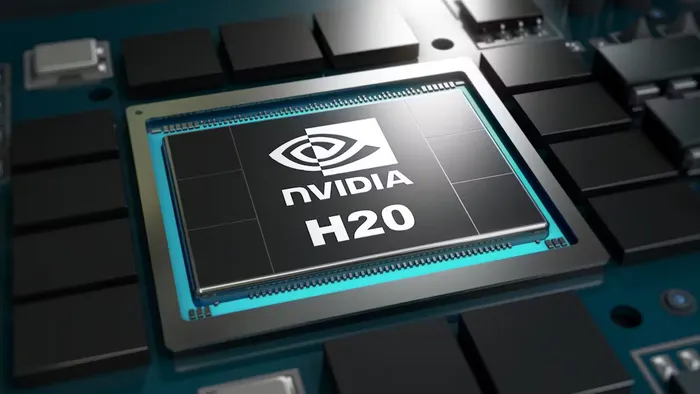
Nvidia confirmed it did not sell any H20 chips to Chinese customers in Q2, though $180 million of prior H20 orders were recognized. Additionally, $650 million in H20 revenue came from a non-China customer.
Importantly, Nvidia’s Q3 revenue guidance does not include any assumptions for H20 exports to China. But the Chinese market is too large to ignore. Should Nvidia resume sales in Q3, the current guidance would look conservative and likely be handily beaten.
On the earnings call, CEO Jensen Huang emphasized that China’s AI chip market is worth at least $50 billion, growing at an annualized rate of up to 50%, second only to the U.S. He praised leading Chinese AI models such as DeepSeek, Qwen, and Kimi.
Nvidia aims to sell newer, stronger chips to China, including the upcoming B30A, which outperforms the H20. Samples could be ready as early as September.
The company also disclosed it has received initial H20 export licenses and maintains supply readiness. If U.S.–China approvals proceed, Nvidia could export $2–5 billion worth of H20 chips.
Nvidia Earnings Call Highlights: AI Infrastructure and Sovereign AI
Management highlighted that in the AI era, energy supply is the key bottleneck—“tokens per megawatt” determines customer revenue. Nvidia claims to deliver the strongest performance-per-watt globally.
For example, customers spending $3 million on Nvidia GB200 infrastructure can generate $30 million in token revenue—something no competitor can match. This makes Nvidia the default choice for cloud service providers. OpenAI, the world’s largest unicorn, remains a core client.
By product, Blackwell revenue rose 17% QoQ, hitting a record high and positioned as the main growth driver in Q3. GB300 production is ramping smoothly at around 1,000 racks per week, with CoreWeaveCRWV-- preparing to deploy GB300 instances.
Over the next five years, Nvidia expects to share in $3–4 trillion of AI infrastructure investments, capturing roughly 35% of the ~$50–60 billion per gigawatt AI factory spend.
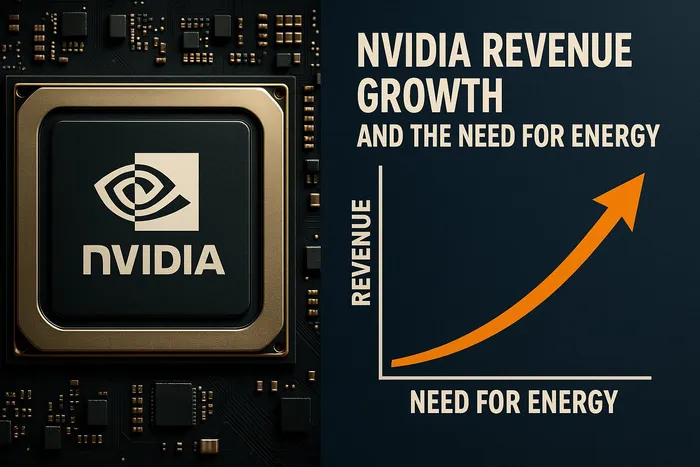
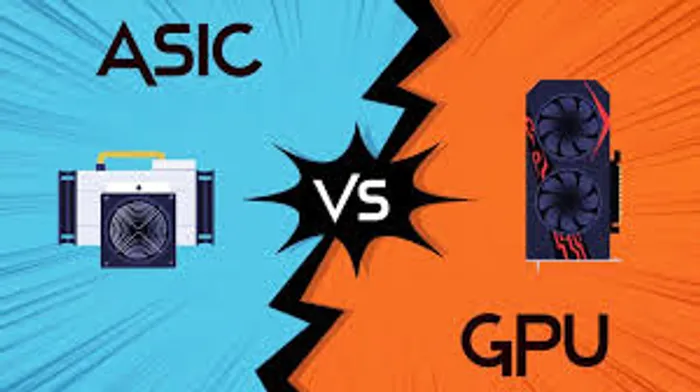
Jensen Huang dismissed ASIC competition as “not a threat,” stressing that Nvidia delivers full systems, not just chips. All major AI frameworks support Nvidia, making it the rational first choice for deploying new model architectures.
By contrast, ASIC-based production at scale remains rare due to software and system complexity.
Another growth driver is sovereign AI. The EU plans to invest €20 billion to build 20 AI factories across France, Germany, Italy, and Spain, including five “super factories,” increasing AI compute infrastructure tenfold.
In the U.K., the Isambard AI supercomputer, built with Nvidia technology, is the nation’s most powerful AI system.
Nvidia expects sovereign AI revenue to exceed $20 billion in 2025, doubling from last year.

Nvidia’s networking business also hit a record $7.3 billion, up 46% QoQ and 98% YoY, fueled by demand for Spectrum-X Ethernet, InfiniBand, and NVLink in AI clusters.
The new Thor robotics platform achieved massive gains in AI performance and efficiency, winning adoption from AmazonAMZN-- Robotics and MetaMETA--.
Finally, gaming revenue reached $4.3 billion, a record high. With expanded supply, the GeForce RTX 5060’s powerful performance, advanced ray tracing, and neural rendering have been widely embraced by global gamers.

Expert analysis on U.S. markets and macro trends, delivering clear perspectives behind major market moves.
Latest Articles
Stay ahead of the market.
Get curated U.S. market news, insights and key dates delivered to your inbox.




Comments
No comments yet