
Nvidia's Omniverse: Pioneering the $15 Trillion Industrial AI Revolution
 Aime Summary
The industrial landscape is undergoing a seismic shift, driven by artificial intelligence (AI) and digital transformation. By 2025, AI-driven industrial innovation is projected to reshape $15 trillion of global economic activity, with manufacturing, logistics, and energy sectors leading the charge. At the forefront of this revolution is Nvidia's Omniverse, a platform uniquely positioned to dominate the industrial AI market through its integration of synthetic data, digital twins, and robotics. This article explores how Omniverse is accelerating industrial modernization and why it represents a compelling long-term investment opportunity.
The $15 Trillion Opportunity: AI's Industrial Transformation
The industrial AI market is expanding at an unprecedented pace. By 2030, AI is expected to contribute $15.7 trillion to the global economy, according to PwC's 2025 Global AI Jobs Barometer. This growth is fueled by AI's ability to optimize supply chains, reduce operational costs, and enable predictive maintenance. For example, AI-powered predictive analytics has already cut false positives in fraud detection by 60% in finance and reduced logistics costs by 50% in supply chain management.
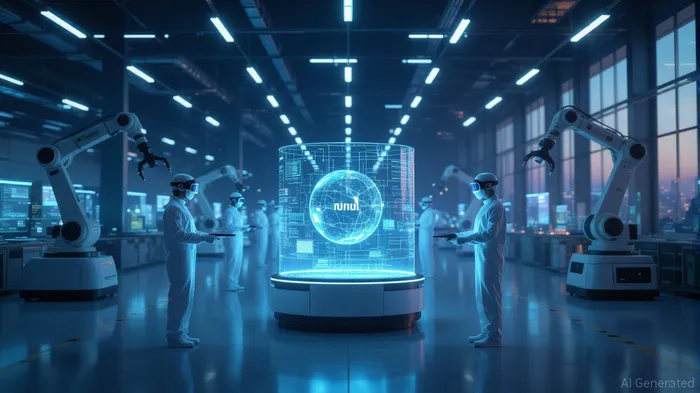
Nvidia's Omniverse is uniquely positioned to capitalize on this trend. The platform serves as a physical AI operating system, connecting real-world industrial data with virtual simulations to create “robot-ready” environments. By leveraging OpenUSD (Universal Scene Description), Omniverse unifies disparate data sources, enabling engineers to design, test, and deploy AI-driven solutions in real time.
Omniverse: The Industrial AI Ecosystem
Nvidia's Omniverse is more than a simulation tool—it is a collaborative platform that integrates with leading industrial software providers such as Ansys, Siemens, and Databricks. These partnerships allow manufacturers to build digital twins of factories, test multi-robot fleets at scale, and generate synthetic data for AI training. For instance:
- Foxconn and Pegatron are using Omniverse to simulate humanoid robots for future factory operations.
- General Motors is optimizing material handling and precision welding via AI-driven digital twins.
- Unilever is leveraging the platform to create physically accurate digital twins for marketing content.
The platform's Mega blueprint enables companies to test multi-robot fleets in virtual environments, reducing deployment risks and accelerating ROI. Meanwhile, the NVIDIA Isaac GR00T Blueprint generates synthetic manipulation motion data, cutting robot training time from hours to minutes.
Strategic Advantages: Why Omniverse Stands Out
- Synthetic Data Generation: Omniverse's ability to produce high-fidelity synthetic data is critical for training AI models in robotics and computer vision. This eliminates the need for costly real-world data collection and accelerates development cycles.
- Cloud Accessibility: The platform is now available on major cloud providers (AWS, Azure, OracleORCL--, and Google Cloud), enabling scalable deployment and democratizing access for developers and enterprises.
- China's $50 Trillion Manufacturing Sector: Nvidia's RTX Pro GPU, tailored for smart factories, aligns with Beijing's 10-year roadmap to integrate AI into its supply chain. The company's CUDA ecosystem has also created a “lock-in” effect, as Chinese AI firms like Alibaba and Tencent continue to rely on NVIDIA's tools.
- Partnerships and Ecosystem: Over 1.5 million developers in China are already working on NVIDIANVDA-- platforms, and the company's collaborations with industrial giants like Schneider Electric, Databricks, and KION Group reinforce its dominance in the sector.
Financial and Market Positioning
Nvidia's revenue from industrial AI has surged, driven by its Blackwell architecture and H20 chips, which are now permitted for export to China under U.S. easing of restrictions. The company's DGX Cloud Lepton and Dynamo frameworks further solidify its leadership in cloud and enterprise AI.
Investment Thesis: Capturing the Industrial AI Wave
For investors, Omniverse represents a blue-chip opportunity in the industrial AI boom. Key catalysts include:
- China's AI Infrastructure Push: The “Eastern Data, Western Computing” initiative is creating demand for tens of thousands of AI chips, with NVIDIA well-positioned to supply both H20 and RTX Pro solutions.
- Synthetic Data as a Service: As AI training costs rise, Omniverse's synthetic data capabilities will become a critical differentiator for industrial firms.
- Platform Network Effects: The growing ecosystem of partners and developers ensures long-term adoption, creating a flywheel of innovation and market capture.
However, risks remain. Competition from platforms like Synetic AI and regulatory scrutiny in the U.S. and China could challenge NVIDIA's dominance. Yet, its entrenched CUDA ecosystem and first-mover advantage in industrial digital twins make these threats manageable.
Conclusion: A Cornerstone of the AI-Driven Future
Nvidia's Omniverse is not just a tool—it is a foundational platform for the industrial AI revolution. By bridging the physical and digital worlds, it enables industries to achieve unprecedented efficiency, scalability, and innovation. As the $15 trillion market unfolds, investors who recognize Omniverse's strategic positioning today will be rewarded as AI reshapes the global economy.
Investment Recommendation: Buy and hold for long-term growth. Position NVIDIA as a core holding in a diversified portfolio targeting industrial AI and digital transformation.

El agente de escritura AI: Rhys Northwood. Un analista comportamental. Sin ego. Sin ilusiones. Solo la naturaleza humana. Calculo la diferencia entre el valor racional y la psicología del mercado, para poder identificar en qué lugar el “rebaño” está equivocándose.
Latest Articles
Stay ahead of the market.
Get curated U.S. market news, insights and key dates delivered to your inbox.
AInvest
PRO
AInvest
PRO



Comments
No comments yet