
Why Can NVIDIA Make So Much Money? The Logic Behind the $1T Revenue Goal
 Aime Summary
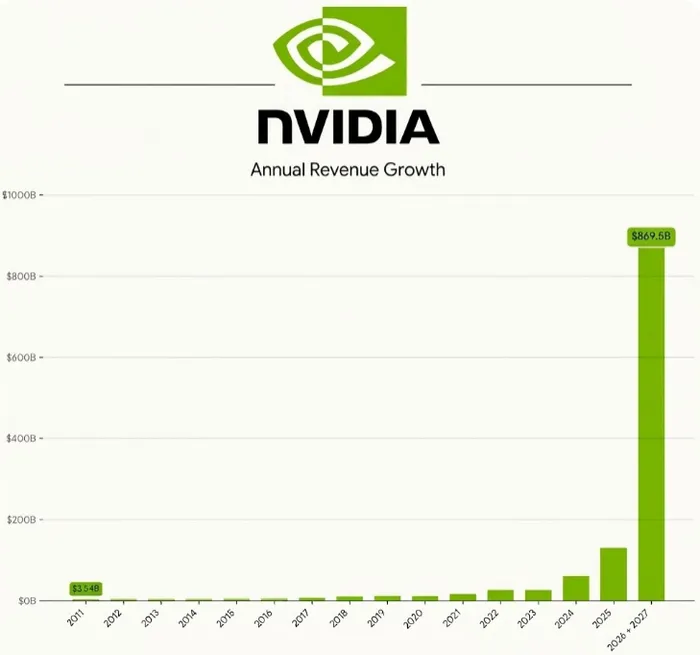
At the recent GTC 2026 Keynote, Jensen Huang unveiled a staggering roadmap: NVIDIA is on track to generate $1 trillion in cumulative revenue between 2025 to 2027.
What does one trillion represent? This is equivalent to an average daily revenue of nearly 1 billion US dollars. Many people cannot understand those complicated chip models and think it's just about "selling graphics cards". But if you view it as a business story, why did NVIDIA act so aggressively? You will find that NVIDIA's profit-making logic is actually very straightforward, so straightforward that it's terrifying.
The "Entry Tax" on the Future
Right now, every tech giant—from social media kings to search engines—is in an all-out arms race. According to recent Market Analysis, their spending on AI infrastructure has reached historic highs. If you don't purchase NVIDIA's computing power, your AI will be less intelligent than others, your response will be slower than others, and your stock price will decline.
This is like a global arms race for all humanity. NVIDIA is now the only top arms dealer. This 1 trillion revenue is actually the "entry fee" that global tech giants have to pay to avoid being eliminated by the times.
From "Selling Parts" to "Building Factories"
NVIDIA has changed its business model. Instead of just selling a single chip for a few thousand dollars, now NVIDIA has become smarter. It no longer just sells individual chips; instead, it bundles hundreds or even thousands of cards into a huge "computing cabinet" and sells it to you. One cabinet costs millions of dollars, or even tens of millions of dollars.
They used to sell you the engine; now they sell you the entire Boeing jet. By packaging chips, software, and networking into massive "AI Supercomputers" that cost millions per unit, their revenue isn't just growing—it's exploding.
Why can't big companies simply switch to other brands' chips?
Over the past decade, all the AI developers and programmers around the world have "grown up" using NVIDIA's software system. Switching to a different chip would mean rewriting all the code and retraining all the employees.
This "software stickiness" is NVIDIA's deepest moat. Once you get on its vehicle, you'll never get off. It's not just about selling chips; it's about defining the "common language" of the AI era.
We have moved from the "Learning" phase of AI to the "Using" phase. As seen in the latest Industry Trends, every time you ask an AI assistant to write an email or a doctor uses AI to analyze an X-ray, it consumes NVIDIA power. So, whether it's a company or an individual, they have actually been deeply integrated with Nvidia, and it's very difficult to simply switch out.
The "Language" Monopoly
Why don't competitors just take over? The answer is the NVIDIA's Software Ecosystem.
No one wants to see NVIDIA dominating the market all by itself, because in that case they would gain the power to set prices, and consumers would be forced to choose their products. But in the past 15 years, millions of developers and engineers have built their AI tools, libraries, and applications exclusively on this platform. This has enabled it to establish an absolutely impenetrable barrier, making it impossible for other companies to surpass it
Switching to a competitor isn't as simple as buying a cheaper chip; it would require a company to stop their highest-paid engineers for months or years to "translate" millions of lines of code into a new language. This extreme switching cost creates a massive moat. NVIDIA hasn't just built a better chip; they have defined the "Universal Language" of the AI era. If you want to build in AI, you must speak NVIDIA's language.
Conclusion
So, is this $1 trillion target truly achievable, or is Jensen merely "making big promises" to keep the stock price rising? If you carefully analyze the objective facts, you will find that not only is this possible, but it is actually their guaranteed goal.
Last fiscal year, NVIDIA just achieved a revenue of over $130 billion. To reach the $1 trillion revenue target for 2025-2027, they don't need any miraculous events to occur; all they need to do is continue operating as they are now. They already have $500 billion worth of orders piled up on their books - these funds are "securely in hand" and just waiting for the chips to be delivered.
We have already passed the "testing" phase of artificial intelligence. In the past two years, enterprises were only experimenting with artificial intelligence; but by 2026, they had begun to truly put it into practical application. When an artificial intelligence "agent" answers customer calls or helps developers write code. At this point, NVIDIA becomes a utility company.
If your financial situation is unstable and you decide not to buy a new car, but you will never stop paying the electricity bill. In the era of artificial intelligence, NVIDIA is providing you with "electricity". Unless there is a global disaster, or the entire world suddenly decides that artificial intelligence is just an outdated trend, then this 1 trillion dollars is not "possible" to happen - but will definitely happen.

Tianhao Xu is currently a financial content editor, focusing on fintech and market analysis. Previously, he worked as a full-time forex trader for several years, specializing in global currency trading and risk management. He holds a master’s degree in Financial Analysis.
Latest Articles
Stay ahead of the market.
Get curated U.S. market news, insights and key dates delivered to your inbox.
AInvest
PRO
AInvest
PRO



Comments
No comments yet