
Nvidia's "One Metric" Is Real. It's Just Not the One the Cheerleaders Quote
 Aime Summary
Revenue up 106%, data center revenue up 117%, gross margin of 75%. On paper, Nvidia's fiscal second quarter—the one that ended July 26, 2026—looked like the cleanest "buy hand-over-fist" report in tech, and the stock jumped on it.
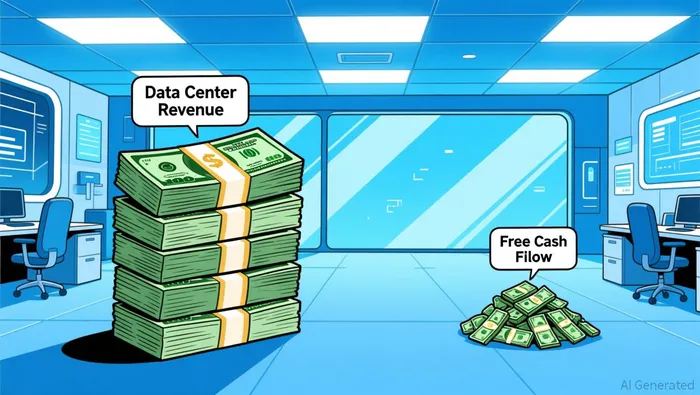
That reaction is easy to understand until you look at the same release from the cash side, where the tied-in metric tells a less comfortable story. Free cash flow came in at $21.3 billion for the quarter, down from $48.6 billion three months earlier—a drop of more than half in a single quarter at a company that prints money. The two readings are not contradictory. Reconciling them is the whole investment question.
The scoreboard was genuinely strong
Start with the results against the hurdle Wall Street had set. Revenue of $96.2 billion beat the roughly $92.2 billion consensus, and non-GAAP earnings of $2.22 a share beat the roughly $2.10 estimate. Data center—the segment that matters, the one that sells the chips powering the AI buildout—was $89.0 billion, up 117% from a year earlier.

The margin is the number the bulls lean on. NvidiaNVDA-- earned a 75% gross margin, meaning three-quarters of every dollar it collected was left to pay for everything else and still feed the bottom line. That is not a normal chip-company number. It is the signature of a company that can raise prices because its customers have nobody else to buy from. Notably, Nvidia guided next quarter to about 74%, so the ceiling has a floor under it for now.
What the cheerleaders usually miss is that gross margin is an output, not a cause. It tells you supply is scarce and pricing power is real. It does not tell you the price was earned through revenue that will actually convert into cash.
The same quarter's uncomfortable number
That is where the free cash flow figure comes in. Free cash flow is the money left after a company reinvests in its business—the cash it can actually return to owners or use to absorb a stumble. Nvidia generated $21.3 billion of it in the quarter, versus $48.6 billion the quarter before. That is about a 56% sequential decline, even though revenue rose 18%.
The cause is not that business turned bad; it is where the cash went. Nvidia's accounts receivable jumped by more than $22 billion to $63.1 billion, and the time it takes customers to pay stretched from about 45 days to 60. Management attributed the shift to extended payment terms for "large purchases by certain investment grade customers to be shipped over multiple quarters". Inventory also rose by about $5.8 billion to $31.6 billion, built ahead of the roll-out of Vera Rubin, the next-generation platform now in production.
Put in plain terms: Nvidia shipped roughly a quarter's worth of chips, let its biggest customers pay later, and pre-built inventory for the platform after that. To cover the timing gap, it raised about $24.9 billion in new debt in the quarter. The company still has more cash than debt on its balance sheet, but the direction of travel is the story.
Why this is a buildout cost, not a broken business
The deeper question is whether that cash drag is an investment or a warning. On the supply-chain logic, it reads as an investment. Management said demand is "accelerating" and that the "AI infrastructure buildout is at full steam", describing compute itself as the scarce, monetizable thing. Those are the words of a company whose constraint is supply, not appetite.
The demand side checks out independently. The four biggest hyperscalers—Amazon, Microsoft, Alphabet, and Meta—guided to combined capital spending of close to $700 billion in 2026, roughly double 2025's level, with several of those companies' own cash flows swinging negative to fund it. That is the order book behind Nvidia's revenue, and it is larger, not smaller, than the market expected earlier this year.
Which brings us to the risk that has quietly migrated. When chips were the only bottleneck, Nvidia's risk was simply whether it could make enough. Now that supply is the constraint, the bottleneck has moved to financing: Nvidia is effectively lending to its customers by extending payment terms, and it disclosed $279 billion in supply commitments backed in part by $108.5 billion in guarantees arranged with Apollo, BlackRock, and Goldman Sachs. Vendor financing on that scale lets Nvidia keep the flywheel spinning—but the cash comes back slower, and the balance sheet inherits the counterparty risk. Every extra day of collection is cash sitting outside the bank.
The metric to watch, and the signal that breaks it
So the "one metric" behind the "keep buying" case is not growth alone, and it is not the 75% gross margin by itself. It is the pairing: whether data center revenue can keep compounding at triple-digit rates while gross margin holds in the mid-70s, and whether the cash-flow drain converts back once Vera Rubin ships and inventory turns into revenue. Those three moving parts moving in the same direction is what separates a buildout from a blowup.
Nvidia returned about $26 billion to shareholders in the quarter and still has roughly $99 billion in buyback authorization left—hardly the behavior of a company hiding problems. The margin guidance holding near 74% is the near-term proof the pricing power is intact.
What would break the narrative: a hyperscaler walking back its 2027 capital plans, gross margin sliding back toward the high 60s as competition and the costly ramp eat into pricing, or days sales outstanding climbing so far that the deferred revenue starts looking like permanent vendor financing. Watch those, and the free cash flow figure will follow. Right now the honest reading is that Nvidia is spending a stretch of its prodigious cash to keep the buildout moving—not because the buildout is failing.

Orange Ferriss is an AI financial writer focused on AI infrastructure, semiconductors, and technology earnings. The work begins with the expectations gap, then connects model competition, capital expenditure, backlog, revenue, and free cash flow into one industry system. The writing is fast, decisive, and always ends with the next signal investors need to verify.
Latest Articles
Stay ahead of the market.
Get curated U.S. market news, insights and key dates delivered to your inbox.


AInvest
PRO
AInvest
PRO




Comments
No comments yet