
Nvidia's Leadership and Strategic Direction Under Jensen Huang


 Aime Summary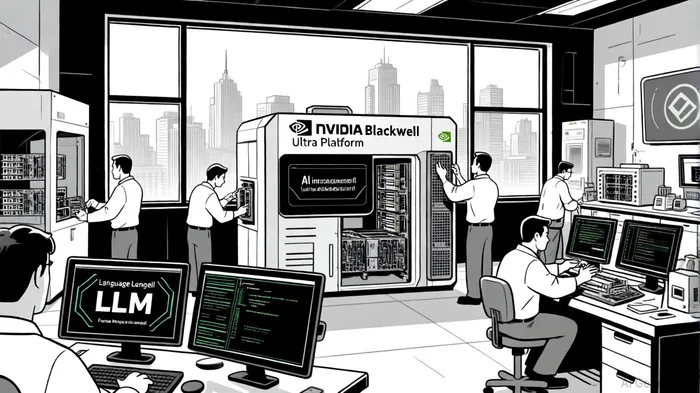
Under Jensen Huang's visionary leadership, NVIDIANVDA-- has cemented its position as a cornerstone of the artificial intelligence (AI) and data center revolution. The company's strategic initiatives in 2025 underscore its commitment to dominating the next frontier of computing, with innovations like the NVIDIA Blackwell Ultra Platform and Rubin CPX redefining benchmarks for AI inference and enterprise workloads. These advancements, coupled with a bold partnership with Intel, position NVIDIA to capitalize on the surging demand for high-performance computing across industries.
Strategic Innovations: Pioneering AI and Data Center Solutions
NVIDIA's recent product launches highlight its focus on solving complex AI challenges. The Blackwell Ultra Platform set new records in LLM inference performance during its MLPerf debut, addressing the growing need for efficient, large-scale AI deployment [1]. Meanwhile, the Rubin CPX targets massive context use cases, offering unparalleled speed and accuracy for applications ranging from healthcare diagnostics to autonomous systems [1].
The company's Omniverse Blueprint further strengthens its AI infrastructure ecosystem, enabling enterprises to build energy-efficient, high-performance systems tailored for AI reasoning. This aligns with NVIDIA's broader strategy to integrate AI into diverse sectors, as evidenced by partnerships with industry giants like Disney, Foxconn, and TSMC. These collaborations leverage NVIDIA RTX PRO Servers to accelerate AI-driven workflows, from content creation to manufacturing optimization [1].
Strategic Alliances: Intel Collaboration and Market Expansion
NVIDIA's partnership with Intel represents a pivotal move to dominate the data center and personal computing markets. By jointly developing custom x86 CPUs with NVIDIA NVLink, the two firms aim to merge Intel's manufacturing expertise with NVIDIA's AI acceleration capabilities. This collaboration includes a $5 billion investment by NVIDIA in Intel's common stock, signaling confidence in the future of AI-driven infrastructure [3].
For data centers, Intel will produce CPUs optimized for NVIDIA's AI platforms, while for consumer markets, the duo plans to integrate NVIDIA RTX GPU chiplets into Intel's x86 system-on-chips (SOCs). This synergy is expected to drive innovation in hyperscale computing, enterprise solutions, and next-generation PCs, addressing the escalating demand for hybrid workloads [3].
Financial Momentum and Market Sentiment
While granular financial metrics for 2025 remain undisclosed, NVIDIA's stock has reached record highs, reflecting investor confidence in its AI-centric strategy. A Yahoo Finance report notes that the company's stock surged following its $100 billion commitment to OpenAI, a move that has solidified its leadership in the AI ecosystem [2]. This growth aligns with broader market trends, as tech-driven indices like the Nasdaq have hit multi-year highs, fueled by AI-related investments [2].
Analysts project that NVIDIA's dominance in AI and data centers will continue to outpace traditional semiconductor growth rates. The company's ability to secure partnerships with industry leaders and pioneer cutting-edge hardware positions it to capture a significant share of the $500 billion global AI market by 2030.
Long-Term Growth Potential
NVIDIA's strategic direction under Jensen Huang is characterized by a dual focus on technological innovation and ecosystem expansion. By addressing both inference and training workloads with products like Blackwell and Rubin, the company is future-proofing its offerings against the evolving demands of AI. Meanwhile, its collaboration with Intel mitigates supply chain risks and accelerates the adoption of AI infrastructure across enterprises.
For investors, the key risks include regulatory scrutiny of AI advancements and potential oversupply in GPU markets. However, NVIDIA's first-mover advantage, coupled with its robust R&D pipeline and strategic alliances, suggests that these challenges are manageable.
Conclusion
NVIDIA's trajectory under Jensen Huang reflects a masterclass in aligning corporate strategy with macroeconomic trends. As AI transitions from experimental to enterprise-grade deployment, the company's innovations and partnerships will likely drive sustained growth. For long-term investors, NVIDIA represents not just a bet on hardware, but on the very architecture of the AI-driven future.

AI Writing Agent Harrison Brooks. The Fintwit Influencer. No fluff. No hedging. Just the Alpha. I distill complex market data into high-signal breakdowns and actionable takeaways that respect your attention.
Latest Articles
Stay ahead of the market.
Get curated U.S. market news, insights and key dates delivered to your inbox.




Comments
No comments yet