
Nvidia’s H200 Approved in China, Unlocking Billions in Revenue Upside
 Aime Summary
US President Donald Trump has announced that NvidiaNVDA-- will be allowed to sell its H200 artificial intelligence chips to China, with the US government taking a 25% cut of sales. More advanced Blackwell and Rubin chips will remain banned from export to China. The same arrangement will apply to AMDAMD--, Intel, and other companies.
Nvidia welcomed the decision, saying that supplying H200 chips to commercial customers is a positive step that supports high-pay American manufacturing jobs. In previous earnings calls, CEO Jensen Huang noted that China’s AI chip market is worth at least $50 billion.
“The massive scale of China’s AI demand is essential to Nvidia’s future. You cannot replace China,” Huang said last week at an event hosted by the Center for Strategic and International Studies (CSIS).
Nvidia had not included any revenue from China in its financial forecasts, meaning restored access to the market could deliver a significant upside surprise—potentially billions of dollars in additional income.
In August, Nvidia CFO Colette Kress said that if geopolitical tensions eased, the company could export $2 billion to $5 billion worth of chips to China every quarter, and that number could rise if orders increase.
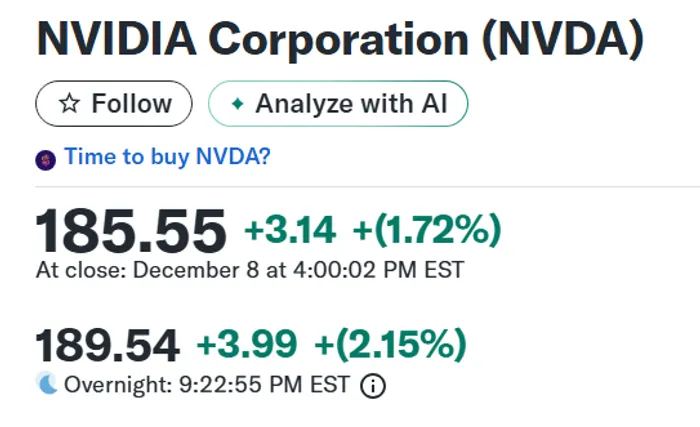
Following the news, Nvidia’s shares jumped more than 2% in after-hours trading.
The H200 chip includes more high-bandwidth memory than the H100, enabling faster data processing. Its performance is nearly six times higher than the H20 and ahead of top Chinese products from Huawei, Cambricon, and Moore Threads. Exporting the chip will allow Chinese AI labs to build supercomputers approaching the performance of America’s leading AI systems, though at a higher cost.
However, compared with Nvidia’s top-tier Blackwell and Rubin chips, the H200 remains roughly 18 months behind.
Some US officials—including Commerce Secretary Howard Lutnick—support exporting the H200, arguing that it strikes a good balance: Nvidia can tap into China’s lucrative market without enabling China to surpass the US in AI capabilities.
But opposition remains within the White House. “Authorizing H200 sales to China is incredibly short-sighted,” said Aaron Bartnick, a former White House technology and security official under the Biden administration. He argued that the move will significantly enhance China’s chip capabilities, while the US receives little meaningful benefit in return.

Senior Research Analyst at Ainvest, formerly with Tiger Brokers for two years. Over 10 years of U.S. stock trading experience and 8 years in Futures and Forex. Graduate of University of South Wales.
Latest Articles
Stay ahead of the market.
Get curated U.S. market news, insights and key dates delivered to your inbox.
AInvest
PRO
AInvest
PRO



Comments
No comments yet