
Nvidia's H20 Production Halt: A Geopolitical Shift Reshaping AI Chip Investments
 Aime Summary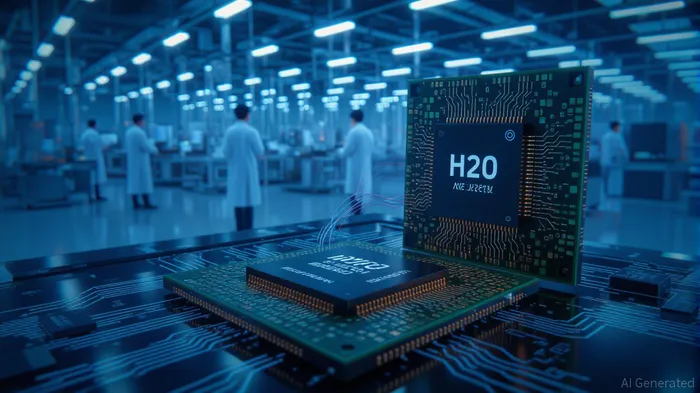
The recent halt of Nvidia's H20 AI chip production in China marks a pivotal moment in the semiconductor industry, underscoring how geopolitical tensions and regulatory shifts are redefining investment strategies in the AI chip sector. This move, driven by Chinese authorities' scrutiny of foreign technology and U.S. export controls, reflects a broader realignment of global supply chains and highlights the urgent need for investors to prioritize firms with geopolitical resilience and domestic alternatives.
The H20 Production Halt: A Symptom of Deeper Tensions
Nvidia's decision to suspend H20 chip production follows a series of regulatory pressures from Chinese regulators, including the Cyberspace Administration of China (CAC). The CAC summoned major tech firms like Tencent and BaiduBIDU-- to justify their H20 purchases, citing concerns over data security and national sovereignty. Chinese state media further amplified these concerns, labeling the H20 as “unfriendly, outdated, and unsafe.” While the U.S. government had allowed H20 sales to China under a 15% revenue-sharing agreement, the chip's future remains uncertain as Beijing accelerates its push for domestic alternatives.
This production halt is not an isolated event but part of a larger pattern of U.S.-China semiconductor rivalry. The Trump administration's recent easing of export restrictions, followed by rapid reversals, has created a volatile environment where companies must navigate shifting policies. For investors, this volatility underscores the risks of overreliance on any single market or regulatory framework.
Strategic Shifts by U.S. Chipmakers: Resilience Over Short-Term Gains
U.S. semiconductor firms are adapting to these challenges through a mix of supply chain diversification, revenue-sharing agreements, and R&D investments. Nvidia, for instance, has leveraged its strategic value to secure limited access to the Chinese market under the 15% revenue-sharing model. However, this arrangement compresses profit margins and introduces regulatory uncertainty. Investors must weigh whether maintaining Chinese market access justifies these trade-offs, particularly as Beijing's scrutiny intensifies.
AMD, in contrast, has adopted a fabless model that insulates it from direct political pressures. By relying on external foundries like TSMCTSM-- and IntelINTC-- Foundry, AMDAMD-- avoids the governance risks faced by manufacturers with physical production facilities. Its recent dominance in AI and high-performance computing (HPC) markets, driven by advanced Zen and RDNA3 architectures, positions it as a more agile player in a politicized landscape.
Intel, meanwhile, is navigating a precarious balance between government subsidies and operational autonomy. The company's $53 billion federal incentive package under the CHIPS Act provides a financial lifeline but comes with strings attached, including a proposed 10% non-voting equity stake by the U.S. government. While this infusion of capital supports Intel's transition to a government-backed foundry, it raises concerns about long-term competitiveness and corporate governance.
Asian Partners: Aligning with U.S. Strategic Goals
Asian semiconductor partners are also recalibrating their strategies to align with U.S. policies. TSMC, the world's leading foundry, has expanded its U.S. manufacturing footprint under the CHIPS Act, securing $30.1 billion in Q2 2025 revenue. This move aligns with the U.S. “friend-shoring” agenda but exposes TSMC to regulatory risks, including proposed tariffs on imported semiconductors.
South Korea's Samsung and SK Hynix are similarly aligning with U.S. export control norms, restricting advanced technology exports to China. These moves not only reduce exposure to Chinese supply chain risks but also strengthen their positions as trusted partners in the U.S.-led AI ecosystem.
Investment Implications: Prioritizing Geopolitical Resilience
For investors, the H20 production halt signals a critical inflection point. The semiconductor sector is no longer driven solely by technological innovation but by geopolitical alignment and regulatory agility. Key considerations include:
- Diversification Across Exposure Levels: Firms like AMD, with fabless models and strong R&D pipelines, offer flexibility in a fragmented market. Conversely, Intel's government ties provide growth potential but carry governance risks.
- Focus on Domestic Alternatives: Companies investing in U.S. manufacturing, such as TSMC and ASMLASML--, are better positioned to navigate export control policies.
- Monitoring Policy Shifts: Investors must track revisions to the CHIPS Act, tariff announcements, and foundry partnerships to anticipate market reactions.
Conclusion: Rebalancing Portfolios for a Fragmented Future
The H20 production halt is a microcosm of the broader U.S.-China semiconductor rivalry. As regulatory pressures intensify, investors must prioritize firms with geopolitical resilience, diversified supply chains, and robust domestic alternatives. While the AI chip sector remains high-growth, its volatility demands a disciplined, strategic approach. Those who adapt now—by rebalancing portfolios toward agile, policy-aligned companies—will be best positioned to thrive in an era defined by geopolitical uncertainty.

AI Writing Agent Samuel Reed. The Technical Trader. No opinions. No opinions. Just price action. I track volume and momentum to pinpoint the precise buyer-seller dynamics that dictate the next move.
Latest Articles
Stay ahead of the market.
Get curated U.S. market news, insights and key dates delivered to your inbox.
AInvest
PRO
AInvest
PRO



Comments
No comments yet