
Nvidia H20 $23B Sales at Risk Amid China Criticism
Bloomberg, citing people familiar with the matter, reported that in recent weeks, Chinese regulators have issued notices to multiple companies — both state-owned and private — requiring them to use domestic alternatives instead of Nvidia’s H20 chips in any work related to national security.
According to one of the sources, Beijing sent formal inquiries to some companies that had ordered H20 chips, asking why they chose Nvidia’s product over Chinese-made versions, whether the H20 was truly indispensable, and whether any security risks had been identified.
Chinese state broadcaster CCTV’s affiliated media outlets also publicly criticized the H20, alleging it carried risks of “tracking and remote shutdown.” They further claimed the chip’s total computing power was only 20% of the standard H100, with an energy efficiency ratio of about 0.37 TFLOPS/W — below the 0.5 TFLOPS/W efficiency benchmark. The commentary concluded: “When a chip is neither green, nor advanced, nor secure, consumers naturally can choose not to buy it.”
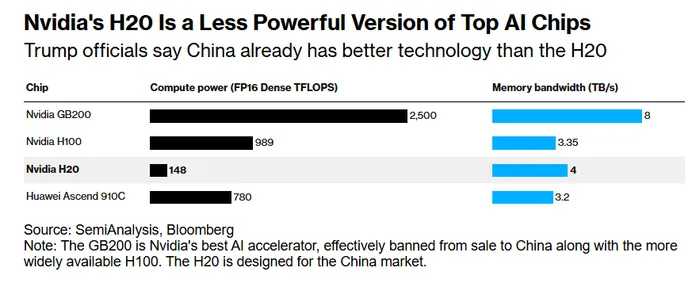
Some Chinese companies are reportedly planning to respond to the inquiries by reducing orders for Nvidia chips.
U.S. Tracking Devices Deepen Chinese Concerns
Separately, Reuters reported that the U.S. government has identified a batch of high-end chips at high risk of being smuggled into China, and secretly embedded tracking devices in them. Some witnesses claimed to have seen pictures and videos showing chip distributors removing the trackers — some as large as a smartphone — from DellDELL-- and Super MicroSMCI-- servers. This revelation further validated China’s security concerns.
Nvidia’s H20 Sales Scale and Replacement Risk
Bernstein analysts estimate that, based on Nvidia’s previous guidance, the company was expected to sell about 1.5 million H20 chips to China in 2025, generating roughly $23 billion in revenue. Given Beijing’s strong opposition, NvidiaNVDA-- may have to significantly cut its revenue forecast.
However, Beijing’s stance is not an outright ban. Many industry analysts believe Chinese companies will still seek H20 chips because they perform exceptionally well in certain AI workloads.
“Chinese firms may not yet be ready to fully shift to domestic alternatives, as local chips still cannot match H20 in some specialized workloads,” said Homin Lee, senior macro strategist at Lombard Odier.
Kevin Cassidy of Rosenblatt Securities added that he does not believe Nvidia’s processor sales to China will be materially impacted because “Chinese companies want the best available chips.” He said Nvidia’s and AMD’s chips remain superior to domestic options.
Cost Implications and Revenue-Sharing Pressure
According to a Biden-era U.S. government estimate, if Chinese companies could not use the H20, the cost of running inference on advanced AI models could rise three- to six-fold.
In addition to a possible sales downgrade, Nvidia and AMDAMD-- have agreed to remit 15% of their China high-end chip sales revenue to the U.S. government. Some scholars in China have suggested imposing a reciprocal 15% levy on the two companies’ China sales in exchange for allowing continued market access.
Antitrust Investigation and Potential Heavy Fines
In December 2024, Chinese regulators announced an antitrust probe into Nvidia, which remains unresolved. Under Chinese law, confirmed violations can result in fines of up to 10% of annual China revenue, or up to five times that in severe cases.
Nvidia generated $10.3 billion in China revenue in fiscal 2024, meaning the maximum fine could reach $5 billion. Given Beijing’s increasingly critical tone toward Nvidia, analysts expect the penalty to be substantial.

Expert analysis on U.S. markets and macro trends, delivering clear perspectives behind major market moves.
Latest Articles
Stay ahead of the market.
Get curated U.S. market news, insights and key dates delivered to your inbox.




Comments
No comments yet