
Nvidia's Geopolitical Tightrope: AI Dominance at a Crossroads
The U.S.-China AI chip rivalry has reached a critical juncture, and no company is at the center of this clash more than Nvidia. As the world's leading supplier of advanced AI hardware, the firm faces an existential balancing act: comply with U.S. export controls aimed at curbing China's technological ambitions while maintaining access to a market that once accounted for nearly 95% of its Chinese GPU sales. CEO Jensen Huang's recent statements and congressional warnings underscore the stakes. This article explores how geopolitical tensions are reshaping Nvidia's strategy, its supply chain, and the investment case for its stock.
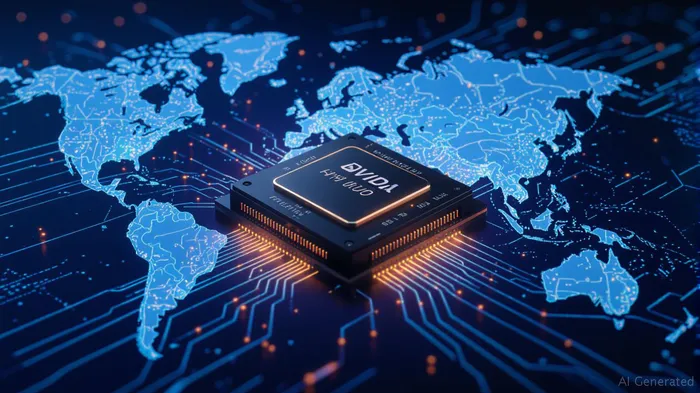
The Huang Doctrine: Adapt or Lose Relevance
Huang's public remarks over the past year reveal a pragmatic acceptance of the new reality. U.S. export controls on advanced chips like the H20 series have indeed not stopped China's AI progress, as he acknowledged in a Computex 2025 keynote. Instead, the restrictions have spurred domestic innovation, with Chinese firms like DeepSeek now offering competitive alternatives. Yet, the cost to NvidiaNVDA-- has been steep: a 50% decline in market share in China and $15 billion in lost annual revenue by Huang's own estimates.
The CEO's response? Redesign. Nvidia is now rolling out chips like the B30 and B40 series, engineered to comply with U.S. export rules while still appealing to Chinese customers. This technical pivot reflects a broader strategy: stay relevant in China without violating U.S. mandates.
Senators Sound the Alarm: A Bipartisan Warning
While Huang navigates the commercial side, U.S. lawmakers are sounding the alarm over the national security risks. Senators Elizabeth Warren (D-MA) and Jim Banks (R-IN) recently warned Nvidia to avoid meeting Chinese firms tied to military or intelligence activities during Huang's planned July trip to Beijing. Their letter, leaked to Reuters, cited concerns that Nvidia's new Shanghai research facility and plans for a lower-cost Blackwell chip could indirectly aid China's military modernization.
The senators' argument hinges on a stark reality: AI hardware is a dual-use technology. While Nvidia insists its technology is meant for civilian applications, U.S. policymakers fear it could accelerate China's capabilities in autonomous weapons or surveillance systems. The bipartisan push for stricter oversight—such as mandatory checks on chip destinations—threatens to further complicate Nvidia's China strategy.
Supply Chain Shifts: Winners and Losers
The geopolitical chessboard is reshaping semiconductor supply chains in two key ways:
1. Diversification beyond China: U.S. export controls have accelerated AI infrastructure investments in Europe, the Gulf States, and India, where Nvidia now commands over 80% market share.
2. Chinese self-reliance: Beijing's $1.5 trillion tech plan aims to reduce reliance on U.S. chips, with firms like Boschung and Horizon Robotics ramping up production of AI-optimized silicon.
For investors, this means Nvidia's growth is increasingly tied to non-Chinese markets. However, its dominance in generative AI training clusters—where its GPUs are still unmatched—gives it a critical edge.
The Investment Thesis: Long-Term Bet with Near-Term Risks
Case for holding NVDA:
- Global AI adoption is accelerating: The $100 billion AI infrastructure market is growing at 25% annually, with Nvidia's software ecosystem (e.g., CUDA) locking in customers.
- R&D moat: Its $10 billion annual R&D budget ensures it stays ahead in chip design and AI software.
Near-term risks:
- Regulatory overreach: Stricter U.S. rules or a Chinese backlash (e.g., tariffs on U.S. chips) could hurt margins.
- Chinese competition: Firms like DeepSeek's DS8000 GPU, which matches H20 performance, threaten long-term pricing power.
Conclusion: Walk the Line, but Stay Invested
Nvidia's ability to thread the geopolitical needle—adapting to U.S. rules while retaining Chinese influence—will determine its trajectory. While the short-term path is fraught with regulatory uncertainty, the long-term opportunity in AI infrastructure remains unmatched. For investors with a 5+ year horizon, Nvidia's dominance in the AI stack justifies its premium valuation. However, those sensitive to near-term volatility should consider hedging with exposure to chipmakers like Intel (INTC) or AI software stocks like Palantir (PLTR).
The bottom line: Nvidia is the Microsoft of AI hardware. Its role in shaping the next decade of technological progress makes it a core holding for any growth portfolio—provided you can stomach the geopolitical turbulence along the way.
Data as of July 2025. Past performance does not guarantee future results.

Delivering real-time insights and analysis on emerging financial trends and market movements.
Latest Articles
Stay ahead of the market.
Get curated U.S. market news, insights and key dates delivered to your inbox.
AInvest
PRO
AInvest
PRO



Comments
No comments yet