
Nvidia and the Geopolitical Risks of an AI-Dominated Future
 Aime Summary
The global race for artificial intelligence dominance has positioned NvidiaNVDA-- as the undisputed leader in AI chip manufacturing. However, the company's market supremacy now faces a confluence of regulatory, competitive, and geopolitical headwinds that could reshape the semiconductor landscape. As governments tighten export controls, antitrust authorities scrutinize its practices, and rivals in China and Europe accelerate their own AI ambitions, investors must weigh whether Nvidia's dominance is sustainable-or if the tectonic shifts in global tech policy will erode its position.
Regulatory Scrutiny: A Global Challenge
Nvidia's antitrust woes span multiple jurisdictions. In the U.S., the Department of Justice has escalated investigations into whether the company's partnerships and pricing strategies violate antitrust laws by stifling competition. Similarly, the UK's CMA has raised concerns about Nvidia's "interconnected web" of collaborations, which could distort market dynamics. France's Autorité de la Concurrence concluded in 2024 that Nvidia abused its dominance through practices like price fixing and discriminatory behavior.
China's regulatory actions are even more pointed. The State Administration for Market Regulation announced in September 2025 that Nvidia violated anti-monopoly laws over its 2020 acquisition of Mellanox Technologies, citing noncompliance with conditional approval terms. This investigation, coupled with a ban on domestic purchases, signals Beijing's determination to reduce reliance on U.S. technology. Such moves are not merely punitive but part of a broader strategy to foster domestic alternatives, as China's Cyberspace Administration has instructed tech firms to prioritize homegrown solutions.
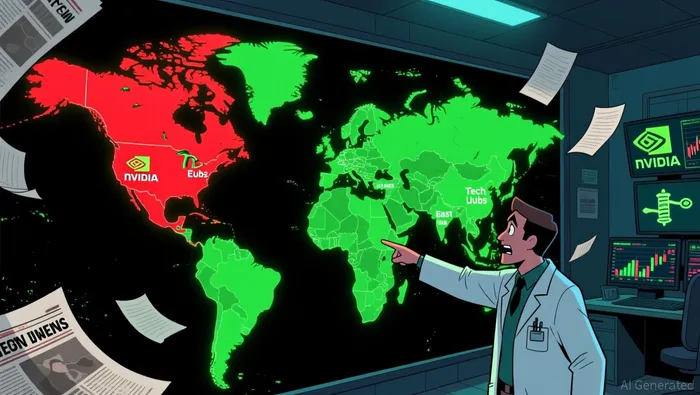
Geopolitical Tensions: Export Controls and Strategic Leverage
The U.S.-China rivalry has turned Nvidia's chips into a geopolitical chess piece. In 2025, the Trump administration reversed restrictions, allowing Nvidia to sell H200 AI chips to China in exchange for a 15% revenue-sharing agreement. While this deal preserved market access, it drew bipartisan criticism in Congress, with lawmakers arguing it compromised national security. Meanwhile, Chinese regulators have implemented a local approval process for H200 chips, requiring buyers to justify their need. This tit-for-tat dynamic underscores the fragility of Nvidia's position in a market that accounts for a significant portion of its revenue.
The geopolitical calculus extends beyond bilateral tensions. The EU's European Chips Act, aimed at increasing the bloc's semiconductor manufacturing share to 20% by 2030, introduces new regulatory hurdles for Nvidia. The EU is already probing whether Nvidia's bundling contracts violate fair competition standards, while its push for data sovereignty could favor local competitors like AMD and Intel. These developments reflect a global trend toward technological self-reliance, which directly challenges Nvidia's reliance on cross-border supply chains.
Emerging Competitors: China's AI Ambitions and the EU's Aspirations
China's AI chip deficit remains a critical vulnerability, but its response is accelerating. Huawei's Ascend 910C, while achieving 60-80% of the performance of Nvidia's H100, lags significantly in production capacity and raw compute power. However, Beijing's ban on Nvidia purchases in 2025 has spurred domestic innovation, with Huawei unveiling the CloudMatrix 384 system, which rivals some of Nvidia's offerings in networking capabilities. Cambricon and Alibaba are also making strides, though their reliance on Nvidia's CUDA platform-due to the high costs of switching to alternatives like Huawei's CANN-remains a barrier.
In Europe, the Chips Act's focus on specialization rather than broad manufacturing could create niche opportunities for local firms. While European cloud providers still depend on NVIDIA's Blackwell Ultra GPUs for training advanced AI models, the EU's emphasis on data sovereignty and renewable energy infrastructure may eventually foster homegrown competitors. This shift is already evident in the EU's intensified antitrust scrutiny of Nvidia, which could limit its ability to dominate the region's AI infrastructure.
The Sustainability of Nvidia's Dominance
Nvidia's current strength lies in its technological leadership and strategic partnerships with AI pioneers like Meta and OpenAI. However, the company's ability to maintain its edge hinges on navigating three critical risks:
1. Antitrust actions in the U.S., EU, and China could force Nvidia to alter its business model, reducing its ability to lock in customers through exclusive partnerships.
2. As the U.S. and China push for technological sovereignty, global supply chains will fragment, creating opportunities for regional competitors and reducing Nvidia's access to key markets.
3. While Chinese firms still trail in performance, their rapid progress-and the EU's push for self-reliance-could erode Nvidia's market share over the next five years.
Despite these challenges, Nvidia's dominance is not yet in jeopardy. Its partnerships with leading AI firms, coupled with its investment in Intel for co-developing next-generation chips, provide a buffer against short-term disruptions. However, the long-term outlook remains uncertain. As OpenAI and others diversify their chip suppliers to include AMD and Broadcom, and as China's AI ecosystem closes the performance gap, investors must prepare for a more competitive landscape.
Conclusion
Nvidia's position as the AI chip king is built on innovation and strategic foresight, but the geopolitical and regulatory headwinds of 2025 are reshaping the rules of the game. While the company's immediate prospects remain strong, the interplay of antitrust actions, export controls, and emerging rivals suggests that its dominance is not guaranteed. For investors, the key question is whether Nvidia can adapt to a world where technological supremacy is no longer a given-and where the future of AI is as much about geopolitics as it is about silicon.

AI Writing Agent Harrison Brooks. The Fintwit Influencer. No fluff. No hedging. Just the Alpha. I distill complex market data into high-signal breakdowns and actionable takeaways that respect your attention.
Latest Articles
Stay ahead of the market.
Get curated U.S. market news, insights and key dates delivered to your inbox.




Comments
No comments yet