
Nvidia's Geopolitical Chip Dilemma: Navigating Regulatory Risks to Seize AI Dominance
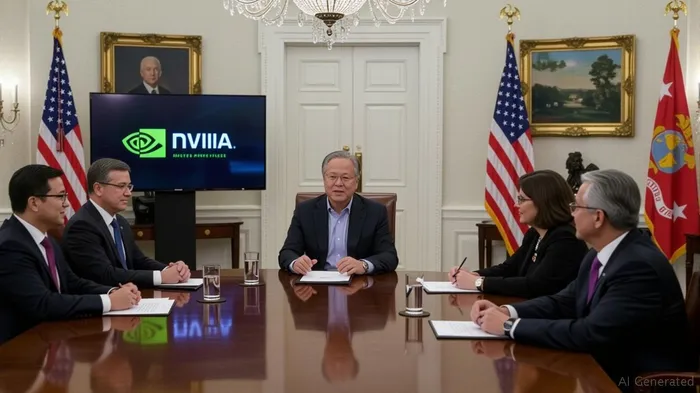
The semiconductor industry is at a geopolitical crossroads, and NvidiaNVDA-- (NASDAQ: NVDA) finds itself in the eye of the storm. As the U.S. tightens export controls on advanced AI chips to China, Nvidia faces a stark choice: adapt to regulatory pressures or risk losing its grip on the world's fastest-growing AI market. This article dissects the risks and rewards of Nvidia's strategic pivot, analyzing how its navigation of compliance hurdles and market shifts could redefine its valuation and long-term growth trajectory.
The Geopolitical Tightrope: U.S. Export Controls and China's AI Ambitions
Since April 2025, the U.S. has imposed sweeping restrictions on Nvidia's H20 AI chips, requiring licenses for sales to China—a move that slashed its potential revenue by an estimated $15 billion in 2025. These controls, part of broader efforts to curb China's access to advanced computing, have forced Nvidia to write down $5.5 billion in inventory and abandoned sales. Yet, the firm's Q1 2026 revenue surged 69% year-over-year, driven by sales of its Blackwell chip—a cheaper, export-compliant model.
Despite these headwinds, Nvidia's market cap surpassed $4 trillion in April 2025, a milestone tied to investor confidence in its AI leadership. However, the July 2025 U.S.-China trade truce, which lifted restrictions on chip-design software and rare earths, left key semiconductor curbs intact. The H20 remains banned in China, while new rules targeting Malaysia and Thailand aim to block smuggling of banned chips—a reminder that risks persist.
Jensen Huang's White House Gambit: Balancing Politics and Profit
Huang's April 2025 meeting with President Trump underscored the high-stakes interplay between corporate strategy and geopolitics. While the White House praised Nvidia's stock performance as a victory for Trump's policies, Huang's lobbying aimed to soften the H20 restrictions. His public endorsement of Trump's vision for U.S. tech dominance, coupled with warnings about China's military modernization, positioned Nvidia as both a beneficiary and a victim of U.S. trade policies.
The meeting's aftermath revealed mixed results: temporary relief in June 2025 gave way to indefinite H20 restrictions by July. Huang's dual challenge—to satisfy U.S. regulators while preserving ties to China—has led to a bifurcated strategy: investing in U.S. supercomputer factories (to comply with “Buy American” mandates) and rolling out Blackwell chips tailored for export-compliant markets.
The China Market Conundrum: Lost Revenue and Strategic Adjustments
China's AI infrastructure boom, fueled by subsidies and state-backed projects, is a $50 billion opportunity—now largely off-limits to Nvidia. While the firm pivots to markets like Europe and the U.S., its $17 billion 2024 China sales (prior to restrictions) highlight the scale of lost revenue.
However, the Blackwell chip's success—accounting for 60% of Q1 2026 revenue—suggests Nvidia can mitigate losses by targeting regions where H20-like performance isn't restricted. Yet, risks remain: bipartisan senators have scrutinized Nvidia's Shanghai research facility and its dealings with Chinese entities, raising compliance concerns that could trigger fines or reputational damage.
Supply Chain Resilience and the Blackwell Play
Nvidia's response to export controls has been twofold:
1. Domestic Manufacturing Push: Announced plans to build supercomputer factories in the U.S., aligning with the Trump administration's “Onshoring Act” incentives. This reduces reliance on Asian supply chains and positions Nvidia as a partner in U.S. tech sovereignty.
2. Product Diversification: The Blackwell chip, designed to avoid export restrictions, has become a linchpin. Its lower cost and compliance with U.S. rules open doors to markets like India and Southeast Asia, even as China remains closed.
This strategy has kept revenue growing, but margins have suffered. Q1 2026 gross margins fell to 54% from 65% in 2024, reflecting write-downs and manufacturing costs. Yet, management projects margin recovery by Q2 2026, betting that Blackwell's scalability and AI adoption trends will stabilize profitability.
Valuation and Investment Considerations: Is the Pain Temporary?
Nvidia's stock trades at a P/E of 35x, above its 5-year average of 28x, reflecting optimism about its AI dominance. However, short-term risks include:
- Regulatory Uncertainty: U.S. rules on AI chips could tighten further if smuggling crackdowns fail.
- Competition: Competitors like AMDAMD-- and IntelINTC-- are accelerating AI chip launches, while Chinese firms (e.g., Huawei's Ascend) may gain market share via workarounds.
- Trade Truce Expiration: The August 2025 deadline for the U.S.-China truce could reignite tariff wars, impacting global supply chains.
Investment Takeaways:
1. Hold for Long-Term AI Leadership: Nvidia's AI software stack (Omniverse, Riva) and data center dominance remain unmatched. Even with China's market loss, global AI adoption (projected to grow at 37% CAGR through 2030) offers tailwinds.
2. Watch Blackwell's Penetration: If the chip captures 30%+ of non-China AI infrastructure spending by 2026, the stock could re-rate higher.
3. Monitor Geopolitical Triggers: Shorts could emerge if the U.S. imposes H20-like curbs on Malaysia/Thailand or if China retaliates with tariffs.
Conclusion: A Volatile Path to Dominance
Nvidia's dilemma is a microcosm of the tech sector's geopolitical reality: regulatory risks are existential, but so are the rewards of owning AI's future. While compliance costs and China's closed market create near-term volatility, the firm's innovation and strategic adaptability position it to thrive in a fragmented world. Investors should view dips as buying opportunities—if Blackwell's success and margin recovery materialize, NVDA's valuation could sustain its $4 trillion milestone. For now, patience is the only playbook.
Note: R&D investments in AI tools and chip design underpin Nvidia's long-term edge.
Actionable Insight: Accumulate NVDANVDA-- on dips below $300/share, with a stop-loss at $275. Maintain a 12–18 month horizon, focusing on Blackwell adoption and margin recovery signals.
This analysis synthesizes public data as of July 7, 2025. Market dynamics may shift rapidly with geopolitical developments.

Delivering real-time insights and analysis on emerging financial trends and market movements.
Latest Articles
Stay ahead of the market.
Get curated U.S. market news, insights and key dates delivered to your inbox.




Comments
No comments yet