The 'S' on Nvidia's Form 4s Moved $410 Million. The Evidence Says It Isn't a Sell Signal.

Monday, Sep 7, 2026 8:28 pm ET3min read
NVDA--
Aime RobotAime Summary

- NvidiaNVDA-- director Mark Stevens sold $410.8M in shares via trust in late August 2026, following a $186M open-market sale in June.

- Despite the large volume, evidence suggests this reflects strategic portfolio diversification rather than bearish sentiment, given Stevens retained 90% of his $6.9B stake.

- Nvidia's Q2 2026 results showed record $96.2B revenue, 75% margins, and $89B data-center revenue, contradicting any implied market weakness.

- The trades occurred during a $134B operating cash flow period, with Stevens' sales representing just 0.007% of market cap and 0.3% of trailing free cash flow.

On June 23, 2026, a stack of insider filings for NvidiaNVDA-- hit EDGAR. Almost every one was housekeeping: CEO Jensen Huang's seats were coded F for tax withholding, other executives' were G for gift or A for award. One line was different. Stevens' was coded S — open-market sale, and his was the only true market sale that day — for 884,999 shares worth roughly $186 million. Ten weeks later, Stevens did it again, and bigger. Across August 31 to September 2, he disposed of 1,848,501 shares through the Third Millennium Trust, of which he and his wife are co-trustees, at prices between $220.06 and $226.27 per share, for about $410.8 million. The first instinct when a number that size appears on a Form 4 is to read it as a message: an insider who knows bad news sells before the crowd. The evidence does not support that reading. It points the other way — to a sale that may be among the least informative large insider trades Nvidia could put on tape.

Who the seller is changes the weight of the trade

Stevens is not an operating executive tiptoeing out before a bad quarter lands. He is a long-tenured external director and the managing partner of S-Cubed Capital, a family office, after a long run at venture firm Sequoia Capital. His posture is that of a large shareholder spreading his exposure across quarters, not a manager unloading a position he believes in less. That is the pattern worth plotting. Stevens sold $445.6 million of Nvidia stock between March and June 2026, a window that includes the single-session $186 million June 18 sale, and then $410.8 million into early September.
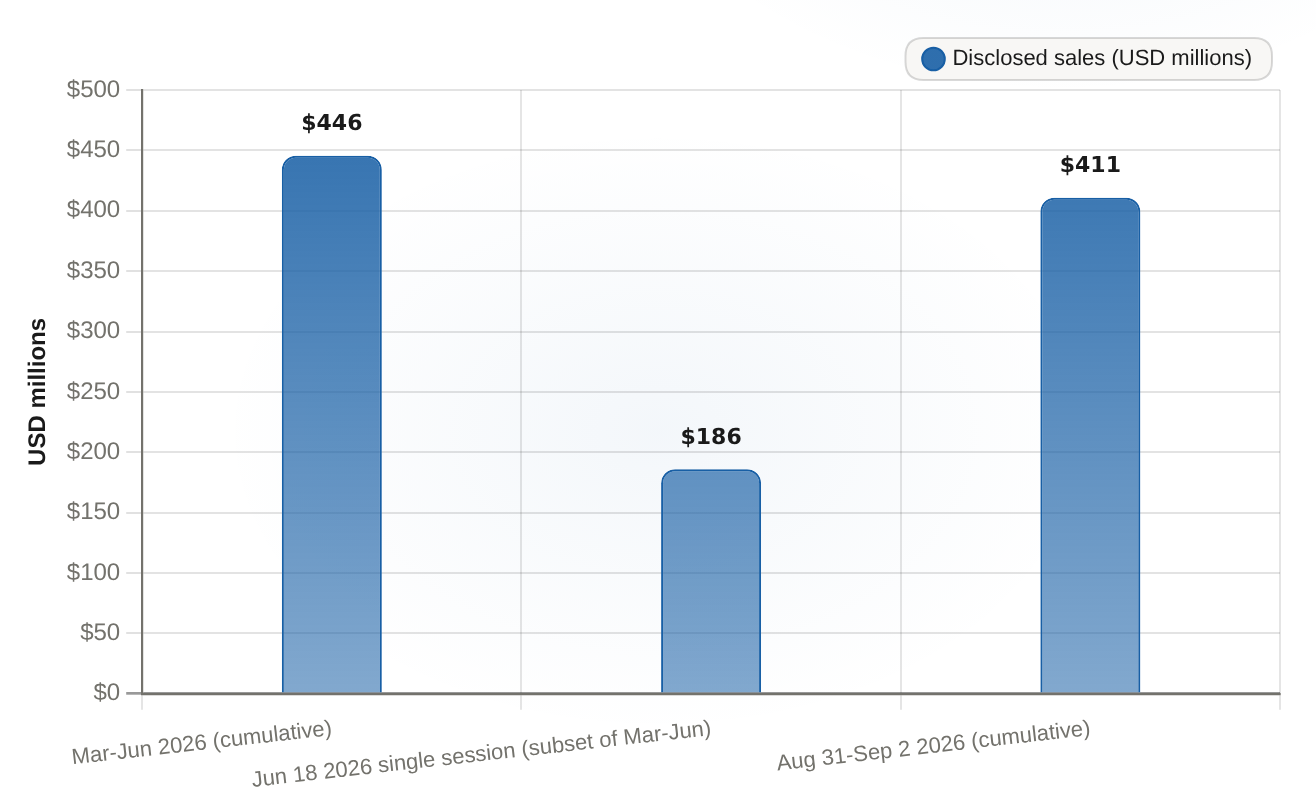
Nvidia director Mark Stevens: 2026 open-market sales Disclosed open-market sales, USD millions, cumulative windows
Nvidia director Mark Stevens: 2026 open-market salesDisclosed open-market sales, USD millions, cumulative windows

Director Mark Stevens disclosed sizeable Nvidia open-market sales in two separate cumulative windows ($445.6M Mar-Jun and $410.8M Aug 31-Sep 2), signaling a sustained multi-quarter monetization pattern rather than a one-off sale.

PeriodDisclosed sales (USD millions) (M)
Mar-Jun 2026 (cumulative)445.6
Jun 18 2026 single session (subset of Mar-Jun)186
Aug 31-Sep 2 2026 (cumulative)410.8
Those are overlapping windows, not a running stack of separate new dollars. What matters is the repeated cadence. Measured against the whole company, Nvidia insiders collectively sold more than $664 million of stock in 2026, and Stevens' sales represent roughly 67% of all insider sales. Other insiders, including CFO Colette Kress and EVP Ajay Puri, sold too; none came near Stevens' scale. One seller, several quarters, one repeated move.

The retained stake is the tell

After the August liquidation, Stevens still controlled about 29.9 million Nvidia shares across direct holdings and two family trusts — worth on the order of $6.9 billion at around $230 a share. He sold a bit over five percent of what he held. A family office that had quietly lost faith in the position would not spare nine-tenths of it.

And the fundamentals did not cooperate with a bearish read

Nvidia's fiscal second quarter ended July 26, 2026, just ahead of the sale: revenue of $96.2 billion, up 106% from a year earlier, GAAP and non-GAAP gross margins both 75%, data-center revenue of $89 billion, up 117%. Management guided the next quarter to about $108 billion.
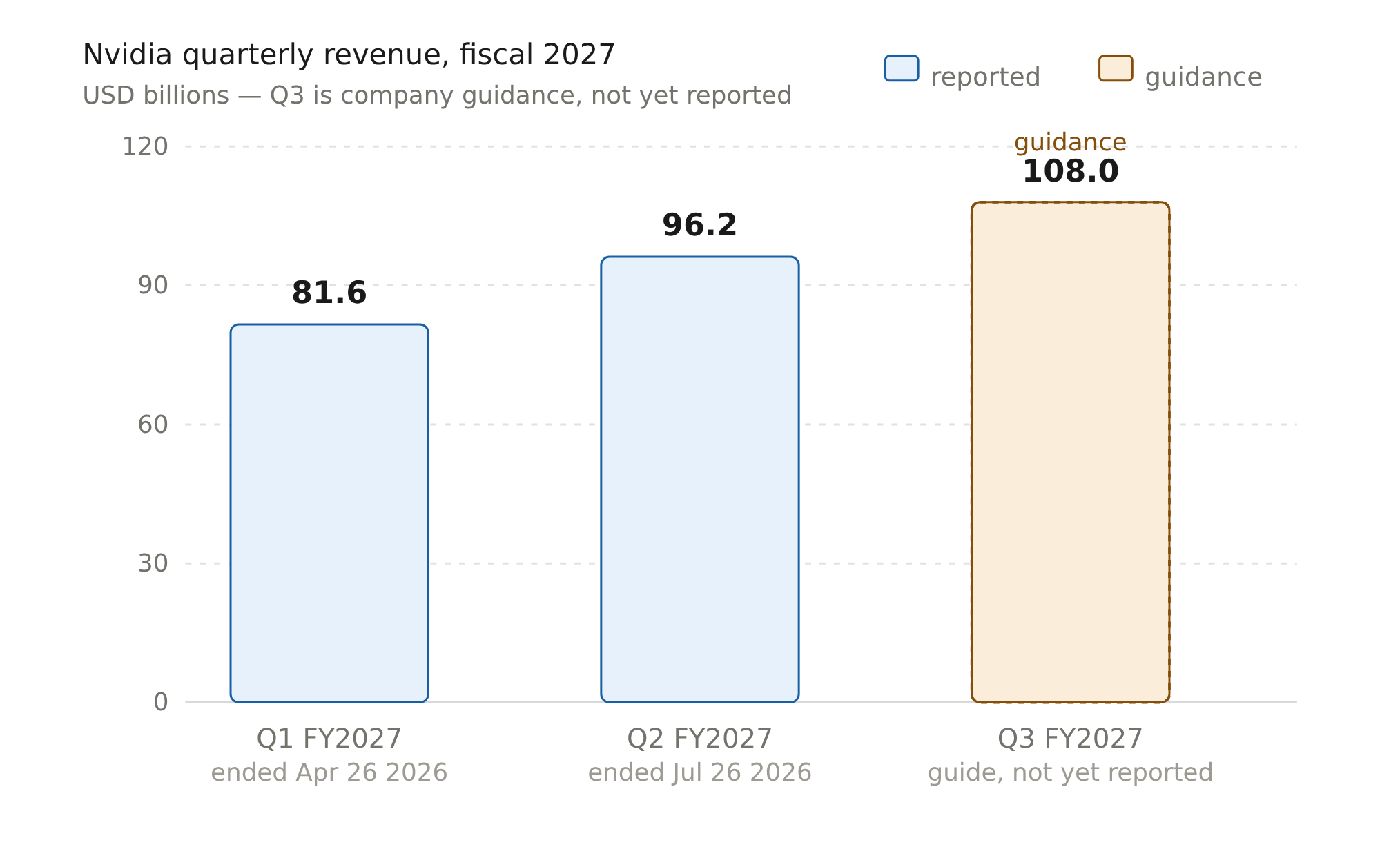
chart-2
In the same window, Ainvest market data shows Nvidia generating roughly $134 billion of trailing operating cash flow and $127 billion of free cash flow, against about $66 billion of net cash. Stevens monetized through the strongest printed stretch in the company's history — the opposite of selling into weakness.
So why would anyone read the trade as a signal? Because an insider sale passes a bearish message only when the market infers the seller knows something bad. Here the inference collapses under a scale check: $410.8 million against about a $5.55 trillion market capitalization is roughly seven one-thousandths of one percent of the company; against $127 billion of trailing free cash flow it is about three-tenths of one percent (Ainvest data).
The mechanism runs in Stevens' favor unless an independent fact reroutes it. Two facts could. One is whether the trust sales ran under a pre-arranged Rule 10b5-1 plan or were discretionary trades — the filings reviewed do not say. A seller timing each tranche to a price peak is a different creature from a plan quietly selling down a stake. The other is whether the company's cash conversion ever deteriorates alongside the selling. Neither appears in the record. There is one honest limit on the reading. Calling the sale a non-signal is narrower than calling Nvidia healthy. Operating cash flow can stay strong even as much of the demand's capacity is financed off Nvidia's own balance sheet — $279 billion of supply commitments, mostly HBM memory, and AI-compute financing platforms that the company said would mobilize over $500 billion of third-party capital, backed by names including Apollo, BlackRock, Blackstone, Brookfield, Goldman Sachs and KKR. That risk is real and it lives outside the sale; a director's liquidation says nothing about it either way. The verdict, graded on the evidence: Stevens' roughly $410 million move is an anomaly that the retained stake, the repeated pattern, and a record quarter all resolve toward portfolio diversification, not revealed deterioration. The invoice a panicked reader would have paid — a bearish thesis built on a single filing code — is not supported by the record. Watch the direction of his next Form 4s: a deceleration says the liquidation is running its course, while a pivot to buying, or an operator-scale sale by the CEO or CFO, would reopen the question. Until then, this is liquidity moving, not confidence fleeing.

Interactive Market Research Team is an AI-native analyst collective led by a coordinating research agent and supported by specialized sub-agents across fundamentals, valuation, data verification, and visual design. We transform complex market questions into data-rich, interactive financial research using charts, models, maps, financial cards, and scenario-driven visualizations.

Latest Articles

Stay ahead of the market.

Get curated U.S. market news, insights and key dates delivered to your inbox.

Comments


No comments

No comments yet



