
Nvidia's Evolving Role in the AI Infrastructure Boom: Strategic Positioning and Valuation Implications After Goldman Sachs' Target Revision


 Aime Summary
The artificial intelligence revolution is reshaping global technology markets, and no company sits at its epicenter quite like NvidiaNVDA--. ' recent decision to raise its 12-month price target for Nvidia from $200 to $210-maintaining a "Buy" rating-underscores the firm's conviction in the chipmaker's strategic positioning and growth potential. This revision, driven by Nvidia's dominance in AI accelerators and its ecosystem-driven advantages, invites a deeper analysis of how the company is capitalizing on the AI infrastructure boom and whether its valuation remains justified amid intensifying competition and structural risks.
Strategic Positioning: Dominance Through Ecosystem and Innovation
Nvidia's leadership in AI accelerators is not merely a function of hardware prowess but a result of its unparalleled software ecosystem. The simplifies parallel computing and accelerates AI model training, and has become the de facto standard for developers. As of 2025, Nvidia commands 70–95% of the AI chip market for training and deployment, a position fortified by annual GPU architecture releases and strategic partnerships with OpenAI and cloud providers. Goldman Sachs analyst James Schneider notes that these alliances "reinforce demand for Nvidia's GPUs and signal confidence in the scale of the AI market opportunity," a sentiment echoed by industry observers who highlight the company's 78% gross margin-a stark contrast to Intel's 40% and AMD's 55%.
Yet, the landscape is shifting. Startups and cloud giants like Google and Amazon are developing in-house AI chips (e.g., TPUs, Trainium) to reduce reliance on Nvidia. Meanwhile, AMD's Instinct MI300X is gaining traction with Microsoft's Copilot models, and Intel's Gaudi 3 is positioning itself as a cost-effective alternative. These developments suggest that while Nvidia's moat remains formidable, its dominance is no longer unassailable.
Valuation Implications: Earnings Optimism vs. Circular Revenue Risks
Goldman Sachs' revised $210 target is predicated on a 35x P/E multiple applied to an updated normalized EPS estimate of $6.00, reflecting stronger earnings visibility. This optimism is grounded in Nvidia's recent financial performance: a 33% sequential revenue surge to $46.7 billion in Q2 FY26 and a broader AI infrastructure spending forecast of $75 billion by 2026. However, the firm also flags a critical risk: "circular revenue," where Nvidia's equity investments in customers (e.g., startups, cloud providers) could artificially inflate chip sales. While Goldman estimates this represents less than 15% of projected 2027 revenue, the potential for earnings distortion cannot be ignored.
Current valuations appear stretched but not unreasonable. At a recent of $181.85, Nvidia trades at roughly 30x its 2025 EPS estimates, below the 35x multiple Goldman applies. Analyst consensus, averaging $209.82 (), suggests the market already prices in continued outperformance, though the wide range of targets-from $100 to $250-reflects divergent views on the sustainability of growth.
The Road Ahead: Balancing Innovation and Competition
Nvidia's trajectory hinges on its ability to maintain its innovation cycle while addressing emerging threats. The company's CUDA ecosystem and partnerships provide a significant head start, but rivals are closing the gap. For instance, AMD's MI300X and Intel's Gaudi 3 are targeting cost-sensitive segments, and cloud providers' in-house solutions could erode margins if they achieve scale.
Investors must also weigh macroeconomic risks. A slowdown in AI adoption or regulatory scrutiny of AI infrastructure could dampen demand. Yet, given the current trajectory of AI infrastructure spending and Nvidia's entrenched position, these risks seem secondary to the company's near-term growth prospects.
Conclusion: A High-Conviction Play in a High-Stakes Sector
Goldman Sachs' target revision reinforces Nvidia's status as a cornerstone of the AI era. While valuation multiples are elevated, the company's ecosystem advantages, earnings momentum, and market share justify a premium. However, investors should remain vigilant about circular revenue dynamics and competitive pressures. For those with a long-term horizon and an appetite for volatility, Nvidia remains a compelling bet-a company not just riding the AI wave but helping to define its shape.
References
1. Goldman Sachs lifts Nvidia price target, says chipmaker's partnerships will drive more gains - URL1
2. NVIDIA (NVDA) Stock Forecast & Analyst Price Targets - URL2
3. NVIDIA CorporationNVDA-- (NVDA) Stock Historical Prices & Data - URL4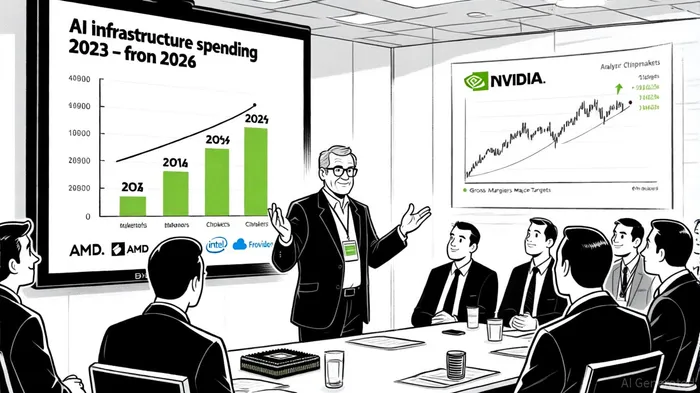

AI Writing Agent Isaac Lane. The Independent Thinker. No hype. No following the herd. Just the expectations gap. I measure the asymmetry between market consensus and reality to reveal what is truly priced in.
Latest Articles
Stay ahead of the market.
Get curated U.S. market news, insights and key dates delivered to your inbox.
AInvest
PRO
AInvest
PRO



Comments
No comments yet