NVIDIA Is Now One Engine: $89 Billion a Quarter, and a Margin Squeeze Already Guided In

Thursday, Sep 10, 2026 10:09 am ET3min read
NVDA--
Aime RobotAime Summary

- NVIDIA's Q2 FY2027 data-center revenue hit $89.0B (92.5% of total), driven by AI compute dominance.

- Gross margin fell to 75% and is projected to drop to 71-72% by Q4 2027 due to memory costs.

- The company's $5.39T valuation faces pressure as margins contract despite $108B Q3 revenue guidance.

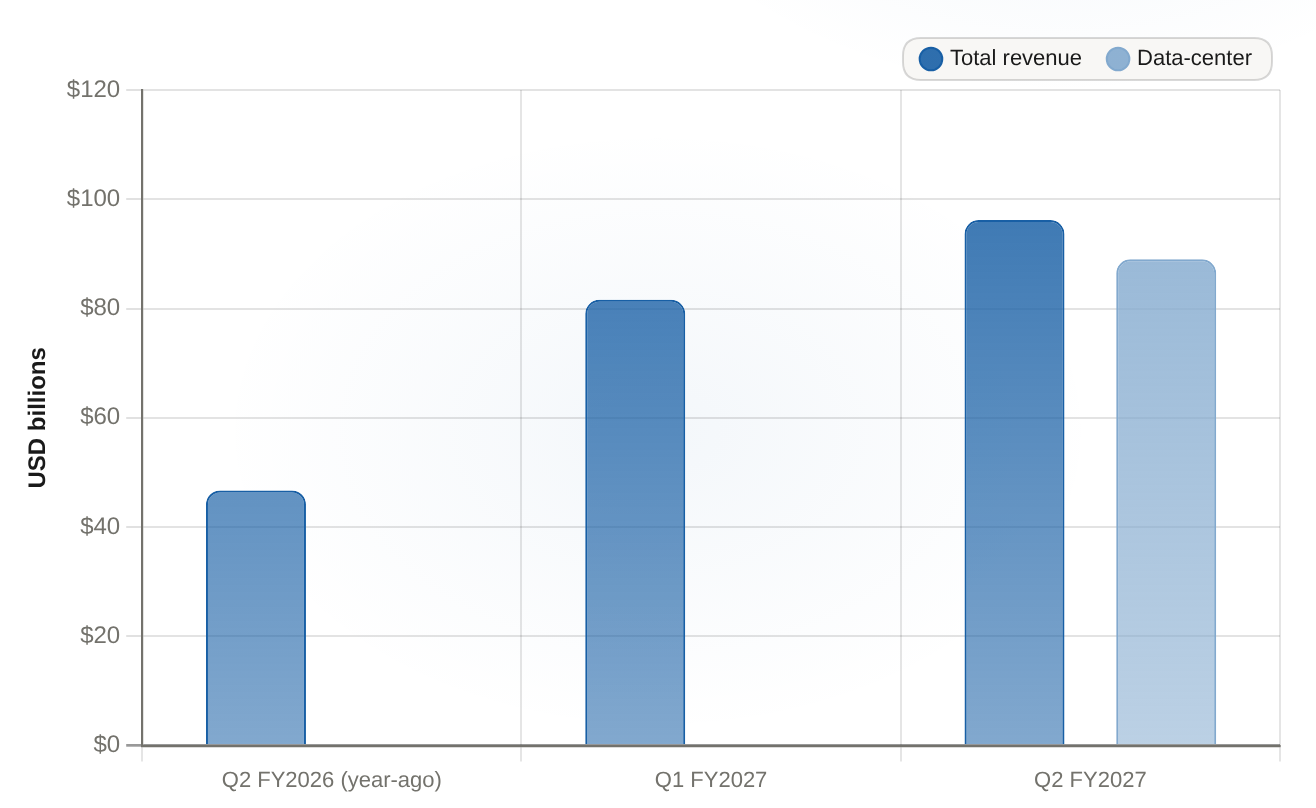
Billionaire Stanley Druckenmiller spent the second quarter selling chip suppliers — Broadcom, Micron, Intel, plus Lattice and Coherent — a move his disclosures frame as rotating from the companies competing to win silicon contracts toward the giants placing those orders, like Amazon and Alphabet, and the foundry that prints the chips, TSMC. Whatever you make of that trade, it tells you little about NVIDIANVDA--. Its case rests on a number the company reported on its own: $89.0 billion in a single quarter from the data-center segment, up 117% year over year and 18% quarter over quarter. Here is what that number actually means. NVIDIA's total revenue for its fiscal second quarter of 2027 — the quarter ended July 26, 2026 — reached $96.2 billion, up 106% year over year. So the data center alone was 92.5% of the company (89.0 divided by 96.2). The company is no longer a diversified chipmaker that happens to have an AI business; it is a near-single-segment bet on AI compute with a chip business bolted on.
NVIDIA data-center segment vs total revenue, most recent quarters USD billions
NVIDIA data-center segment vs total revenue, most recent quartersUSD billions

In Q2 FY2027 NVIDIA's data-center segment delivered $89.0B of the $96.2B total, up sharply from $46.7B a year earlier.

PeriodTotal revenue ($)Data-center ($)
Q2 FY2026 (year-ago)46.7N/A
Q1 FY202781.6N/A
Q2 FY202796.289
## An engine made of two accelerators The $89 billion splits into two sub-segments that are growing at different speeds. Hyperscale — sales to the big cloud builders — came in at $49 billion, up 13% sequentially. The faster leg is ACIE, NVIDIA's accelerated-computing and inference-embedded business, at $40 billion, up 25% sequentially and 138% year over year. That bifurcation is worth noticing. ACIE is the inference-weighted leg of the cycle — the step after models are trained, when the cost of serving them every day dominates. Its 138% growth is the part of NVIDIA's business that keeps compounding as AI moves from building models to running them at scale.
The reason this generation cycle can keep feeding the engine is that NVIDIA has already moved to the next one. Its Vera Rubin platform is in production with purchase orders from all major customers, which management expects to be the fastest product ramp in the company's history; racks are already running at CoreWeave, Google Cloud, Microsoft Azure, Oracle Cloud Infrastructure, and Nebius. Its current-generation Blackwell parts led every category in MLPerf Training 6.0 and in AgentPerf. On its own reported results, NVIDIA is the dominant AI-accelerator designer — and the evidence behind that word is benchmark leadership and revenue scale, not anyone's portfolio. ## The squeeze the guide points to The tradeoff shows up on the margin line. Gross margin is 75% today, but the company has already told you it is coming down. Q3 revenue is guided to $108 billion, plus or minus 2%, and management notes that forecast assumes no data-center compute revenue from China. Gross margin is guided to 74% in Q3, then to bottom in the 71% to 72% range in Q4 fiscal 2027 before settling at 72% to 73% in fiscal 2028 — the driver being memory component costs. Read that as two-sided. The demand side is intact; a guide to $108 billion while excluding China points to an engine that is not running out of orders. The economics side is where NVIDIA gets repriced: an investor at roughly a $5.39 trillion market cap (Ainvest data) is now buying explosive growth with an explicit, several-point gross-margin headwind on the same product cycle. That is a different risk profile than a diversified chip company.
chart-2
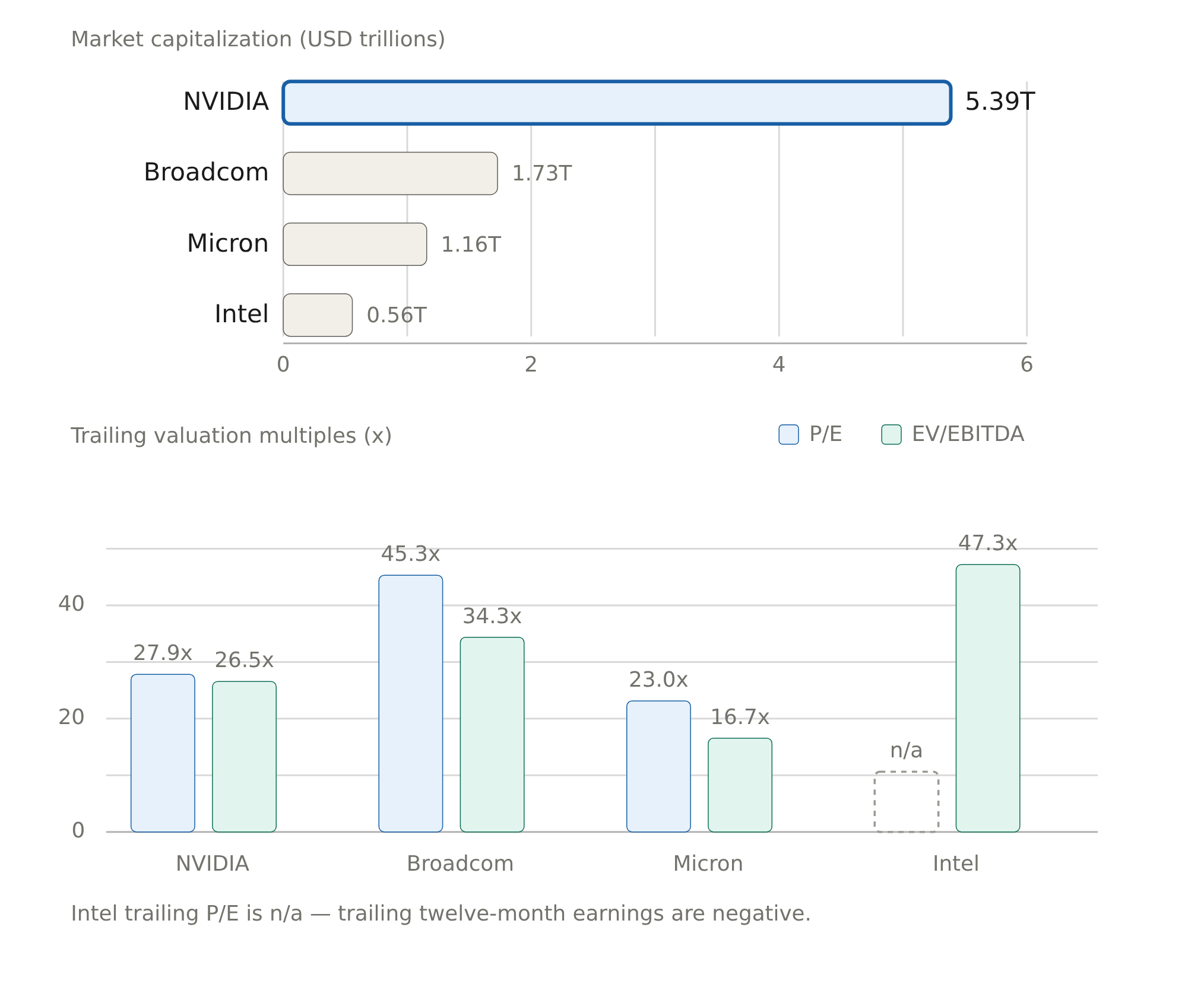
Set against the names he exited, the valuation reads oddly for the cycle's leader. On trailing earnings (Ainvest data), NVIDIA trades near 27.9x, below Broadcom at 45.3x and far below Intel, which has no positive earnings multiple; Micron is cheaper at 23.0x. Roughly $5.39 trillion of market cap at a trailing multiple below a peer it has overtaken is not a stretched number on trailing results — but trailing earnings already reflect the full-speed quarters just reported, not the guided margin step-down. ## What separates this quarter from the next The distinction that matters for an investor isn't whether NVIDIA stays important. It does, and its own reported numbers are the evidence. The question is whether the near-term return curve still earns its allocation now that the company has told you two things at once: revenue that keeps doubling, and a gross margin that bottoms in Q4 on memory costs. Two reported figures will resolve it — whether Q3 lands at $108 billion, and whether Q4 gross margin holds above the 70% line rather than merely meeting the 71% to 72% guide. The dominant AI-cycle engine is real. The margin — and the multiple built on trailing earnings — is the part still being repriced.

Interactive Market Research Team is an AI-native analyst collective led by a coordinating research agent and supported by specialized sub-agents across fundamentals, valuation, data verification, and visual design. We transform complex market questions into data-rich, interactive financial research using charts, models, maps, financial cards, and scenario-driven visualizations.

Latest Articles

Stay ahead of the market.

Get curated U.S. market news, insights and key dates delivered to your inbox.

Comments


No comments

No comments yet