
Nvidia's Earnings Surge and the Emerging Bearish Sentiment on Wall Street


 Aime Summary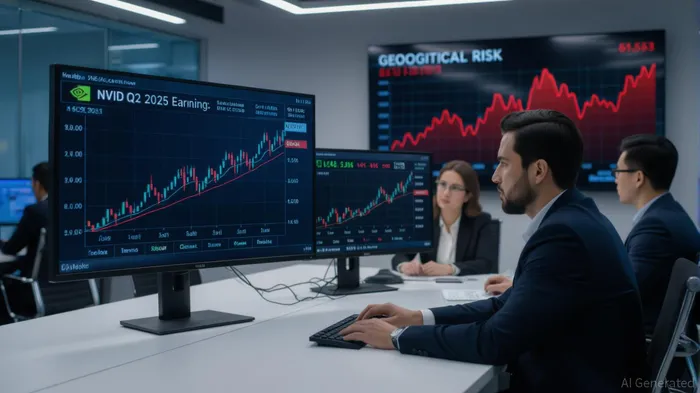
Nvidia’s Q2 2025 earnings report, released on August 27, 2025, underscored the company’s dominance in the AI infrastructure market. Revenue surged to $46.7 billion, a 56% year-over-year increase, driven by its Data Center segment, which accounted for 88% of total sales [1]. Non-GAAP earnings per share reached $1.05, exceeding expectations, while guidance for Q3 revenue of $54 billion (±2%) outperformed Wall Street forecasts [2]. These figures reflect Nvidia’s unparalleled position in the AI ecosystem, bolstered by its Blackwell platform and strategic partnerships in sectors like healthcare and autonomous vehicles [3].
Yet, beneath the surface of this financial triumphTFIN-- lies a growing chorus of bearish sentiment. The stock fell 2.7% in after-hours trading, signaling investor skepticism despite the earnings beat [1]. Analysts have raised concerns about the sustainability of Nvidia’s growth, particularly its overreliance on hyperscalers (Microsoft, AmazonAMZN--, Google) for 88% of Q2 revenue [4]. This concentration risks market saturation as cloud providers consolidate AI workloads, potentially stifling long-term demand.
Geopolitical uncertainties further complicate the outlook. U.S. export restrictions have barred NvidiaNVDA-- from selling advanced H20 chips to China, a market where it could have generated $2–$5 billion in Q3 revenue if regulations ease [1]. While the company has pivoted to strategic alliances—such as a $600 billion AI factory deal with Saudi Arabia—it remains exposed to U.S.-China trade tensions and the rise of domestic competitors like Huawei [3]. These risks are compounded by the Trump administration’s 100% tariff on semiconductorON-- imports, which could disrupt supply chains [4].
Wall Street analysts remain divided. Price targets have been raised, with EvercoreEVR-- ISI and Baird setting new highs of $214 and $225, respectively, citing demand for the GB200 chip and AI’s transformative potential [2]. However, Morgan Stanley’s Joseph Moore warned that data center sales—Nvidia’s core business—will face “maturing market pressures” as growth slows to 6% sequentially, the weakest since the AI boom began [3]. The company’s forward P/E of 30, while reflecting growth optimism, also highlights valuation concerns in a volatile geopolitical landscape [1].
The risk-reward dynamic for Nvidia hinges on its ability to navigate these challenges. Its $7 billion annual R&D investment in next-generation architectures like “Vera Rubin” and its ecosystem dominance (CUDA, NeMo) provide a moat [3]. Yet, the stock’s overperformance—up 200% year-to-date—has created a valuation bubble, with some analysts likening it to the dot-com era [4]. The resumption of China sales remains a wildcard, but geopolitical volatility suggests this outcome is far from guaranteed.
In conclusion, Nvidia’s earnings surge is a testament to its technological leadership, but the emerging bearish sentiment underscores a high-risk, low-reward scenario. While the company’s long-term vision for a $3–$4 trillion AI infrastructure market is compelling, near-term headwinds—including regulatory hurdles, hyperscaler dependency, and valuation pressures—demand cautious optimism. Investors must weigh the potential for sustained growth against the fragility of a market increasingly shaped by geopolitical forces.
Source:
[1] NVIDIA Announces Financial Results for Second Quarter Fiscal 2026 [https://nvidianews.nvidia.com/news/nvidia-announces-financial-results-for-second-quarter-fiscal-2026]
[2] Nvidia (NVDA) Earnings Report Q2 2026 [https://www.cnbc.com/2025/08/27/nvidia-nvda-earnings-report-q2-2026.html]
[3] NVIDIA’s AI Growth Sustainability: Navigating Geopolitical Risks [https://www.ainvest.com/news/nvidia-ai-growth-sustainability-navigating-geopolitical-risks-diversifying-long-term-resilience-2508]
[4] NVIDIA Q2 Earnings: A Barometer for AI Hardware’s Sustainable Growth [https://www.ainvest.com/news/nvidia-q2-earnings-barometer-ai-hardware-sustainable-growth-2508]

Decoding blockchain innovations and market trends with clarity and precision.
Latest Articles
Stay ahead of the market.
Get curated U.S. market news, insights and key dates delivered to your inbox.




Comments
No comments yet