
Nvidia's Earnings and the Fading Correlation with Bitcoin: A New Era for AI and Crypto Investors


 Aime Summary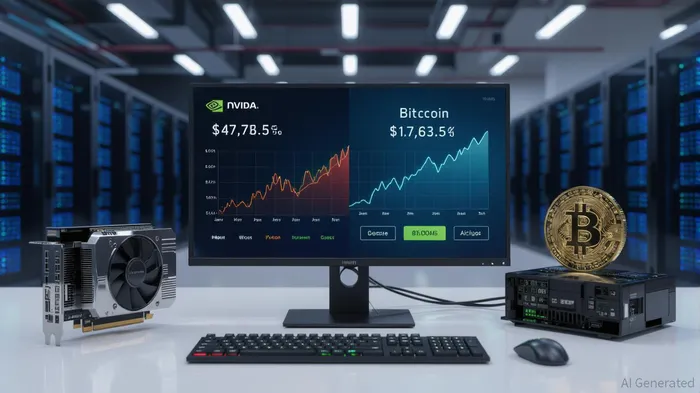
The once-tight bond between Nvidia's earnings and Bitcoin's price movements is unraveling, signaling a pivotal shift in how investors should approach the interplay between AI-driven tech stocks and crypto assets. For years, the semiconductor giant's quarterly results served as a bellwether for BitcoinBTC--, with 7 out of 10 quarters since 2023 seeing positive Bitcoin price action following Nvidia's earnings reports. However, recent data reveals a weakening correlation coefficient—dropping from 0.80 in early 2024 to 0.69 in 2025, with some periods as low as 0.36. This divergence raises critical questions about the sustainability of the perceived link and the evolving dynamics between AI equities and crypto markets.
The Drivers Behind the Divergence
Nvidia's dominance in AI and semiconductors has long been a tailwind for Bitcoin. The company's GPUs power both AI training and Bitcoin mining, creating a symbiotic relationship. Yet, the factors driving each asset are now diverging.
Nvidia's Earnings: A Tale of AI and Enterprise Demand
Nvidia's recent outperformance—driven by its Blackwell AI platform and surging data center revenue—reflects robust demand for AI infrastructure. In Q2 2025, the company reported $46.7 billion in revenue, a 56% year-over-year increase in its data center segment. This growth is fueled by enterprise adoption of AI, with clients ranging from cloud providers to automotive firms. However, regulatory headwinds, such as a 15% fee on China sales, have tempered profits, reducing Q2 earnings by $8 billion.
Bitcoin's Trajectory: Macro and Regulatory Forces
Bitcoin, meanwhile, is increasingly influenced by macroeconomic uncertainty and regulatory developments. The Federal Reserve's dovish pivot and expectations of rate cuts in September 2025 have introduced volatility, while crypto-specific factors like halving cycles and institutional adoption play a growing role. For example, Bitcoin's initial drop to a seven-week low of $110,000 following Nvidia's Q2 2025 earnings—despite the stock's record high—highlighted the crypto market's sensitivity to broader economic signals over tech-sector optimism.
Implications for Investors: Rebalancing in a Post-Bull Market
The fading correlation has profound implications for portfolio strategies. Historically, investors treated NvidiaNVDA-- and Bitcoin as complementary assets, leveraging their co-movement to hedge or amplify returns. But with a 3-month correlation of 0.83 (as of August 2025) and a 52-week correlation of 0.88, the diversification benefits of holding both are diminishing.
1. Rethinking Diversification
The strong positive correlation means that combining Nvidia and Bitcoin offers limited risk mitigation. For instance, while Nvidia's 90-day return on investment is 0.7 times higher than Bitcoin's, its volatility is 1.43 times lower. This suggests Nvidia provides better risk-adjusted returns, but both assets remain exposed to similar macroeconomic risks, such as interest rate changes and dollar strength. Investors should consider alternative pairings, such as pairing AI equities with defensive sectors or allocating to crypto assets with lower correlations to tech stocks.
2. Sector-Specific Exposure
The AI value chain is shifting from hardware (Nvidia's domain) to customer-facing applications. Investors should prioritize companies with clear revenue streams and profitability, such as those leveraging AI in healthcare or finance. Meanwhile, crypto investors may focus on blockchain infrastructure or institutional-grade tokens rather than speculative altcoins.
3. Macro-Driven Hedging
As Bitcoin's price becomes more tied to macroeconomic trends, investors should hedge against rate cuts and geopolitical risks. For example, Bitcoin's recent volatility spikes (BTC volatility jumping from 15% to 38% post-earnings) underscore the need for options-based strategies to protect against downside risks.
The Road Ahead: A New Equilibrium
The fading Nvidia-Bitcoin link does not signal the end of their interdependence but rather a recalibration. Nvidia's AI-driven growth will continue to shape global capital flows, while Bitcoin's role as a macro hedge and digital store of value will evolve. Investors must now navigate a landscape where AI equities and crypto assets are influenced by distinct, yet overlapping, forces.
For those balancing exposure between these asset classes, the key is to align allocations with risk tolerance and time horizons. Nvidia's earnings remain a critical indicator for tech-sector optimism, but Bitcoin's trajectory will increasingly depend on its own fundamentals. As the Fed's policy path and crypto regulations crystallize, the era of simplistic correlations may give way to a more nuanced, diversified approach.
In this new era, investors who adapt to the shifting dynamics between AI and crypto will be best positioned to capitalize on the opportunities—and mitigate the risks—of a rapidly evolving market.

Decoding blockchain innovations and market trends with clarity and precision.
Latest Articles
Stay ahead of the market.
Get curated U.S. market news, insights and key dates delivered to your inbox.
AInvest
PRO
AInvest
PRO



Comments
No comments yet