
Nvidia Earnings Take Center Stage as Markets Open Mixed Amid Tech Crosscurrents
📺 Bitcoin $200K? The math behind the next crypto supercycle. 👇
U.S. stocks opened on uneven footing Wednesday as investors braced for Nvidia’s highly anticipated earnings after the bell. The Dow slipped roughly 5 points to 46,087, essentially flat (–0.01%), while the S&P 500 edged up 0.1% to 6,624, and the Nasdaq added 0.2% to 22,473. Small caps showed modest strength, with the Russell 2000 rising 0.3% to 234.1. Commodities were mixed: crude oil tumbled to $59.09 (–2.6%), extending a multi-session slide, while gold climbed to $4,116 (+1.2%) as traders sought safety ahead of tonight’s tech catalyst. BitcoinBTC-- hovered near $91,100 (–0.3%), stabilizing after overnight volatility. With macro data light, the entire tape remains positioned around one question: what Nvidia’s results reveal about the durability of the AI investment cycle.
Street Awaits Nvidia’s Signal on AI Spending
Few earnings events command the Street’s attention like Nvidia’s, and analysts describe tonight as one of the most pivotal moments of the year. In the words of Wedbush analyst Daniel Ives, “it all comes down to gauging the AI Revolution demand story which starts and ends with Nvidia” . He added that “there is one company in the world that is the foundation for the AI Revolution and that is Nvidia”—positioning CEO Jensen Huang at the center of what investors increasingly view as a defining moment for global tech spending.
Wedbush expects NvidiaNVDA-- to surpass consensus estimates, citing strong Asian supply-chain checks, a surge in hyperscaler capex, and “robust demand for Blackwell” on the conference call. The firm argues Street estimates remain “significantly underestimated,” with Big Tech capex alone expected to top $550 billion in 2026. Traders across global desks have described conditions as unusually quiet heading into the print, a reflection of how much near-term sentiment is tied to Nvidia’s outlook for enterprise AI adoption and chip supply tightness.
Target Stagnates While Lowe’s Shows Early Stabilization
Target remained under pressure as its third-quarter results highlighted persistent weakness in discretionary categories. Net sales declined 1.5%, comps fell 2.7%, and margins were essentially flat amid rising markdowns. Shares continue to hover near their multi-year $85 floor as the retailer prepares a $5 billion capex program—one of its largest in years—focused on remodels, assortment resets, and broad price cuts across 3,000 essentials. Target is simultaneously rolling out a new OpenAI-powered ChatGPT shopping integration next week to streamline multi-item orders and drive-up fulfillment. But with traffic still deteriorating and store-level discretionary demand soft, investors remain split on whether the company is nearing a bottom or drifting toward a value-trap setup.
Lowe’s, by contrast, delivered a cleaner quarter that helped ease concerns across the home-improvement sector. Shares surged about 5% after adjusted EPS of $3.06 beat expectations and comps rose 0.4%, better than feared following Home Depot’s disappointing results a day earlier. Strength in the Pro segment, double-digit gains in home services, and an 11.4% jump in online sales signaled early stabilization. Margins held steadier than expected, and management lifted its full-year revenue forecast—primarily due to its Foundation Building Materials acquisition—while trimming EPS guidance amid a cautious consumer backdrop. The results underscored the widening divide in retail: while Target leans on price cuts and AI-enabled digital engagement to revive foot traffic, Lowe’s is benefiting from Pro demand, better digital execution, and a business mix less exposed to discretionary softness.
Bond Markets Reflect Global Rate Distortions
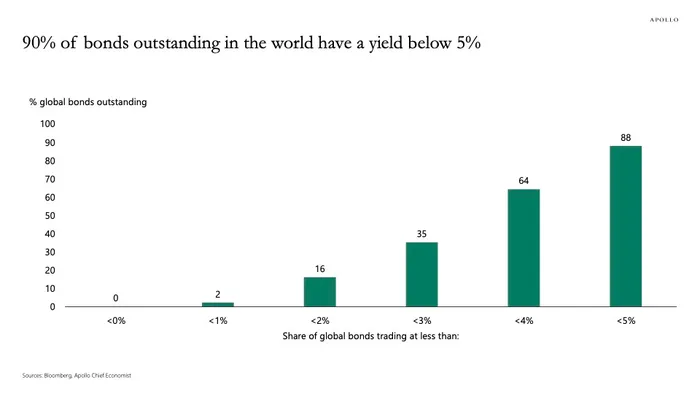
Fixed-income markets continue to show an unusual distribution of global yields. As highlighted by Apollo Global Management Chief Economist Torsten Slok, 90% of the world’s bonds yield below 5%, with the majority clustered beneath 4% . Such concentration underscores the challenge for income-focused investors as central banks navigate late-cycle policy, and risk assets remain sensitive to even small shifts in rate expectations.
Small Businesses Confront Tariff Pressures Ahead of Holidays
Bank of America Institute data shows tariff pressures climbing sharply for larger firms, with companies generating more than $1 million in annual revenue seeing tariff payments rise over 120% year over year in October. Smaller firms, by contrast, have pulled back since midsummer—likely due to inventory front-loading ahead of the holiday season. Inventory payments for small businesses rose a modest 0.6% on a three-month moving-average basis, while seasonal hiring remains below last year’s levels. The data continues to reflect a “K-shaped” recovery across U.S. small business, with profitability diverging between the largest and smallest firms.
All Eyes on the Bell Tonight
With crude under pressure, gold bid higher, crypto steady, and equities mixed, markets appear to be treading water until Nvidia delivers the datapoints investors have been waiting for since early fall. As Ives put it, tonight’s print could be a “validation moment” for the next leg of the AI spending cycle—one that could either reignite the tech rally into year-end or confirm the growing whispers of an “AI bubble” from the sidelines.

Adam Shapiro es un creador de contenidos que ha ganado tres premios Emmy, un ex reportero de noticias de una red y el fundador de TALKENOMICS, una empresa de producción multimedia. En AInvest, creó y lanzó Capital & Power, una serie de podcast de videos diseñada para generar involucramiento e instaurar un liderazgo de opinión, mientras que también produce emisiones en vivo originales, artículos financieros y contenidos de videos enfocados a inversores. Anteriormente, como reportero en el canal de negocios de FOX, Shapiro estableció la sucursal de Washington, D.C., del canal y reportó desde la Casa Blanca, Capitolio y la Reserva Federal, además de garantizar entrevistas exclusivas bipartitas con líderes influyentes. Su reportaje ayudó a consolidar a FOX Business como el canal de negocios más visto por televisión. Al mismo tiempo, su serie original de TALKENOMICS atrajo a decenas de miles de espectadores por episodio a través de conversaciones profundas con legisladores, economistas y líderes de opinión. En Yahoo Finance, jugó un papel de liderazgo crítico en la expansión de la programación digital a ocho horas de cobertura de noticias financieras en vivo, de manera notable, lo que aumentó el tráfico de 68 millones a 104 millones de visitantes únicos mensuales y generó ingresos de publicidad de cero a más de 50 millones de dólares anuales. Yahoo Finance continúa beneficiándose de la credibilidad de las entrevistas exclusivas de Shapiro con el ex presidente Donald Trump y numerosos directores generales de las 500 empresas más importantes de Fortune.
Latest Articles
Stay ahead of the market.
Get curated U.S. market news, insights and key dates delivered to your inbox.




Comments
No comments yet